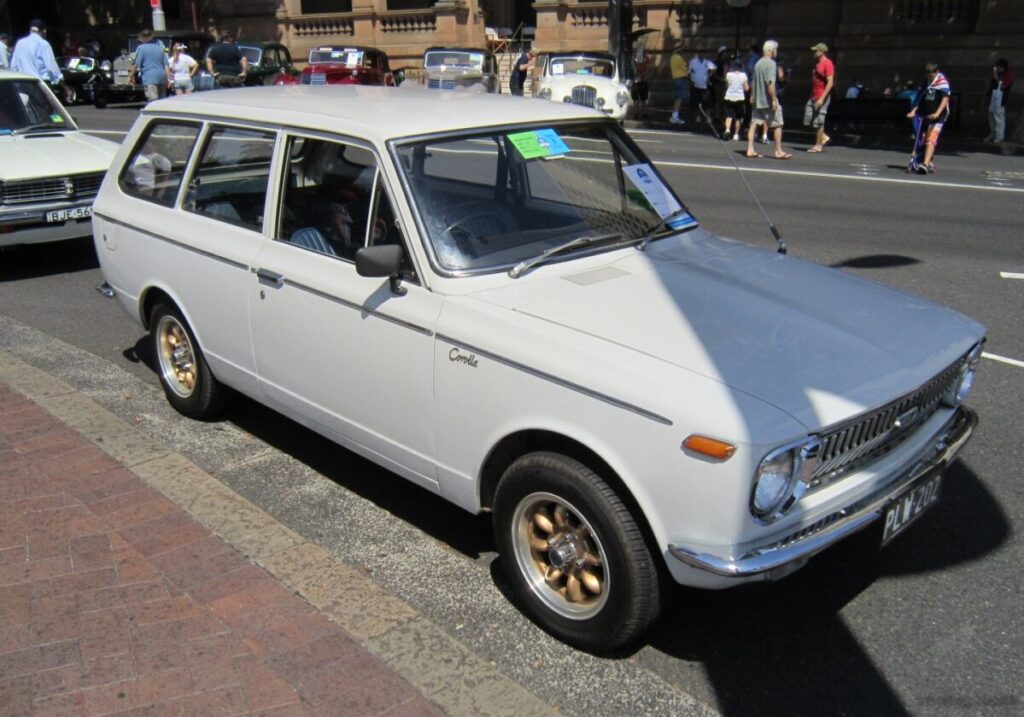
The Toyota Corolla E10 Station Wagon, introduced in 1969 and produced through 1970, represented Toyota’s entry into the compact estate car market. This variant, specifically the 1200 model producing 68 horsepower, was a significant addition to the first-generation Corolla (E10) lineup, which was built on the A-series platform. Positioned as a practical and affordable family vehicle, the 1200 Station Wagon offered increased cargo capacity compared to the sedan and coupe models, appealing to buyers needing versatility without sacrificing Toyota’s reputation for reliability. It was primarily sold in Japan, Australia, and select European markets.
Powertrain & Engine Architecture
The heart of the Corolla 1200 Station Wagon was the 3K engine, a 1.2-liter (1166 cc) inline-four cylinder gasoline engine. This engine, a mainstay of early Corolla production, featured a cast iron block and cylinder head, and utilized an overhead valve (OHV) valvetrain with two valves per cylinder. The 3K engine was known for its simplicity and durability, characteristics that contributed to the Corolla’s overall reliability. Fuel delivery was managed by a single carburetor, a common setup for vehicles of this era. The engine produced 68 horsepower at 6000 rpm and 93 Nm (68.59 lb-ft) of torque at 3800 rpm. The engine was mounted longitudinally in the front of the vehicle.
The 1200 Station Wagon was exclusively offered with a four-speed manual transmission. This transmission was a fully synchronized unit, providing smooth gear changes for the time. The rear-wheel drive configuration was standard for all E10 Corollas. The gear ratios were optimized for fuel efficiency and everyday driving, rather than outright performance. First gear was relatively low for starting from a standstill, while fourth gear was an overdrive ratio intended for highway cruising.
Engine Specifications
The 3K engine’s bore and stroke measured 75 mm (2.95 in) and 66 mm (2.6 in) respectively, resulting in a compression ratio of 9:1. The engine’s relatively low compression ratio allowed it to run on lower octane gasoline, which was a consideration in many markets where the Corolla was sold. The engine’s power-to-litre ratio was 58.3 hp/l, a respectable figure for a naturally aspirated engine of this displacement in the late 1960s.
Driving Characteristics
The Corolla 1200 Station Wagon, with its 68 horsepower and relatively lightweight construction (780 kg / 1719.61 lbs), offered adequate performance for everyday driving. Acceleration was modest, with a 0-60 mph time estimated to be around 16-18 seconds. The car’s top speed was approximately 135 km/h (83.89 mph). The manual transmission required deliberate shifting, but the gear ratios were well-matched to the engine’s powerband. Compared to potential future higher-output versions of the Corolla, or even the larger-engined models available at the time, the 1200 felt somewhat underpowered, particularly when fully loaded with passengers and cargo. However, this was a trade-off for improved fuel economy and lower running costs.
The rear-wheel drive layout provided predictable handling, although the car was not particularly sporty. The suspension, while simple, offered a comfortable ride on most road surfaces. The steering, utilizing a cone worm and recirculation balls system, was relatively heavy but provided good feedback.
Equipment & Trim Levels
The Corolla 1200 Station Wagon was generally sparsely equipped, reflecting its position as an entry-level vehicle. Standard features typically included basic instrumentation (speedometer, fuel gauge), vinyl upholstery, and simple steel wheels with hubcaps. The interior was functional and durable, prioritizing practicality over luxury. Trim levels were limited, with most examples featuring minimal ornamentation. Optional extras were available, such as a radio, heater, and upgraded upholstery, but these were not commonly specified. The dashboard layout was straightforward, with all controls within easy reach of the driver.
Chassis & Braking
The Corolla 1200 Station Wagon utilized a body-on-frame construction, which was common for vehicles of this era. The front suspension consisted of independent coil springs with a transverse stabilizer bar, providing a reasonable level of ride comfort and handling. The rear suspension employed a rigid axle with leaf springs, a simpler and more robust design. The braking system featured disc brakes on the front wheels and drum brakes on the rear wheels. The brakes were mechanically operated, providing adequate stopping power for the car’s weight and performance. The steering system was a cone worm with recirculation balls, offering a reasonable level of precision.
Market Reception & Comparison
The Toyota Corolla 1200 Station Wagon was generally well-received by critics and consumers alike. It was praised for its reliability, fuel efficiency, and practicality. Compared to other compact estate cars of the time, such as the Volkswagen Beetle and the Ford Escort, the Corolla offered a compelling combination of features and value. The 1200 engine, while not particularly powerful, was known for its longevity and low maintenance costs. Fuel economy was a strong point, averaging around 35-40 mpg in real-world driving. The car’s relatively simple construction also meant that repairs were generally straightforward and affordable.
Compared to other Corolla variants, such as the 1500 models, the 1200 offered a more economical option for buyers who did not require the extra performance. The 1500 models were more expensive to purchase and maintain, while the 1200 provided a balance of affordability and practicality.
Technical Specifications
| Body Type | Station Wagon (Estate) |
| Engine Type | Inline-Four, Gasoline |
| Engine Displacement | 1166 cc (71.15 cu. in.) |
| Engine Code | 3K |
| Power Output | 68 hp @ 6000 rpm |
| Torque Output | 93 Nm (68.59 lb-ft) @ 3800 rpm |
| Compression Ratio | 9:1 |
| Fuel System | Carburetor |
| Transmission | 4-Speed Manual |
| Drive Wheels | Rear Wheel Drive |
| Kerb Weight | 780 kg (1719.61 lbs) |
| Maximum Weight | 1200 kg (2645.55 lbs) |
| Fuel Tank Capacity | 36 liters (9.51 US gal) |
| Length | 3895 mm (153.35 in) |
| Width | 1490 mm (58.66 in) |
| Height | 1400 mm (55.12 in) |
| Wheelbase | 2285 mm (89.96 in) |
Legacy
The Toyota Corolla E10 Station Wagon, particularly the 1200 variant, holds a significant place in automotive history as one of the early examples of a reliable and affordable compact estate car. The 3K engine proved to be exceptionally durable, and many examples remain on the road today, often with high mileage. In the used car market, these Corollas are sought after by enthusiasts and collectors, particularly those looking for a classic Japanese vehicle. While parts availability can be a challenge, the engine’s simplicity and the Corolla’s overall robust construction make it a relatively easy car to maintain. The 1200 Station Wagon represents a pivotal moment in Toyota’s history, establishing the Corolla as a global automotive icon and demonstrating the company’s commitment to quality and reliability.