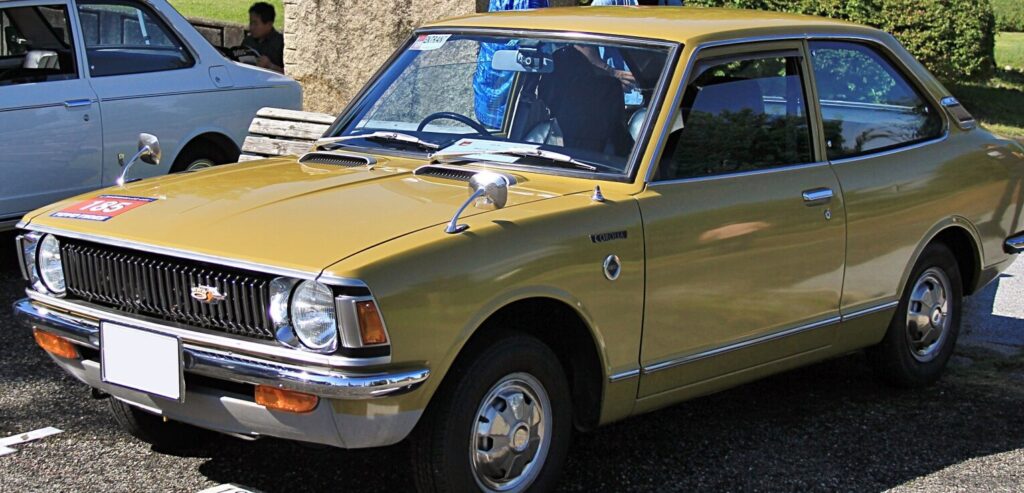
The Toyota Corolla II 2-door sedan, designated the E20 series, was produced from May 1970 to July 1974. This generation represented a significant step forward for Toyota, offering a more refined and spacious vehicle compared to its predecessor. Within the E20 lineup, the 1200 variant equipped with a 68 horsepower engine and an automatic transmission occupied the entry-level position, aimed at buyers prioritizing affordability and ease of use. It served as the gateway to the Corolla family, offering basic transportation with Toyota’s reputation for reliability. The E20 platform was a departure from the earlier Corolla models, featuring a longer wheelbase and wider track, contributing to improved ride comfort and interior space.
The 1200 Automatic: Positioning and Market Context
The 1.2L 68 hp automatic version of the Corolla II was specifically targeted at buyers who desired the convenience of an automatic transmission without the higher cost associated with the larger-displacement engines offered in the range. Compared to the 1600 GT models, which were geared towards enthusiasts and offered significantly more power, the 1200 Automatic prioritized fuel economy and ease of driving. It also differed from the more utilitarian base models with manual transmissions, offering a more comfortable and accessible driving experience for a broader audience. This trim level was popular with families and individuals seeking a reliable and economical daily driver.
Powertrain & Engine Architecture
The heart of the Corolla II 1200 Automatic was the 3K engine, a 1,166 cc (71.15 cubic inches) inline-four cylinder gasoline engine. This engine produced 68 horsepower at 6000 rpm and 93 Nm (68.59 lb-ft) of torque at 3800 rpm. The 3K engine featured a naturally aspirated configuration with a compression ratio of 9:1. It utilized an overhead valve (OHV) valvetrain with two valves per cylinder. Fuel delivery was managed by a carburetor, a common feature for vehicles of this era. The engine was mounted longitudinally in the front of the vehicle.
The automatic transmission was a 3-speed unit. While specific details regarding the transmission’s internal construction are limited, it was designed to provide smooth and relatively simple gear changes, prioritizing ease of use over performance. The transmission’s gear ratios were optimized for fuel efficiency and everyday driving conditions. The rear-wheel drive configuration was standard for the E20 Corolla II.
Driving Characteristics
The 1200 Automatic offered a comfortable, albeit unhurried, driving experience. With 68 horsepower propelling a vehicle weighing 745 kg (1642.44 lbs), acceleration was modest. The 0 to 60 mph time was not a primary consideration for buyers of this trim level. The automatic transmission contributed to a smooth ride, particularly in city driving. However, compared to the manual transmission versions or the more powerful 1600cc models, the 1200 Automatic exhibited slower response times and less overall agility. The 3-speed automatic, while convenient, lacked the flexibility and efficiency of modern transmissions. The rear-wheel drive layout provided predictable handling characteristics, typical of vehicles from this period.
Equipment & Trim Levels
The 1200 Automatic trim level was relatively basic in terms of standard equipment. It typically included cloth upholstery, a simple dashboard layout with basic instrumentation (speedometer, fuel gauge, and temperature gauge), and standard exterior trim. Features considered optional extras included a radio, upgraded interior trim materials, and potentially a vinyl roof. The interior was designed for practicality and durability rather than luxury. The 2-door sedan body style offered reasonable access to the rear seats, although it wasn’t as convenient as a 4-door configuration. The focus was on providing essential features at an affordable price point.
Chassis & Braking
The Corolla II 1200 Automatic featured an independent coil spring suspension with a transverse stabilizer bar at the front, providing a reasonable level of ride comfort. The rear suspension utilized a rigid axle with leaf springs, a common design for rear-wheel drive vehicles of this era. The front brakes were disc brakes, offering better stopping power than the drum brakes used on the rear wheels. The steering system was a cone worm type with recirculation balls, providing a relatively direct steering feel. The relatively light weight of the vehicle helped to compensate for the limitations of the braking system.
Market Reception & Comparison
The Corolla II 1200 Automatic was generally well-received by consumers seeking a reliable and economical vehicle. Critics praised its fuel efficiency (5.2 l/100 km, equivalent to 45.2 US mpg) and Toyota’s reputation for build quality. However, the engine’s modest power output was often noted as a limitation, particularly when compared to competitors offering larger displacement engines. Compared to other trims within the Corolla II lineup, the 1200 Automatic offered the best fuel economy but the lowest performance. Its primary advantage was its affordability and ease of driving, making it an attractive option for first-time car buyers and those prioritizing practicality.
Technical Specifications
| Brand | Toyota |
| Model | Corolla II |
| Generation | E20 |
| Type (Engine) | 1200 (68 Hp) Automatic |
| Start of Production | May, 1970 |
| End of Production | July, 1974 |
| Engine Model/Code | 3K |
| Engine Displacement | 1166 cm3 (71.15 cu. in.) |
| Number of Cylinders | 4 |
| Engine Configuration | Inline |
| Cylinder Bore | 75 mm (2.95 in.) |
| Piston Stroke | 66 mm (2.6 in.) |
| Compression Ratio | 9:1 |
| Number of Valves per Cylinder | 2 |
| Fuel Injection System | Carburetor |
| Engine Aspiration | Naturally Aspirated |
| Valvetrain | OHV |
| Power | 68 Hp @ 6000 rpm |
| Torque | 93 Nm @ 3800 rpm (68.59 lb.-ft. @ 3800 rpm) |
| Fuel Consumption (Combined) | 5.2 l/100 km (45.2 US mpg, 54.3 UK mpg, 19.2 km/l) |
| Maximum Speed | 140 km/h (86.99 mph) |
| Kerb Weight | 745 kg (1642.44 lbs.) |
| Fuel Tank Capacity | 45 l (11.89 US gal | 9.9 UK gal) |
| Length | 3945 mm (155.31 in.) |
| Width | 1505 mm (59.25 in.) |
| Height | 1375 mm (54.13 in.) |
| Wheelbase | 2335 mm (91.93 in.) |
| Drivetrain | Rear Wheel Drive |
| Gearbox | 3-speed Automatic |
Legacy
The Toyota Corolla II 1200 Automatic, while not the most powerful or technologically advanced vehicle of its time, played a crucial role in establishing Toyota’s reputation for reliability and affordability. The 3K engine proved to be remarkably durable, and many examples of this engine are still running today. In the used car market, these vehicles are sought after by collectors and enthusiasts who appreciate their simplicity and classic styling. While finding a well-maintained example can be challenging, the 1200 Automatic remains a testament to Toyota’s engineering prowess and its commitment to building vehicles that stand the test of time. The automatic transmission, while basic, proved to be relatively reliable, contributing to the overall longevity of these vehicles.