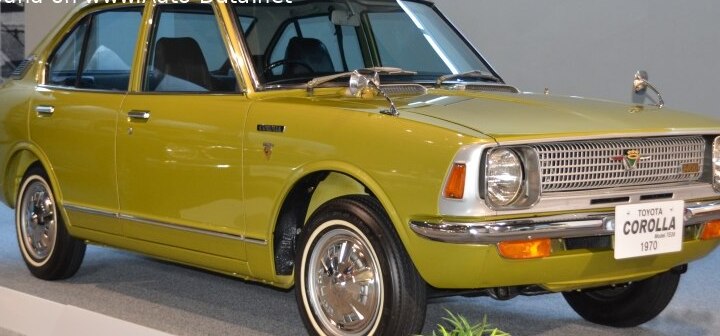
The Toyota Corolla II 4-door sedan (E20) 1200, powered by the 68 horsepower 3K engine, represented an important step in Toyota’s expansion into global markets. Produced from May 1970 to July 1974, this variant occupied the entry-level position within the E20 Corolla lineup, offering affordable and reliable transportation. It was a key model in the second generation of the Corolla, built on the E20 platform, and aimed at a broader customer base than its predecessor. The 1200 model was designed to be a practical and economical family car, competing with other compact sedans of the era.
The 1.2L 3K Powertrain & Engine Architecture
At the heart of the Corolla II 1200 was the 3K-U inline-four cylinder engine, displacing 1166 cc (71.15 cubic inches). This engine was a naturally aspirated, gasoline-fueled unit, characterized by its simplicity and durability. The 3K featured an overhead valve (OHV) valvetrain with two valves per cylinder. Fuel delivery was managed by a single carburetor, a common setup for vehicles of this period. The engine produced 68 horsepower at 6000 rpm and 93 Nm (68.59 lb-ft) of torque at 3800 rpm. The engine’s bore and stroke measured 75mm x 66mm, respectively, and it operated with a compression ratio of 9:1. The 3K engine was known for its robust construction and relatively easy maintenance, making it a popular choice for both Toyota and aftermarket mechanics.
Transmission and Drivetrain
The standard transmission for the Corolla II 1200 was a four-speed manual gearbox. While an automatic transmission was offered in some markets, it was not a common pairing with the base 1200 engine. The drivetrain was rear-wheel drive (RWD), a configuration typical for sedans of this era. The engine’s longitudinal mounting and rear-wheel drive layout contributed to a balanced weight distribution, though it wasn’t particularly sporty in handling. The 4-speed manual transmission provided relatively direct engagement, contributing to the car’s modest acceleration.
Driving Characteristics
The Corolla II 1200 with the 3K engine and manual transmission offered modest but adequate performance for everyday driving. Its top speed was approximately 145 km/h (90.1 mph). Acceleration was not a strong point, with the car prioritizing fuel efficiency and reliability over outright speed. The weight-to-power ratio of 11 kg/hp indicated a relatively heavy car for its horsepower output. The carburetor-fed engine delivered power in a linear fashion, with peak torque arriving at 3800 rpm. This meant that the engine required to be revved to achieve optimal performance, but it also provided a predictable and manageable driving experience. Compared to later Corolla models with larger engines, the 1200 felt noticeably slower, but it was still capable of keeping pace with traffic in most situations.
Equipment & Trim Levels
The Corolla II 1200 was designed as a no-frills, economical vehicle. Standard equipment typically included basic vinyl upholstery, a simple dashboard layout with analog gauges, and minimal exterior trim. Features like a radio, heater, and upgraded interior materials were often optional extras. The interior was functional and focused on practicality, with ample space for five passengers considering the car’s compact dimensions. Trim levels were relatively limited, with most 1200 models offering a similar level of standard equipment. The focus was on providing a reliable and affordable mode of transportation, rather than luxury or advanced features.
Chassis & Braking
The Corolla II 1200 featured a relatively conventional chassis design for the early 1970s. The front suspension utilized an independent coil spring setup with a transverse stabilizer bar, providing a reasonable level of ride comfort and handling. The rear suspension employed a rigid axle with leaf springs, a cost-effective and durable design. Braking was accomplished with disc brakes on the front wheels and drum brakes on the rear. The steering system was a cone worm type with recirculation balls, offering a relatively direct but not particularly precise steering feel. The car’s curb weight of 750 kg (1653.47 lbs) contributed to its manageable handling characteristics, despite the limitations of the suspension and braking systems.
Market Reception & Comparison
The Toyota Corolla II 1200 was generally well-received by critics and consumers alike. It was praised for its reliability, fuel economy (4.7 l/100 km, 50 US mpg, 60.1 UK mpg), and affordability. Compared to other compact sedans of the era, such as the Ford Cortina or the Volkswagen Beetle, the Corolla II 1200 offered a compelling combination of features and value. While its performance was not exceptional, it was sufficient for most everyday driving needs. The 1200 model served as an excellent entry point into the Corolla range, attracting buyers who prioritized practicality and economy over performance. Compared to the larger-engined Corolla variants, the 1200 was significantly more fuel-efficient, making it a popular choice for budget-conscious buyers.
Technical Specifications
| Brand | Toyota |
| Model | Corolla II 4-door sedan (E20) |
| Type (Engine) | 1200 (68 Hp) |
| Start of production | May, 1970 |
| End of production | July, 1974 |
| Powertrain Architecture | Internal Combustion engine |
| Body type | Sedan |
| Seats | 5 |
| Doors | 4 |
| Fuel consumption (combined) | 4.7 l/100 km (50 US mpg, 60.1 UK mpg, 21.3 km/l) |
| Maximum speed | 145 km/h (90.1 mph) |
| Weight-to-power ratio | 11 kg/Hp |
| Weight-to-torque ratio | 8.1 kg/Nm |
| Power | 68 Hp @ 6000 rpm |
| Torque | 93 Nm @ 3800 rpm (68.59 lb.-ft. @ 3800 rpm) |
| Engine layout | Front, Longitudinal |
| Engine Model/Code | 3K |
| Engine displacement | 1166 cm3 (71.15 cu. in.) |
| Number of cylinders | 4 |
| Engine configuration | Inline |
| Cylinder Bore | 75 mm (2.95 in.) |
| Piston Stroke | 66 mm (2.6 in.) |
| Compression ratio | 9:1 |
| Number of valves per cylinder | 2 |
| Fuel injection system | Carburettor |
| Engine aspiration | Naturally aspirated |
| Valvetrain | OHV |
| Kerb Weight | 750 kg (1653.47 lbs.) |
| Fuel tank capacity | 45 l (11.89 US gal | 9.9 UK gal) |
| Length | 3945 mm (155.31 in.) |
| Width | 1505 mm (59.25 in.) |
| Height | 1375 mm (54.13 in.) |
| Wheelbase | 2335 mm (91.93 in.) |
| Front track | 1255 mm (49.41 in.) |
| Rear track | 1245 mm (49.02 in.) |
| Minimum turning circle | 9 m (29.53 ft.) |
| Drivetrain Architecture | Rear wheel drive |
| Number of gears | 4 gears, manual transmission |
| Front suspension | Independent coil spring, Transverse stabilizer |
| Rear suspension | Rigid axle suspension, Leaf spring |
| Front brakes | Disc |
| Rear brakes | Drum |
| Steering type | Cone worm with recirculation balls |
Legacy
The Toyota Corolla II 1200, particularly the 3K-powered variant, established a reputation for exceptional reliability and longevity. Many examples of this car remain on the road today, a testament to Toyota’s engineering prowess. While not particularly collectible, well-maintained examples are sought after by enthusiasts and classic car collectors. The 3K engine itself is known for its durability and relatively simple maintenance requirements. In the used car market, these Corollas are often valued for their affordability and ease of repair. The 1200 model played a crucial role in establishing the Corolla as a global automotive icon, paving the way for future generations of this popular and dependable vehicle.