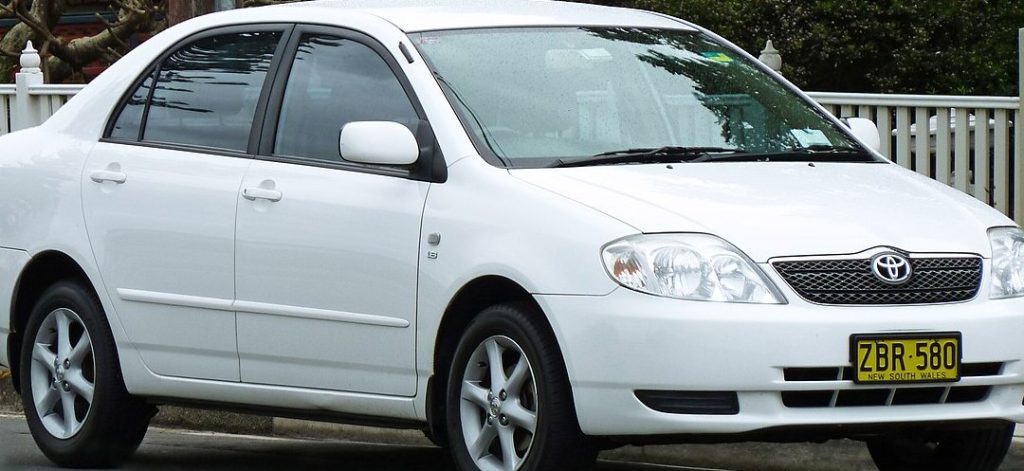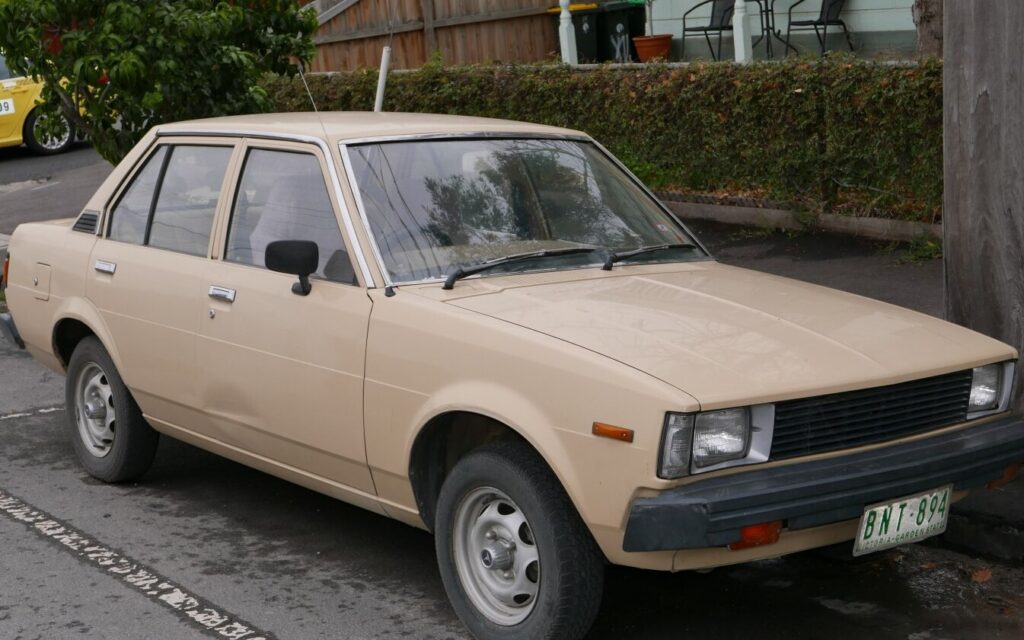
The Toyota Corolla E70, produced between 1979 and 1983, represented the fourth generation of Toyota’s globally successful Corolla line. Within the E70 range, the 1.3-liter (KE70) variant, producing 60 horsepower, served as the entry-level model in many markets, particularly North America and parts of Europe. This model was designed to offer affordable and reliable transportation during a period of increasing fuel costs and economic uncertainty. The KE70 distinguished itself through its simple, robust engineering and focus on practicality, making it a popular choice for first-time car buyers and those seeking economical daily transportation. It was a key component of Toyota’s strategy to broaden the Corolla’s appeal and compete effectively in the compact car segment.
The 1.3L (KE70) Corolla: An Entry-Level Staple
The KE70 1.3L Corolla occupied the base trim level within the E70 lineup. While higher-spec models offered larger engines (1.6L) and more luxurious features, the KE70 prioritized fuel efficiency and affordability. It was positioned as the most accessible Corolla variant, appealing to buyers for whom cost was a primary concern. This positioning meant it often featured a more spartan interior and fewer standard amenities compared to its siblings. The KE70 was available in various body styles, including a two-door coupe, a four-door sedan (the most common), and a five-door wagon, though the sedan was the most prevalent in North American markets.
Powertrain & Engine Architecture
The heart of the KE70 was the 4K-U engine, a 1.3-liter (1290 cc) inline-four cylinder gasoline engine. This engine was a naturally aspirated, overhead valve (OHV) design. It featured a single carburetor – typically a Solex or Aisan unit – for fuel delivery. The 4K-U engine was known for its simplicity and durability, rather than outright performance. It utilized a cast iron block and cylinder head, contributing to its longevity. The engine produced 60 horsepower at 6,000 rpm and 78 lb-ft of torque at 3,600 rpm. The KE70 was typically equipped with a four-speed manual transmission, but a three-speed automatic transmission was also offered, albeit less commonly. The automatic transmission was a traditional torque converter type, prioritizing smooth operation over sporty responsiveness. The engine’s compression ratio was 8.5:1, and it required unleaded gasoline. The 4K-U engine was a continuation of Toyota’s ‘K’ engine family, known for its reliability and ease of maintenance.
Driving Characteristics
The driving experience in a KE70 1.3L was characterized by its modest performance. Acceleration was leisurely, and the car was not designed for rapid overtaking. The 0-60 mph time was estimated to be around 15-17 seconds. The four-speed manual transmission allowed drivers to extract the most from the engine, but the automatic version further diminished acceleration. The automatic transmission’s gear ratios were geared towards fuel economy rather than performance. The KE70’s suspension consisted of independent front suspension with MacPherson struts and a rear leaf spring setup. This configuration provided a comfortable ride, but handling was somewhat imprecise, especially when compared to more modern vehicles. Steering was unassisted in most models, requiring a bit more effort at low speeds. Despite its limitations, the KE70 offered predictable handling and a generally pleasant driving experience for everyday commuting.
Equipment & Trim Levels
The KE70 1.3L, as the entry-level model, typically came with a relatively basic set of standard features. Interior upholstery was usually vinyl or a durable cloth material. The dashboard was functional and straightforward, featuring a basic instrument cluster with speedometer, fuel gauge, and temperature gauge. AM radio was often standard, with an optional cassette player available. Power steering, air conditioning, and electric windows were generally not available on the base KE70 model, though they could be found on higher trim levels. Exterior features included steel wheels with hubcaps, basic bumpers, and minimal chrome trim. Optional extras included upgraded audio systems, a sunroof, and different wheel covers. The focus was on providing essential transportation without unnecessary frills.
Chassis & Braking
The KE70 featured a body-on-frame construction, which was common for cars of that era. This contributed to its durability and ease of repair. The front suspension utilized MacPherson struts, coil springs, and an anti-roll bar. The rear suspension employed a leaf spring setup with shock absorbers. Braking was typically accomplished with drum brakes on all four wheels, although some later models and higher trim levels received front disc brakes. The braking system was adequate for the car’s weight and performance, but lacked the stopping power of more modern systems. Steering was a recirculating ball type, providing a relatively direct feel but requiring more effort than rack-and-pinion steering. The chassis was designed for durability and simplicity, prioritizing reliability over sporty handling.
Market Reception & Comparison
The KE70 1.3L Corolla was generally well-received by critics and consumers alike. It was praised for its reliability, fuel efficiency, and affordability. However, its modest performance was often noted as a drawback. Compared to other compact cars of the time, such as the Honda Civic and Volkswagen Rabbit, the KE70 offered a more comfortable ride but less sporty handling. The 1.6-liter Corolla variants offered significantly more power and were favored by drivers who prioritized performance. In terms of fuel economy, the KE70 1.3L achieved around 30-35 mpg in combined driving, which was competitive for its time. Reliability was a key strength, with many KE70s remaining on the road for decades with proper maintenance. The KE70’s simplicity made it relatively easy and inexpensive to repair, further contributing to its long-term appeal.
Technical Specifications
| Body Type | Four-Door Sedan |
| Engine Model | 4K-U |
| Engine Type | Inline-Four, Naturally Aspirated |
| Displacement | 1290 cc (1.3 L) |
| Power Output | 60 hp @ 6,000 rpm |
| Torque Output | 78 lb-ft @ 3,600 rpm |
| Compression Ratio | 8.5:1 |
| Fuel System | Single Carburetor (Solex or Aisan) |
| Transmission | Four-Speed Manual or Three-Speed Automatic |
| Brakes (Front) | Drum or Disc (depending on model/year) |
| Brakes (Rear) | Drum |
| Suspension (Front) | MacPherson Strut, Coil Spring |
| Suspension (Rear) | Leaf Spring |
| Fuel Capacity | 40 liters (10.6 US gallons) |
| Curb Weight | 980-1050 kg (2160-2315 lbs) |
Legacy
The KE70 1.3L Corolla has earned a reputation as a remarkably durable and reliable vehicle. Many examples are still in use today, often as classic cars or project vehicles. The 4K-U engine is known for its longevity and relatively simple maintenance requirements. Parts availability remains reasonably good, thanks to the Corolla’s widespread popularity. In the used car market, KE70s in good condition are becoming increasingly collectible, particularly among enthusiasts who appreciate their simplicity and classic styling. While not a performance icon, the KE70 1.3L Corolla represents a significant chapter in Toyota’s history, demonstrating the company’s commitment to building affordable, reliable, and long-lasting vehicles. Its enduring presence on roads around the world is a testament to its robust engineering and timeless appeal.