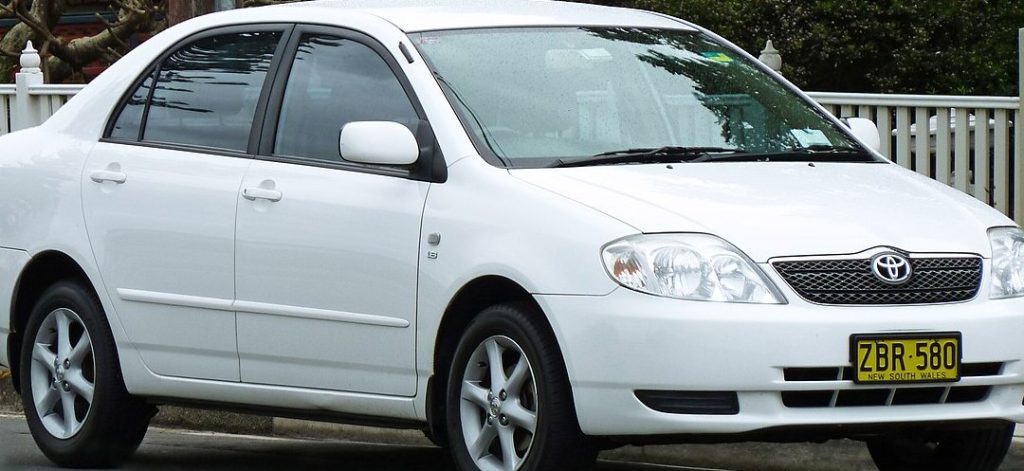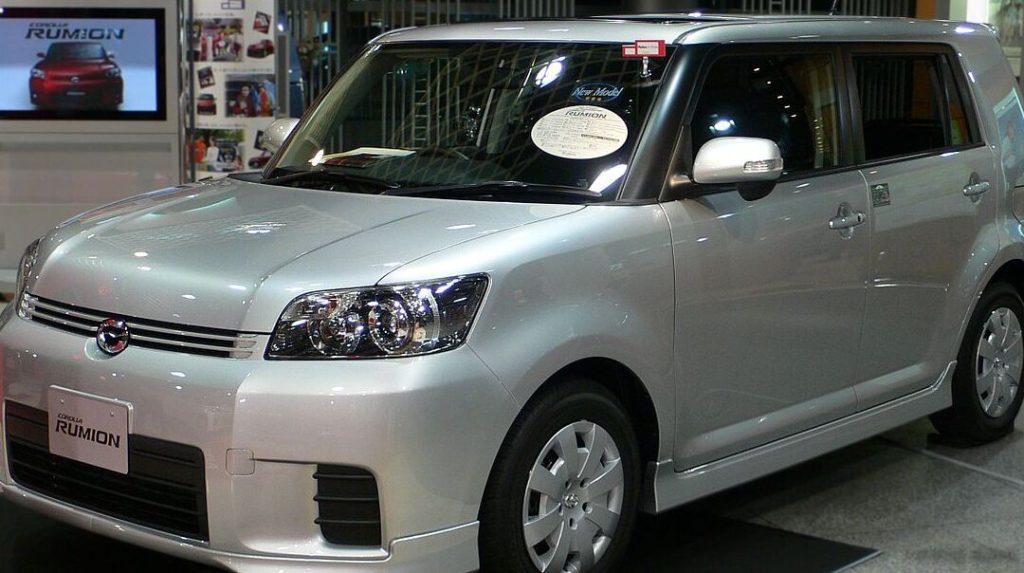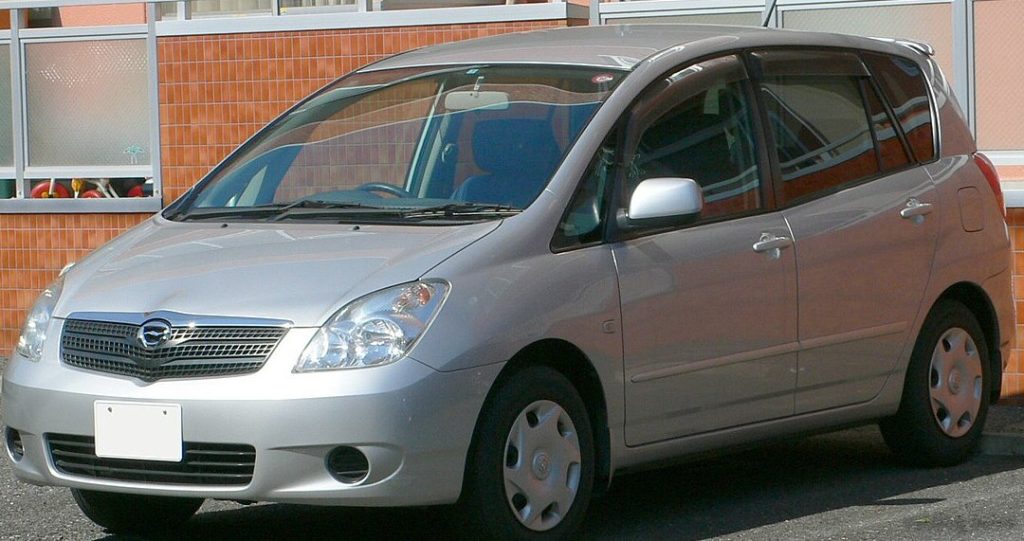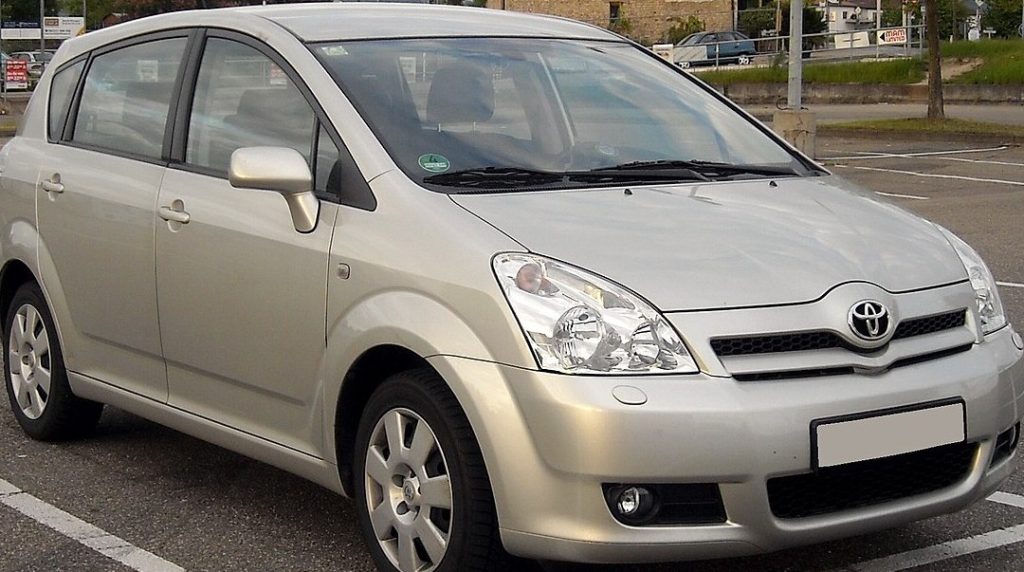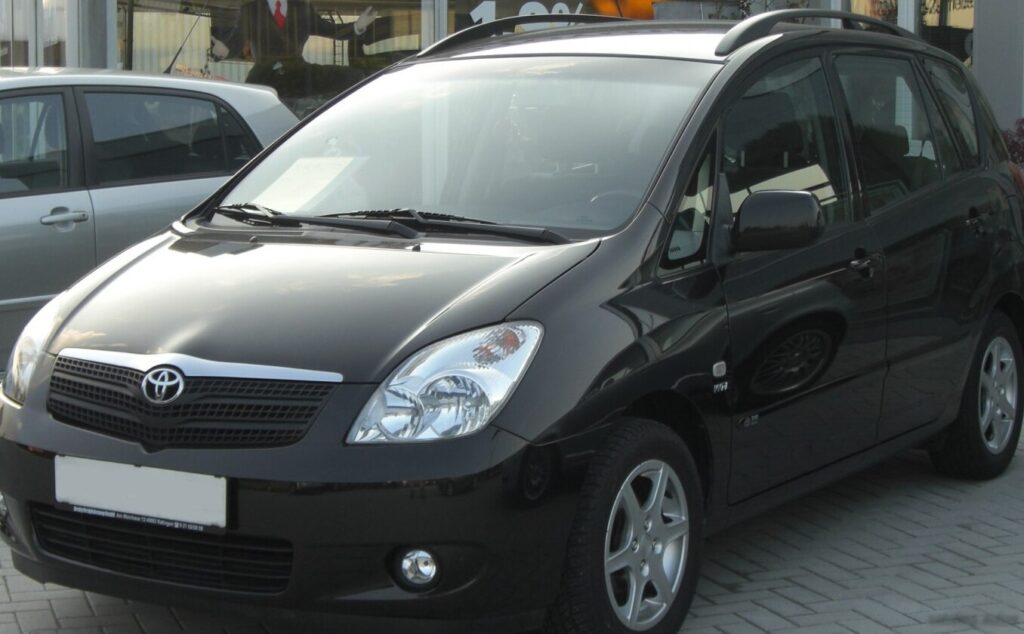
The Toyota Corolla Verso I, specifically the 2.0 D-4D variant producing 90 horsepower, was a compact multi-purpose vehicle (MPV) sold primarily in the European market from 2001 to 2003. Part of the E120 series, it represented Toyota’s entry into the increasingly popular seven-seat MPV segment, offering a practical and relatively affordable family transport solution. This particular engine and trim level occupied a mid-range position within the Verso lineup, balancing fuel efficiency with adequate performance for everyday driving. It was positioned below the more powerful petrol variants and above the base-level diesel options.
Technical Specifications
| Brand | Toyota |
| Model | Corolla Verso |
| Generation | Corolla Verso I (E120) |
| Type (Engine) | 2.0 D-4D (90 Hp) |
| Start of production | 2001 |
| End of production | 2003 |
| Powertrain Architecture | Internal Combustion engine |
| Body type | MPV |
| Seats | 7 |
| Doors | 5 |
| Fuel consumption (urban) | 7.9 l/100 km (29.8 US mpg, 35.8 UK mpg, 12.7 km/l) |
| Fuel consumption (extra urban) | 5.3 l/100 km (44.4 US mpg, 53.3 UK mpg, 18.9 km/l) |
| Fuel consumption (combined) | 6.2 l/100 km (37.9 US mpg, 45.6 UK mpg, 16.1 km/l) |
| Fuel Type | Diesel |
| Acceleration 0 – 100 km/h | 13.5 sec |
| Acceleration 0 – 62 mph | 13.5 sec |
| Acceleration 0 – 60 mph | 12.8 sec |
| Maximum speed | 170 km/h (105.63 mph) |
| Weight-to-power ratio | 14.9 kg/Hp, 67.2 Hp/tonne |
| Weight-to-torque ratio | 6.2 kg/Nm, 160.4 Nm/tonne |
| Power | 90 Hp @ 4000 rpm |
| Power per litre | 45.1 Hp/l |
| Torque | 215 Nm @ 2400 rpm (158.58 lb.-ft. @ 2400 rpm) |
| Engine layout | Front, Transverse |
| Engine Model/Code | 1CD-FTV |
| Engine displacement | 1995 cm3 (121.74 cu. in.) |
| Number of cylinders | 4 |
| Engine configuration | Inline |
| Cylinder Bore | 82.2 mm (3.24 in.) |
| Piston Stroke | 94 mm (3.7 in.) |
| Compression ratio | 18.6:1 |
| Number of valves per cylinder | 4 |
| Fuel injection system | Diesel Commonrail |
| Engine aspiration | Turbocharger, Intercooler |
| Engine oil capacity | 5.9 l (6.23 US qt | 5.19 UK qt) |
| Coolant | 7.6 l (8.03 US qt | 6.69 UK qt) |
| Kerb Weight | 1340 kg (2954.19 lbs.) |
| Max. weight | 1835 kg (4045.48 lbs.) |
| Max load | 495 kg (1091.29 lbs.) |
| Trunk (boot) space – minimum | 415 l (14.66 cu. ft.) |
| Trunk (boot) space – maximum | 1760 l (62.15 cu. ft.) |
| Fuel tank capacity | 55 l (14.53 US gal | 12.1 UK gal) |
| Length | 4240 mm (166.93 in.) |
| Width | 1710 mm (67.32 in.) |
| Height | 1610 mm (63.39 in.) |
| Wheelbase | 2600 mm (102.36 in.) |
| Front track | 1480 mm (58.27 in.) |
| Rear (Back) track | 1490 mm (58.66 in.) |
| Drivetrain Architecture | The Internal combustion engine (ICE) drives the front wheels of the vehicle. |
| Drive wheel | Front wheel drive |
| Number of gears and type of gearbox | 5 gears, manual transmission |
| Front suspension | Spring Strut |
| Rear suspension | Coil spring |
| Front brakes | Ventilated discs |
| Rear brakes | Disc |
| Assisting systems | ABS (Anti-lock braking system) |
| Steering type | Steering rack and pinion |
| Power steering | Hydraulic Steering |
| Tires size | 185/70 R14 |
Powertrain & Engine Architecture
The heart of this Corolla Verso variant is the 1CD-FTV 2.0-liter inline-four diesel engine. This engine was a key component of Toyota’s D-4D (Direct-injection 4-cylinder Diesel) series, known for its focus on fuel efficiency and reduced emissions. The 1CD-FTV utilizes a common rail direct injection system, delivering fuel at extremely high pressure for optimized combustion. A turbocharger with an intercooler further enhances performance by forcing more air into the cylinders. The engine produces 90 horsepower at 4000 rpm and 215 Nm (158.58 lb-ft) of torque at 2400 rpm. The engine’s 18.6:1 compression ratio is typical for a direct injection diesel, contributing to its thermal efficiency. The engine is transversely mounted in the front of the vehicle. The transmission is a five-speed manual gearbox, chosen for its simplicity and cost-effectiveness in this segment.
Driving Characteristics
The 90 hp 2.0 D-4D engine, paired with the five-speed manual transmission, provided adequate, though not exhilarating, performance for the Corolla Verso. Acceleration from 0 to 60 mph took around 12.8 seconds, and top speed was limited to 170 km/h (105.63 mph). The engine’s torque peak at 2400 rpm meant that usable power was available across a broad rev range, making it suitable for carrying passengers and luggage. Compared to the higher-output petrol versions, the diesel felt less responsive, particularly at higher speeds. However, it offered significantly better fuel economy. The manual transmission allowed for greater driver control compared to the optional automatic, and the gear ratios were well-suited to maximizing fuel efficiency and providing reasonable acceleration. The relatively low horsepower and torque figures meant that the vehicle felt strained when fully loaded with seven passengers and luggage, especially on inclines.
Equipment & Trim Levels
The 2.0 D-4D Corolla Verso typically came with a reasonable level of standard equipment. Interior features included cloth upholstery, a basic audio system, power windows, and central locking. Air conditioning was often standard, but could be optional depending on the specific market. Safety features included ABS brakes and driver and passenger airbags. Optional extras included alloy wheels, metallic paint, and a more advanced audio system. The interior design was functional and practical, prioritizing space and usability over luxury. The seven-seat configuration featured folding rear seats to maximize cargo space when not all seats were in use.
Chassis & Braking
The Corolla Verso I utilized a front-wheel-drive layout with a MacPherson strut suspension at the front and a coil spring suspension at the rear. The suspension was tuned for comfort rather than sporty handling, providing a relatively smooth ride. The front brakes were ventilated discs, while the rear brakes were solid discs. ABS (Anti-lock Braking System) was standard, enhancing braking performance and safety. The chassis was designed to accommodate the seven-seat configuration and provide a stable platform for carrying passengers and cargo. Stabilizer bars were included to reduce body roll during cornering.
Market Reception & Comparison
The Toyota Corolla Verso 2.0 D-4D was generally well-received by European motoring press as a practical and economical family vehicle. Critics praised its fuel efficiency, spacious interior, and comfortable ride. However, some noted that the engine lacked outright power and refinement compared to some of its competitors. Compared to the petrol-powered Verso models, the diesel offered superior fuel economy but less performance. Compared to other diesel MPVs in the segment, such as the Renault Scenic or Citroen Xsara Picasso, the Corolla Verso offered a reputation for Toyota’s renowned reliability and build quality. Fuel economy figures of around 37.9 US mpg combined were competitive for the time.
Legacy
The 1CD-FTV engine, while not without its potential issues (such as potential for DPF clogging in later years), proved to be a relatively durable and reliable unit when properly maintained. The Corolla Verso I, including the 2.0 D-4D variant, has maintained a reasonable presence in the used car market, appreciated for its practicality and Toyota’s reputation for dependability. Today, these vehicles represent an affordable entry point into the seven-seat MPV segment, but potential buyers should be aware of the age-related maintenance requirements and the potential for wear and tear on components like the turbocharger and fuel injection system. The 2.0 D-4D version remains a popular choice for those prioritizing fuel economy and reliability over outright performance.