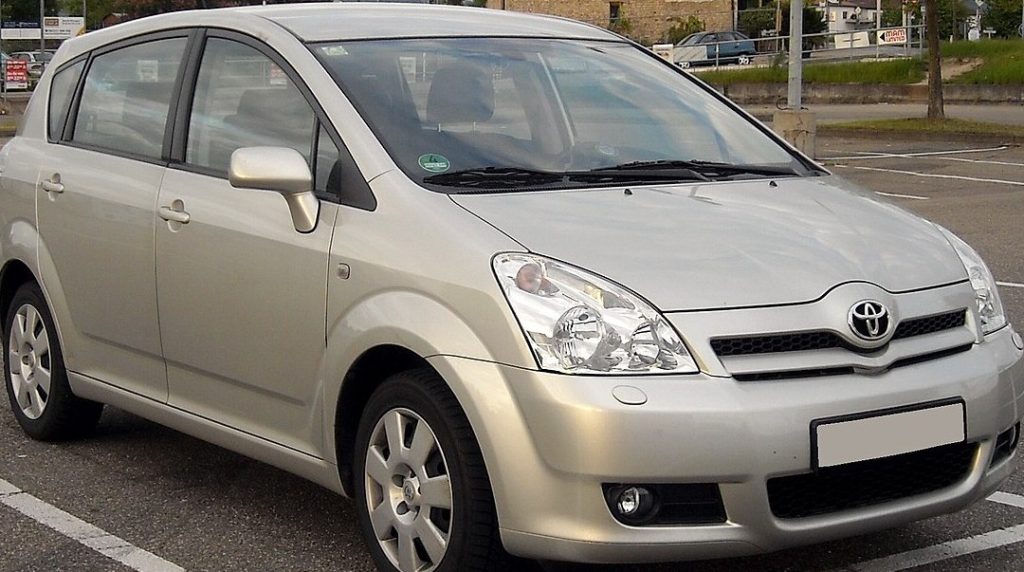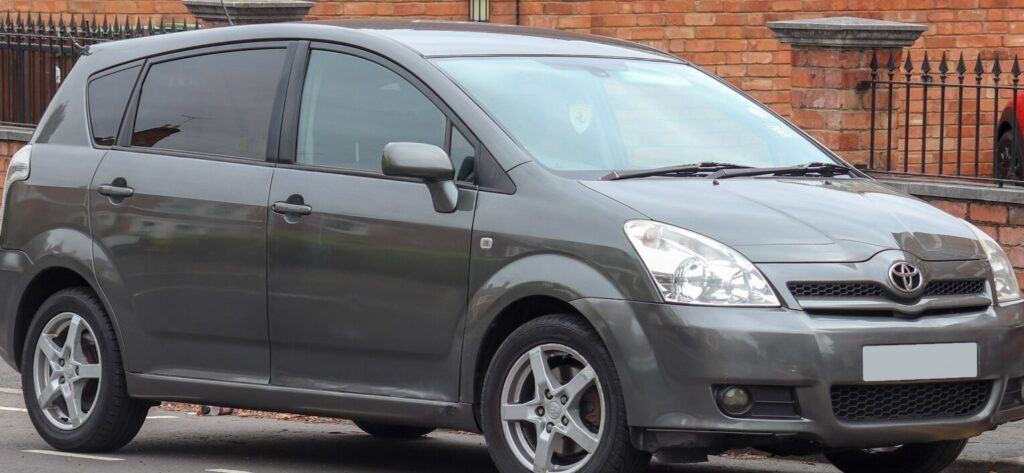
The Toyota Corolla Verso II, specifically the 1.6 VVT-i variant producing 110 horsepower, was a compact multi-purpose vehicle (MPV) sold primarily in the European market from 2004 to 2007. Part of the AR10 series, it represented Toyota’s second attempt at a leisure activity vehicle in that segment, building upon the foundation laid by the first-generation Corolla Verso. This model aimed to provide a practical and versatile option for families, offering a blend of space, comfort, and Toyota’s reputation for reliability. The 1.6L engine and manual transmission configuration positioned it as an entry-level offering within the Verso II range, appealing to buyers prioritizing affordability and fuel efficiency.
Technical Specifications
| Brand | Toyota |
| Model | Corolla Verso |
| Generation | Corolla Verso II (AR10) |
| Type (Engine) | 1.6 VVT-i (110 Hp) |
| Start of production | 2004 |
| End of production | 2007 |
| Powertrain Architecture | Internal Combustion engine |
| Body type | MPV |
| Seats | 5 |
| Doors | 5 |
| Fuel consumption (economy) – urban (NEDC) | 9.5 l/100 km (24.8 US mpg, 29.7 UK mpg, 10.5 km/l) |
| Fuel consumption (economy) – extra urban (NEDC) | 6.4 l/100 km (36.8 US mpg, 44.1 UK mpg, 15.6 km/l) |
| Fuel consumption (economy) – combined (NEDC) | 7.5 l/100 km (31.4 US mpg, 37.7 UK mpg, 13.3 km/l) |
| CO2 emissions (NEDC) | 178 g/km |
| Fuel Type | Petrol (Gasoline) |
| Acceleration 0 – 100 km/h | 12.7 sec |
| Acceleration 0 – 62 mph | 12.7 sec |
| Acceleration 0 – 60 mph | 12.1 sec |
| Maximum speed | 175 km/h (108.74 mph) |
| Emission standard | Euro 4 |
| Weight-to-power ratio | 12.2 kg/Hp, 81.8 Hp/tonne |
| Weight-to-torque ratio | 9 kg/Nm, 111.5 Nm/tonne |
| Power | 110 Hp @ 6000 rpm |
| Power per litre | 68.8 Hp/l |
| Torque | 150 Nm @ 3800 rpm (110.63 lb.-ft. @ 3800 rpm) |
| Engine layout | Front, Transverse |
| Engine Model/Code | 3ZZ-FE |
| Engine displacement | 1598 cm3 (97.52 cu. in.) |
| Number of cylinders | 4 |
| Engine configuration | Inline |
| Cylinder Bore | 79 mm (3.11 in.) |
| Piston Stroke | 81.5 mm (3.21 in.) |
| Compression ratio | 10.5:1 |
| Number of valves per cylinder | 4 |
| Fuel injection system | Multi-port manifold injection |
| Engine aspiration | Naturally aspirated engine |
| Valvetrain | DOHC |
| Engine oil capacity | 3.7 l (3.91 US qt | 3.26 UK qt) |
| Coolant | 5.8 l (6.13 US qt | 5.1 UK qt) |
| Kerb Weight | 1345 kg (2965.22 lbs.) |
| Max. weight | 2035 kg (4486.41 lbs.) |
| Max load | 690 kg (1521.19 lbs.) |
| Trunk (boot) space – minimum | 423 l (14.94 cu. ft.) |
| Trunk (boot) space – maximum | 1563 l (55.2 cu. ft.) |
| Fuel tank capacity | 60 l (15.85 US gal | 13.2 UK gal) |
| Permitted trailer load with brakes (12%) | 1200 kg (2645.55 lbs.) |
| Permitted trailer load without brakes | 450 kg (992.08 lbs.) |
| Length | 4360 mm (171.65 in.) |
| Width | 1770 mm (69.69 in.) |
| Height | 1620 mm (63.78 in.) |
| Wheelbase | 2750 mm (108.27 in.) |
| Front track | 1505 mm (59.25 in.) |
| Rear (Back) track | 1495 mm (58.86 in.) |
| Front overhang | 870 mm (34.25 in.) |
| Rear overhang | 740 mm (29.13 in.) |
| Drag coefficient (Cd) | 0.30 |
| Minimum turning circle (turning diameter) | 11.6 m (38.06 ft.) |
| Drivetrain Architecture | The Internal combustion engine (ICE) drives the front wheels of the vehicle. |
| Drive wheel | Front wheel drive |
| Number of gears and type of gearbox | 5 gears, manual transmission |
| Front suspension | Independent type McPherson, Transverse stabilizer |
| Rear suspension | Transverse stabilizer, Torsion |
| Front brakes | Ventilated discs, 295 mm |
| Rear brakes | Disc, 290 mm |
| Assisting systems | ABS (Anti-lock braking system) |
| Steering type | Steering rack and pinion |
| Power steering | Hydraulic Steering |
| Tires size | 205/55 R16 |
| Wheel rims size | 6.5J x 16 |
Powertrain & Engine Architecture
The Corolla Verso II 1.6 VVT-i utilized the 3ZZ-FE engine, a 1.6-liter inline-four cylinder gasoline engine. This engine was a mainstay in Toyota’s lineup for several years, known for its reliability and relatively simple design. The “VVT-i” designation stands for Variable Valve Timing-intelligent, a system that optimizes valve timing based on engine speed and load, improving both performance and fuel efficiency. The 3ZZ-FE employed multi-port fuel injection, delivering fuel directly to each intake port. The engine’s 16-valve DOHC (Double Overhead Camshaft) configuration further contributed to its breathing efficiency. The five-speed manual transmission was the standard pairing for this engine, offering a direct connection between the engine and the front wheels. The transmission was chosen for its balance of cost-effectiveness and driver engagement.
Driving Characteristics
The 1.6L engine, producing 110 horsepower, provided adequate, but not exhilarating, performance for the Corolla Verso II. Acceleration from 0-60 mph took approximately 12.1 seconds, and top speed was around 108.74 mph. The engine felt most comfortable in the mid-range, offering sufficient power for everyday driving and highway cruising. However, when fully loaded with passengers and luggage, or when tackling steep inclines, the engine could feel strained. The five-speed manual transmission allowed drivers to maintain optimal engine speed for the conditions, but the gear ratios were spaced to prioritize fuel economy over outright performance. Compared to the higher-output 1.8L engine option, the 1.6L felt noticeably less powerful, but it offered a more economical driving experience.
Equipment & Trim Levels
The 1.6 VVT-i trim typically represented the entry point into the Corolla Verso II range. Standard equipment generally included power steering, central locking, electric front windows, and an ABS anti-lock braking system. Interior upholstery was typically cloth, and the dashboard featured a functional, if somewhat basic, design. Optional extras could include air conditioning, alloy wheels, a CD player, and rear electric windows. Higher trim levels, such as the 1.8L variants, offered more luxurious features like automatic climate control, upgraded audio systems, and leather upholstery.
Chassis & Braking
The Corolla Verso II featured an independent McPherson strut suspension at the front, providing a comfortable ride and predictable handling. The rear suspension utilized a torsion beam setup, which was a cost-effective solution for maintaining a reasonable level of ride quality. Brakes consisted of ventilated discs at the front and solid discs at the rear. The ABS system provided enhanced braking control, particularly in slippery conditions. The relatively lightweight nature of the 1.6L variant contributed to its balanced handling characteristics.
Market Reception & Comparison
The Corolla Verso II 1.6 VVT-i was generally well-received by critics as a practical and reliable family vehicle. Its fuel economy was a strong point, particularly compared to larger MPVs. However, some reviewers noted that the 1.6L engine lacked the power to comfortably handle a fully loaded vehicle. Compared to the 1.8L version, the 1.6L offered a more affordable price point, making it an attractive option for budget-conscious buyers. The 1.6L also tended to have slightly lower running costs due to its reduced fuel consumption and potentially lower insurance premiums.
Legacy
The 3ZZ-FE engine, when properly maintained, proved to be a durable and long-lasting unit. The Corolla Verso II, in general, has earned a reputation for reliability, and the 1.6L variant remains a relatively common sight on used car lots today. While not a performance standout, the 1.6 VVT-i offers a dependable and economical transportation solution for families. Its simplicity and proven design make it a relatively easy vehicle to maintain, and parts availability remains good. However, potential buyers should be aware of the engine’s tendency to consume oil, and regular oil level checks are recommended.