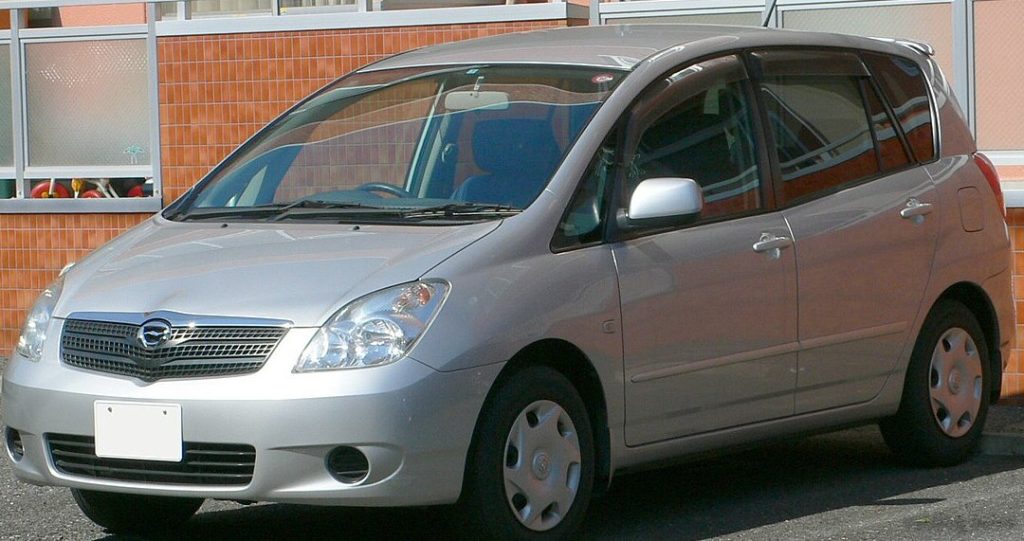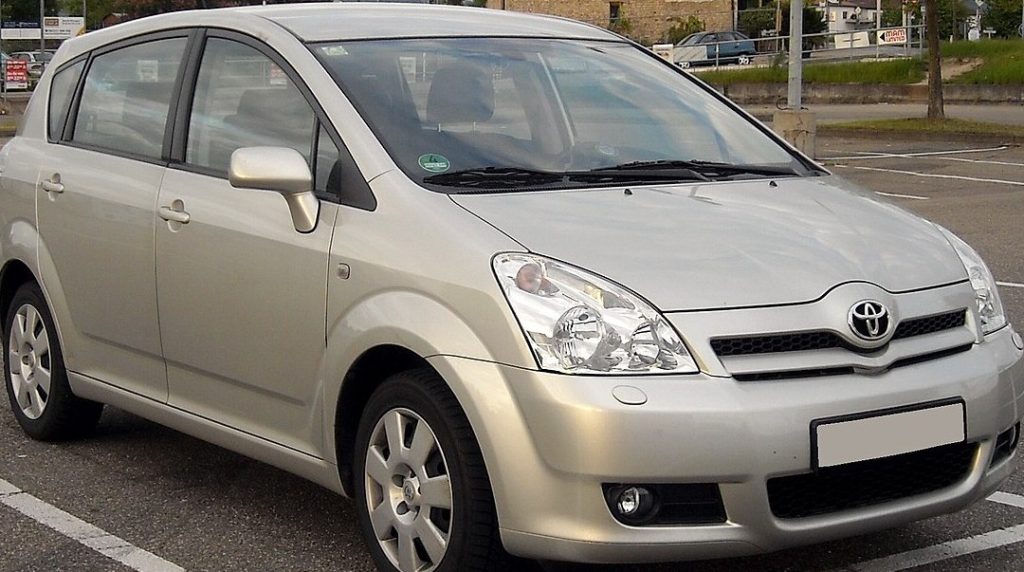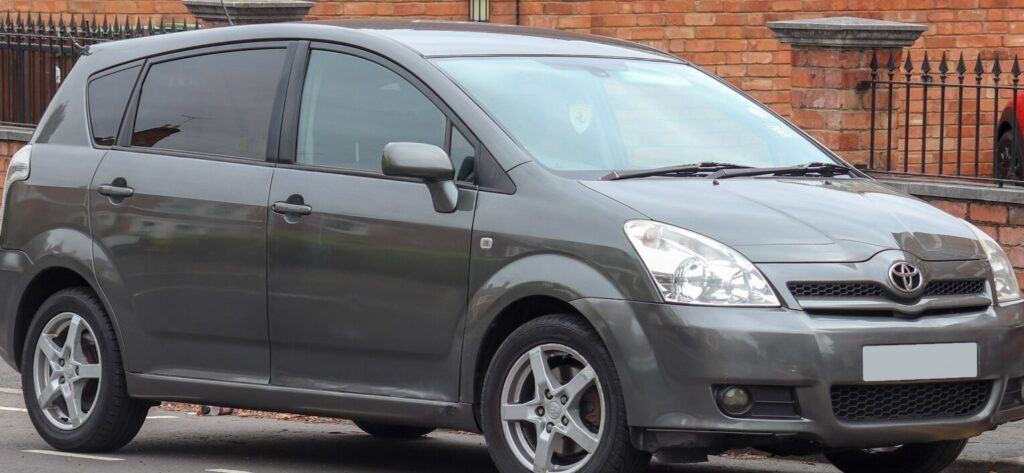
The Toyota Corolla Verso II, specifically the 1.8 VVT-i variant produced between 2004 and 2007, represented a significant step forward in Toyota’s compact MPV offerings. Part of the AR10 series, this model aimed to provide a versatile and family-friendly vehicle within the increasingly competitive European and Asian markets. Positioned as a mid-range option within the Verso II lineup, it offered a balance between performance, fuel efficiency, and affordability, slotting above the base 1.6L engine and below the more powerful (and often diesel-powered) alternatives. This version was primarily geared towards buyers seeking a practical, reliable, and comfortable people carrier for everyday use.
Technical Specifications
| Brand | Toyota |
| Model | Corolla Verso |
| Generation | Corolla Verso II (AR10) |
| Type (Engine) | 1.8 VVT-i (129 Hp) |
| Start of production | 2004 |
| End of production | 2007 |
| Powertrain Architecture | Internal Combustion engine |
| Body type | MPV |
| Seats | 5 |
| Doors | 5 |
| Fuel consumption (economy) – urban (NEDC) | 9.9 l/100 km (23.8 US mpg, 28.5 UK mpg, 10.1 km/l) |
| Fuel consumption (economy) – extra urban (NEDC) | 6.5 l/100 km (36.2 US mpg, 43.5 UK mpg, 15.4 km/l) |
| Fuel consumption (economy) – combined (NEDC) | 7.7 l/100 km (30.5 US mpg, 36.7 UK mpg, 13 km/l) |
| CO2 emissions (NEDC) | 184 g/km |
| Fuel Type | Petrol (Gasoline) |
| Acceleration 0 – 100 km/h | 10.8 sec |
| Acceleration 0 – 62 mph | 10.8 sec |
| Acceleration 0 – 60 mph | 10.3 sec |
| Maximum speed | 195 km/h (121.17 mph) |
| Emission standard | Euro 4 |
| Weight-to-power ratio | 10.5 kg/Hp, 95.2 Hp/tonne |
| Weight-to-torque ratio | 8 kg/Nm, 125.5 Nm/tonne |
| Power | 129 Hp @ 6000 rpm |
| Power per litre | 71.9 Hp/l |
| Torque | 170 Nm @ 4200 rpm (125.39 lb.-ft. @ 4200 rpm) |
| Engine layout | Front, Transverse |
| Engine Model/Code | 1ZZ-FE |
| Engine displacement | 1794 cm3 (109.48 cu. in.) |
| Number of cylinders | 4 |
| Engine configuration | Inline |
| Cylinder Bore | 79 mm (3.11 in.) |
| Piston Stroke | 91.5 mm (3.6 in.) |
| Compression ratio | 10:1 |
| Number of valves per cylinder | 4 |
| Fuel injection system | Multi-port manifold injection |
| Engine aspiration | Naturally aspirated engine |
| Valvetrain | DOHC |
| Engine oil capacity | 3.7 l (3.91 US qt | 3.26 UK qt) |
| Coolant | 5.8 l (6.13 US qt | 5.1 UK qt) |
| Kerb Weight | 1355 kg (2987.26 lbs.) |
| Max. weight | 2035 kg (4486.41 lbs.) |
| Max load | 680 kg (1499.14 lbs.) |
| Trunk (boot) space – minimum | 423 l (14.94 cu. ft.) |
| Trunk (boot) space – maximum | 1563 l (55.2 cu. ft.) |
| Fuel tank capacity | 60 l (15.85 US gal | 13.2 UK gal) |
| Permitted trailer load with brakes (12%) | 1300 kg (2866.01 lbs.) |
| Permitted trailer load without brakes | 450 kg (992.08 lbs.) |
| Length | 4360 mm (171.65 in.) |
| Width | 1770 mm (69.69 in.) |
| Height | 1620 mm (63.78 in.) |
| Wheelbase | 2750 mm (108.27 in.) |
| Front track | 1505 mm (59.25 in.) |
| Rear (Back) track | 1495 mm (58.86 in.) |
| Front overhang | 870 mm (34.25 in.) |
| Rear overhang | 740 mm (29.13 in.) |
| Drag coefficient (Cd) | 0.30 |
| Minimum turning circle (turning diameter) | 11.6 m (38.06 ft.) |
| Drivetrain Architecture | The Internal combustion engine (ICE) drives the front wheels of the vehicle. |
| Drive wheel | Front wheel drive |
| Number of gears and type of gearbox | 5 gears, manual transmission |
| Front suspension | Independent type McPherson, Transverse stabilizer |
| Rear suspension | Transverse stabilizer, Torsion |
| Front brakes | Ventilated discs, 295 mm |
| Rear brakes | Disc, 290 mm |
| Assisting systems | ABS (Anti-lock braking system) |
| Steering type | Steering rack and pinion |
| Power steering | Hydraulic Steering |
| Tires size | 205/55 R16 |
| Wheel rims size | 6.5J x 16 |
INTRODUCTION
The Toyota Corolla Verso II, launched in 2004, was a second-generation compact MPV building upon the success of its predecessor. Designed to appeal to European and Asian families, the AR10 chassis offered increased space and practicality compared to a standard hatchback. The 1.8 VVT-i engine, a mainstay of Toyota’s lineup, was offered as a key engine option, providing a balance of performance and fuel economy. This particular variant was aimed at buyers who prioritized comfort and usability over outright speed, making it a popular choice for daily commutes and family trips.
Powertrain & Engine Architecture
The heart of the Corolla Verso II 1.8 VVT-i is the 1ZZ-FE engine, a 1.8-liter (1794 cc) inline-four cylinder gasoline engine. This engine utilizes Toyota’s Variable Valve Timing-intelligent (VVT-i) technology, which optimizes valve timing based on engine speed and load, improving both power and fuel efficiency. The 1ZZ-FE employs multi-port fuel injection, delivering fuel directly to each cylinder. The engine produces 129 horsepower at 6000 rpm and 170 Nm (125 lb-ft) of torque at 4200 rpm. The engine is transversely mounted in the front of the vehicle. The transmission is a 5-speed manual, offering a relatively conventional driving experience. The engine’s design emphasizes reliability and longevity, typical of Toyota engineering.
Driving Characteristics
The 1.8 VVT-i engine in the Corolla Verso II provides adequate, though not exhilarating, performance. Acceleration from 0-60 mph takes around 10.3 seconds, and the top speed is approximately 121 mph. The engine feels responsive enough for everyday driving, with sufficient torque for overtaking maneuvers. Compared to the base 1.6L engine, the 1.8L offers noticeably more power, especially when fully loaded with passengers and luggage. However, it doesn’t match the punch of the more expensive diesel options. The 5-speed manual transmission is smooth and precise, although the gear ratios are geared towards fuel economy rather than sporty performance. The overall driving experience is comfortable and refined, prioritizing ride quality over handling sharpness.
Equipment & Trim Levels
The 1.8 VVT-i Corolla Verso II typically came equipped with a reasonable level of standard features. These included air conditioning, power windows, central locking, and an audio system. Higher trim levels offered options such as alloy wheels, a sunroof, and upgraded upholstery. Interior materials were generally durable and practical, reflecting the vehicle’s family-oriented focus. The Verso II’s interior is known for its flexible seating arrangements, with the rear seats capable of folding flat or being removed entirely to maximize cargo space. Safety features included ABS brakes and front airbags.
Chassis & Braking
The Corolla Verso II utilizes a McPherson strut front suspension and a torsion beam rear suspension. This setup provides a comfortable ride, absorbing bumps and imperfections in the road effectively. The front brakes are ventilated discs, while the rear brakes are solid discs, providing adequate stopping power for the vehicle’s weight. The steering is hydraulic power-assisted rack and pinion, offering a light and easy driving experience. The vehicle’s weight distribution is relatively balanced, contributing to its stable handling characteristics.
Market Reception & Comparison
The Corolla Verso II 1.8 VVT-i was generally well-received by automotive critics. It was praised for its practicality, reliability, and comfortable ride. However, some reviewers noted that the engine lacked the punch of its competitors, particularly the diesel-powered options. Fuel economy was considered respectable, but not class-leading. Compared to other trims in the Verso II lineup, the 1.8L offered a good balance between performance and price, making it a popular choice for buyers who didn’t require the extra power of the diesel engines. The 1.6L was more affordable, but felt underpowered, while the diesel options were more expensive to purchase and maintain.
Legacy
The 1ZZ-FE engine, found in the Corolla Verso II 1.8 VVT-i, is known for its exceptional reliability and longevity. With proper maintenance, these engines can easily exceed 200,000 miles. The Corolla Verso II itself has proven to be a durable and dependable vehicle, retaining a good reputation in the used car market. While not a particularly exciting vehicle to drive, its practicality, reliability, and affordability have made it a popular choice for families seeking a versatile and dependable MPV. Today, well-maintained examples of the 1.8 VVT-i Corolla Verso II can still be found on the road, testament to Toyota’s engineering prowess.