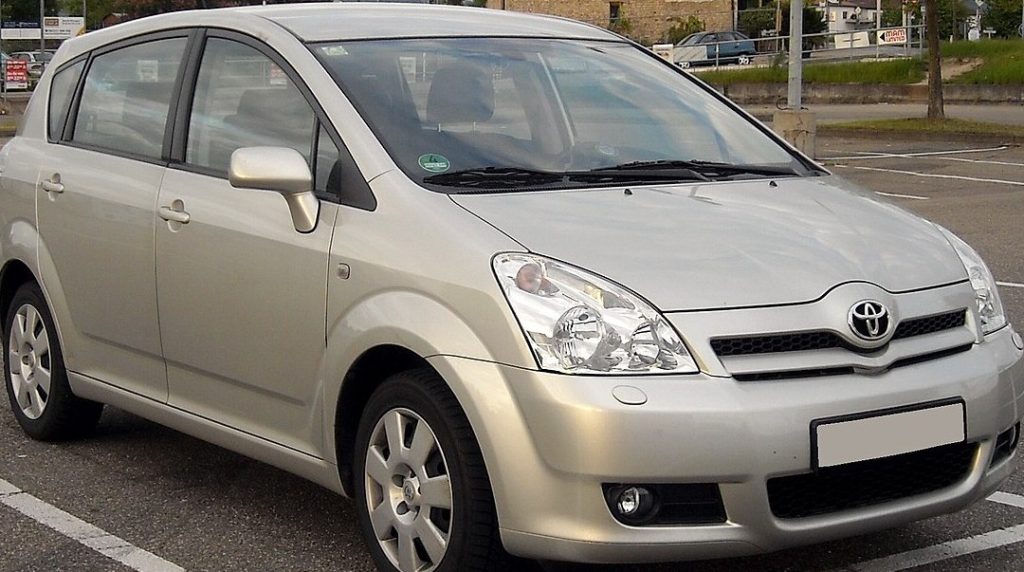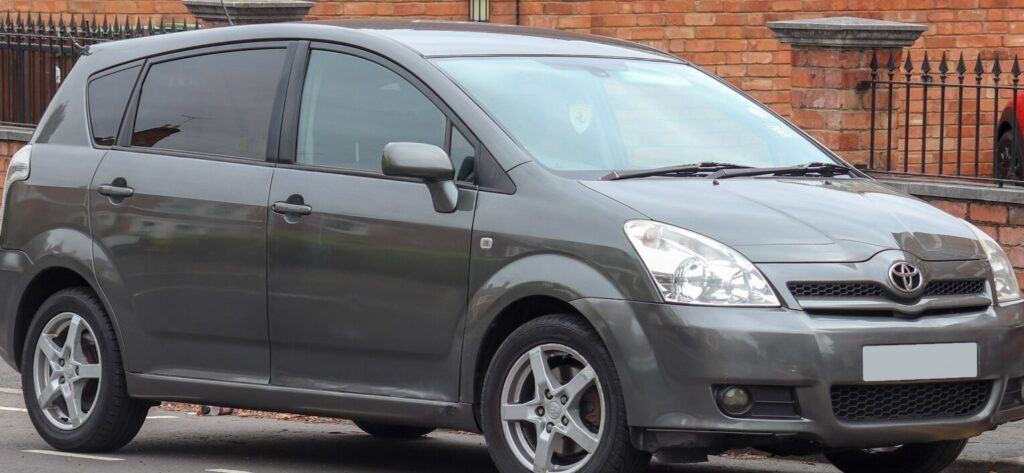
The Toyota Corolla Verso II, specifically the 2.2 D-4D variant producing 136 horsepower, was a compact multi-purpose vehicle (MPV) sold primarily in the European market from 2005 to 2007. Part of the AR10 series, it represented Toyota’s second attempt at a leisure activity vehicle based on the Corolla platform, aiming to provide a more spacious and versatile alternative to traditional hatchbacks. This particular engine and transmission combination occupied a mid-range position within the Verso II lineup, offering a balance between fuel efficiency, performance, and practicality for family use. It was positioned above the lower-powered 1.6L petrol engine options and below the more expensive petrol variants.
Technical Specifications
| Brand | Toyota |
| Model | Corolla Verso |
| Generation | Corolla Verso II (AR10) |
| Type (Engine) | 2.2 D-4D (136 Hp) |
| Start of production | 2005 |
| End of production | 2007 |
| Powertrain Architecture | Internal Combustion engine |
| Body type | MPV |
| Seats | 5 |
| Doors | 5 |
| Fuel consumption (economy) – urban (NEDC) | 8 l/100 km (29.4 US mpg, 35.3 UK mpg, 12.5 km/l) |
| Fuel consumption (economy) – extra urban (NEDC) | 5.3 l/100 km (44.4 US mpg, 53.3 UK mpg, 18.9 km/l) |
| Fuel consumption (economy) – combined (NEDC) | 6.3 l/100 km (37.3 US mpg, 44.8 UK mpg, 15.9 km/l) |
| CO2 emissions (NEDC) | 167 g/km |
| Fuel Type | Diesel |
| Acceleration 0 – 100 km/h | 9.4 sec |
| Acceleration 0 – 62 mph | 9.4 sec |
| Acceleration 0 – 60 mph | 8.9 sec |
| Maximum speed | 195 km/h (121.17 mph) |
| Emission standard | Euro 4 |
| Weight-to-power ratio | 11 kg/Hp, 91 Hp/tonne |
| Weight-to-torque ratio | 4.8 kg/Nm, 207.4 Nm/tonne |
| Power | 136 Hp @ 3600 rpm |
| Power per litre | 61 Hp/l |
| Torque | 310 Nm @ 2000-2800 rpm (228.64 lb.-ft. @ 2000-2800 rpm) |
| Engine layout | Front, Transverse |
| Engine Model/Code | 2AD-FTV |
| Engine displacement | 2231 cm3 (136.14 cu. in.) |
| Number of cylinders | 4 |
| Engine configuration | Inline |
| Cylinder Bore | 86 mm (3.39 in.) |
| Piston Stroke | 96 mm (3.78 in.) |
| Compression ratio | 16.9:1 |
| Number of valves per cylinder | 4 |
| Fuel injection system | Diesel Commonrail |
| Engine aspiration | Turbocharger, Intercooler |
| Valvetrain | DOHC |
| Engine oil capacity | 5.9 l (6.23 US qt | 5.19 UK qt) |
| Coolant | 7.4 l (7.82 US qt | 6.51 UK qt) |
| Kerb Weight | 1495 kg (3295.91 lbs.) |
| Max. weight | 2160 kg (4761.98 lbs.) |
| Max load | 665 kg (1466.07 lbs.) |
| Trunk (boot) space – minimum | 423 l (14.94 cu. ft.) |
| Trunk (boot) space – maximum | 1563 l (55.2 cu. ft.) |
| Fuel tank capacity | 55 l (14.53 US gal | 12.1 UK gal) |
| Permitted trailer load with brakes (12%) | 1300 kg (2866.01 lbs.) |
| Permitted trailer load without brakes | 450 kg (992.08 lbs.) |
| Length | 4360 mm (171.65 in.) |
| Width | 1770 mm (69.69 in.) |
| Height | 1620 mm (63.78 in.) |
| Wheelbase | 2750 mm (108.27 in.) |
| Front track | 1505 mm (59.25 in.) |
| Rear (Back) track | 1495 mm (58.86 in.) |
| Front overhang | 870 mm (34.25 in.) |
| Rear overhang | 740 mm (29.13 in.) |
| Drag coefficient (Cd) | 0.30 |
| Minimum turning circle (turning diameter) | 11.6 m (38.06 ft.) |
| Drivetrain Architecture | The Internal combustion engine (ICE) drives the front wheels of the vehicle. |
| Drive wheel | Front wheel drive |
| Number of gears and type of gearbox | 6 gears, manual transmission |
| Front suspension | Independent type McPherson, Transverse stabilizer |
| Rear suspension | Transverse stabilizer, Torsion |
| Front brakes | Ventilated discs, 295 mm |
| Rear brakes | Disc, 290 mm |
| Assisting systems | ABS (Anti-lock braking system) |
| Steering type | Steering rack and pinion |
| Power steering | Hydraulic Steering |
| Tires size | 205/55 R16 |
| Wheel rims size | 6.5J x 16 |
INTRODUCTION
The Toyota Corolla Verso II 2.2 D-4D, launched in 2005, was a key model in Toyota’s European lineup, designed to cater to the growing demand for compact MPVs. Built on the same platform (the E120 series Corolla) as the standard Corolla, the Verso offered increased interior space and versatility thanks to its taller roofline and reconfigured interior. The 2.2 D-4D engine, designated the 2AD-FTV, was a significant component of the Verso’s appeal, providing a good balance of power and fuel economy. This variant aimed to attract families and individuals needing a practical vehicle for everyday use and occasional longer journeys.
Powertrain & Engine Architecture
The heart of the Corolla Verso II 2.2 D-4D is the 2AD-FTV, a 2.2-liter inline-four cylinder diesel engine. This engine utilizes a common rail direct injection system, delivering fuel directly into the combustion chamber at extremely high pressure for improved efficiency and reduced emissions. The engine features a single overhead camshaft (SOHC) design with four valves per cylinder (DOHC), and is equipped with a turbocharger and intercooler to boost power output. The turbocharger forces more air into the engine, increasing combustion efficiency, while the intercooler cools the compressed air, further enhancing performance. The 2AD-FTV engine produces 136 horsepower at 3600 rpm and 310 Nm (228.64 lb-ft) of torque between 2000 and 2800 rpm. The engine is paired with a six-speed manual transmission, providing a good range of gears for both fuel efficiency and acceleration.
Driving Characteristics
The 2.2 D-4D engine in the Corolla Verso II delivers a respectable driving experience for its class. While not a performance-oriented vehicle, the 310 Nm of torque provides ample pulling power for everyday driving and overtaking maneuvers. The six-speed manual transmission allows drivers to keep the engine in its optimal power band, resulting in responsive acceleration. Compared to the lower-powered 1.6L petrol versions, the 2.2 D-4D offers significantly more torque, making it easier to carry a full load of passengers and luggage. However, it doesn’t possess the outright acceleration of some of its petrol-powered competitors. The gear ratios are well-suited for cruising on highways, and the engine remains relatively quiet and refined at higher speeds. The front-wheel-drive configuration provides predictable handling, although it lacks the all-weather capability of an all-wheel-drive system.
Equipment & Trim Levels
The Corolla Verso II 2.2 D-4D typically came with a reasonable level of standard equipment. Features included air conditioning, power steering, electric front windows, central locking, and an audio system with CD player. Higher trim levels offered additional features such as alloy wheels, rear parking sensors, automatic climate control, and upgraded upholstery. Interior upholstery was typically cloth, with options for higher-quality materials on more expensive trims. The dashboard layout was functional and straightforward, with easy-to-read gauges and controls. Optional extras included a sunroof, navigation system, and leather seats.
Chassis & Braking
The Corolla Verso II utilizes a McPherson strut front suspension system with a transverse stabilizer bar, providing a comfortable and controlled ride. The rear suspension employs a torsion beam setup, which is a cost-effective and space-saving solution. The braking system consists of ventilated discs on the front wheels and solid discs on the rear wheels. Anti-lock Braking System (ABS) was standard, enhancing safety by preventing wheel lockup during hard braking. The steering is a rack and pinion system with hydraulic power assistance, providing precise and responsive steering feel. The vehicle rides on 205/55 R16 tires, mounted on 6.5J x 16 alloy or steel wheels.
Market Reception & Comparison
The Toyota Corolla Verso II 2.2 D-4D was generally well-received by automotive critics for its practicality, fuel efficiency, and comfortable ride. The diesel engine was praised for its torque and economy, making it a popular choice for long-distance drivers. However, some critics noted that the interior design was somewhat bland and lacked the visual appeal of some competitors. Compared to other MPVs in its class, such as the Renault Scenic and Citroën C4 Picasso, the Corolla Verso II offered a more conservative and understated design. Fuel economy was a strong point, with the 2.2 D-4D achieving around 37.3 US mpg on the combined cycle. Reliability was also a key strength, as Toyota is renowned for its build quality and dependability.
Legacy
The Toyota Corolla Verso II 2.2 D-4D has proven to be a reliable and durable vehicle, with many examples still on the road today. The 2AD-FTV engine is known for its longevity, provided it is properly maintained. Common issues include wear and tear on the turbocharger and potential problems with the fuel injectors. In the used car market, the 2.2 D-4D variant typically commands a slightly higher price than the lower-powered petrol versions due to its superior performance and fuel economy. The Corolla Verso II remains a practical and affordable option for families seeking a versatile and dependable MPV.