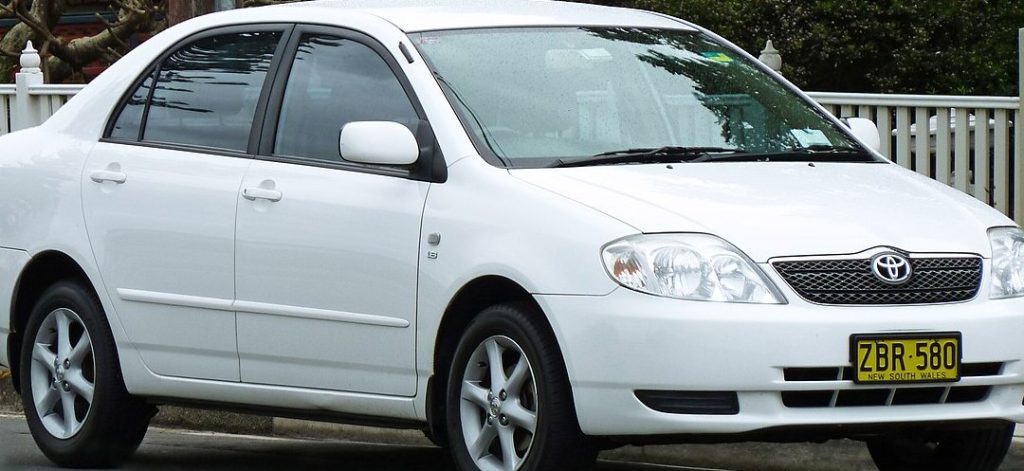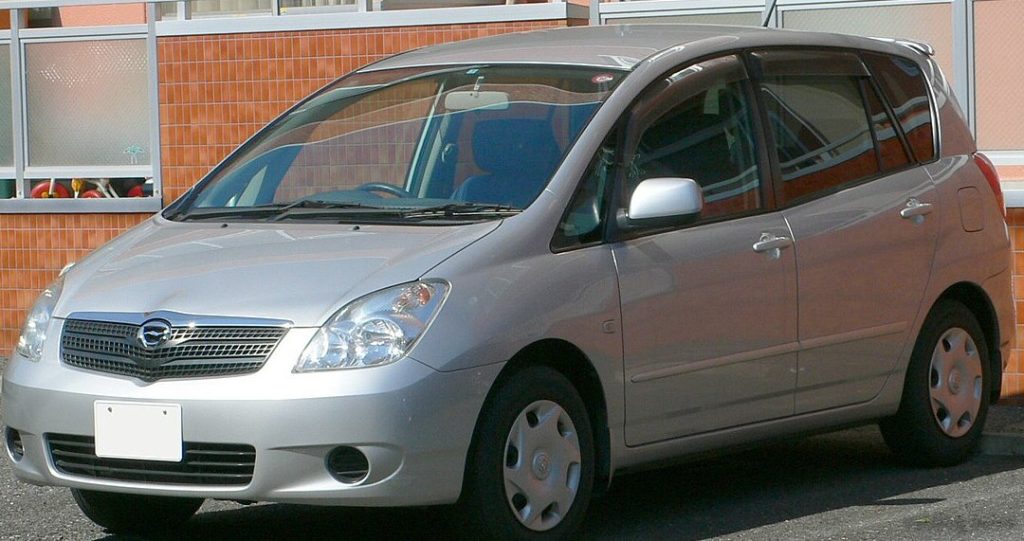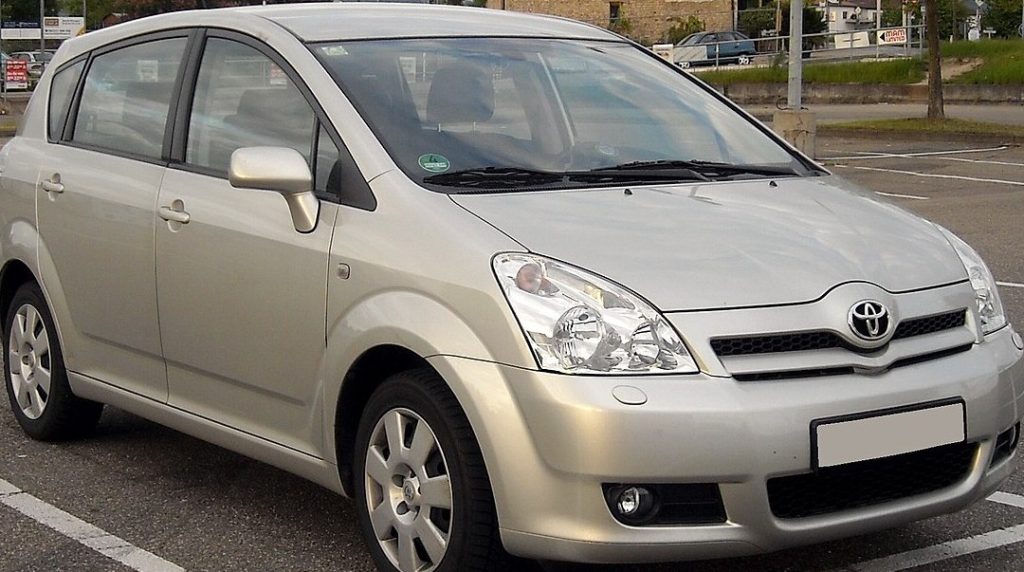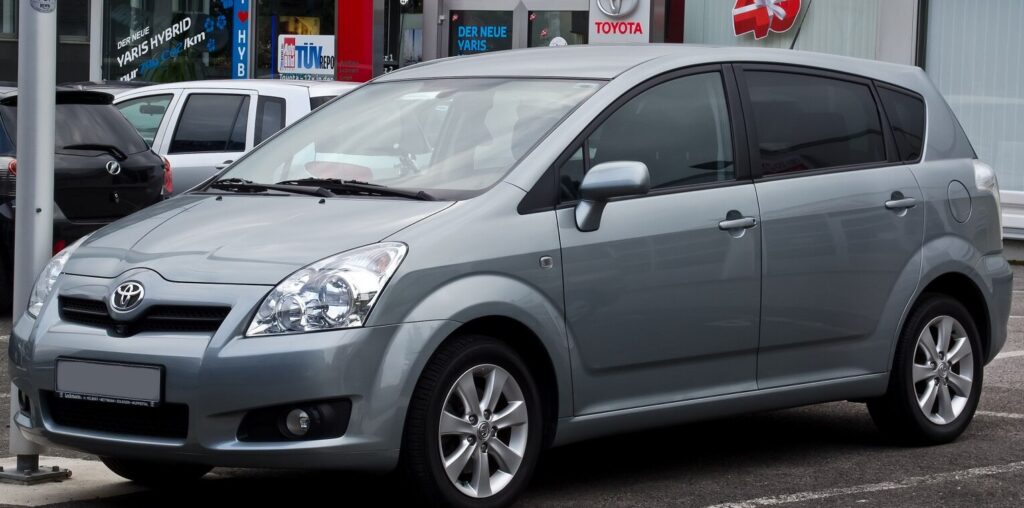
The Toyota Corolla Verso II 2.2 D-4D, produced from 2007 to 2009, represents a mid-cycle refresh of the AR10 generation Corolla Verso, a compact multi-purpose vehicle (MPV) designed primarily for the European market. This variant, equipped with the 2AD-FTV 2.2-liter diesel engine producing 136 horsepower, occupied a middle ground in the Verso lineup, offering a balance between fuel efficiency, practicality, and performance. It aimed to appeal to families seeking a versatile vehicle for both daily commuting and longer journeys. The facelift brought subtle styling updates and refinements to the interior, enhancing the Verso’s overall appeal.
Technical Specifications
| Brand | Toyota |
| Model | Corolla Verso |
| Generation | Corolla Verso II (AR10, facelift 2007) |
| Type (Engine) | 2.2 D-4D (136 Hp) |
| Start of production | 2007 |
| End of production | 2009 |
| Powertrain Architecture | Internal Combustion engine |
| Body type | MPV |
| Seats | 5 |
| Doors | 5 |
| Fuel consumption (urban) | 8.3 l/100 km (28.3 US mpg, 34 UK mpg, 12 km/l) |
| Fuel consumption (extra urban) | 5.6 l/100 km (42 US mpg, 50.4 UK mpg, 17.9 km/l) |
| Fuel consumption (combined) | 6.6 l/100 km (35.6 US mpg, 42.8 UK mpg, 15.2 km/l) |
| CO2 emissions | 173 g/km |
| Fuel Type | Diesel |
| Acceleration 0 – 100 km/h | 10.2 sec |
| Acceleration 0 – 62 mph | 10.2 sec |
| Acceleration 0 – 60 mph | 9.7 sec |
| Maximum speed | 195 km/h (121.17 mph) |
| Emission standard | Euro 4 |
| Weight-to-power ratio | 11 kg/Hp |
| Weight-to-torque ratio | 4.8 kg/Nm |
| Power | 136 Hp @ 3600 rpm |
| Torque | 310 Nm @ 2000-2800 rpm (228.64 lb.-ft. @ 2000-2800 rpm) |
| Engine layout | Front, Transverse |
| Engine Model/Code | 2AD-FTV |
| Engine displacement | 2231 cm3 (136.14 cu. in.) |
| Number of cylinders | 4 |
| Engine configuration | Inline |
| Cylinder Bore | 86 mm (3.39 in.) |
| Piston Stroke | 96 mm (3.78 in.) |
| Compression ratio | 16.9:1 |
| Number of valves per cylinder | 4 |
| Fuel injection system | Diesel Commonrail |
| Engine aspiration | Turbocharger, Intercooler |
| Valvetrain | DOHC |
| Engine oil capacity | 5.9 l (6.23 US qt | 5.19 UK qt) |
| Coolant capacity | 8 l (8.45 US qt | 7.04 UK qt) |
| Kerb Weight | 1500-1570 kg (3306.93 – 3461.26 lbs.) |
| Max. weight | 2160 kg (4761.98 lbs.) |
| Max load | 590-660 kg (1300.73 – 1455.05 lbs.) |
| Trunk (boot) space – minimum | 423 l (14.94 cu. ft.) |
| Trunk (boot) space – maximum | 1785 l (63.04 cu. ft.) |
| Fuel tank capacity | 55 l (14.53 US gal | 12.1 UK gal) |
| Max. roof load | 100 kg (220.46 lbs.) |
| Permitted trailer load with brakes (12%) | 1300 kg (2866.01 lbs.) |
| Permitted trailer load without brakes | 450 kg (992.08 lbs.) |
| Permitted towbar download | 55 kg (121.25 lbs.) |
| Length | 4370 mm (172.05 in.) |
| Width | 1770 mm (69.69 in.) |
| Height | 1620 mm (63.78 in.) |
| Wheelbase | 2750 mm (108.27 in.) |
| Front track | 1505 mm (59.25 in.) |
| Rear track | 1495 mm (58.86 in.) |
| Ride height (ground clearance) | 152 mm (5.98 in.) |
| Drag coefficient (Cd) | 0.30 |
| Minimum turning circle | 12.2 m (40.03 ft.) |
| Drivetrain | Front wheel drive |
| Number of gears | 6 |
| Gearbox type | Manual transmission |
| Front suspension | Independent type McPherson |
| Rear suspension | Torsion |
| Front brakes | Ventilated discs |
| Rear brakes | Disc |
| Assisting systems | ABS (Anti-lock braking system) |
| Steering type | Steering rack and pinion |
| Power steering | Hydraulic Steering |
| Tires size | 205/55 R16 |
| Wheel rims size | 6.5J x 16 |
INTRODUCTION
The Toyota Corolla Verso II, particularly the 2.2 D-4D variant, was a key model in Toyota’s European lineup during the late 2000s. Built on the AR10 platform (shared with the first generation Verso), the facelifted model introduced in 2007 brought cosmetic and minor mechanical updates. The 2.2 D-4D engine was a popular choice for buyers prioritizing fuel economy and torque, making it well-suited for long-distance travel and carrying passengers. This version aimed to provide a practical and reliable family vehicle, competing with other compact MPVs like the Renault Scenic and Citroën C4 Picasso.
Powertrain & Engine Architecture
The heart of the Corolla Verso II 2.2 D-4D is the 2AD-FTV engine, a 2.2-liter inline-four cylinder diesel. This engine utilizes a common rail direct injection system, delivering fuel directly into the combustion chamber at extremely high pressure for improved efficiency and reduced emissions. The 2AD-FTV is a DOHC (Double Overhead Camshaft) engine, featuring four valves per cylinder, contributing to its good breathing and power output. A turbocharger with an intercooler further enhances performance by forcing more air into the engine. The engine produces 136 horsepower at 3600 rpm and a substantial 310 Nm (228.64 lb.-ft.) of torque between 2000 and 2800 rpm. This torque band provides strong pulling power for everyday driving and when fully loaded. The engine also incorporates a diesel particulate filter (DPF) to reduce soot emissions, meeting Euro 4 standards. The 2.2 D-4D was typically paired with a six-speed manual transmission, although an automatic option was also available, though less common.
Driving Characteristics
The 2.2 D-4D engine in the Corolla Verso II delivers a comfortable and relaxed driving experience. While not particularly sporty, the ample torque makes overtaking and merging onto highways relatively effortless. The six-speed manual transmission allows drivers to keep the engine in its optimal power band, maximizing efficiency and responsiveness. Compared to the lower-powered 1.6-liter petrol versions, the 2.2 D-4D offers significantly more pulling power, especially when carrying passengers or luggage. The automatic transmission, while providing convenience, can feel slightly less responsive and may result in slightly lower fuel economy. The Verso’s suspension is tuned for comfort, absorbing bumps and imperfections in the road well, although it doesn’t offer the sharp handling of some competitors.
Equipment & Trim Levels
The Corolla Verso II 2.2 D-4D typically came with a reasonable level of standard equipment. This included air conditioning, power windows, central locking, and an audio system with CD player. Higher trim levels, such as the ‘Comfort’ or ‘Style’ variants, added features like alloy wheels, climate control, rear parking sensors, and upgraded interior trim. Interior upholstery was typically cloth, with options for partial leather. The dashboard layout was functional and straightforward, with easy-to-read instruments. Optional extras included a sunroof, navigation system, and a more advanced audio system.
Chassis & Braking
The Corolla Verso II features a front-wheel-drive layout with an independent McPherson strut suspension at the front and a torsion beam suspension at the rear. This setup provides a good balance between ride comfort and handling. Braking duties are handled by ventilated discs at the front and solid discs at the rear, equipped with an Anti-lock Braking System (ABS) as standard. The steering is rack and pinion with hydraulic power assistance, offering a reasonably direct and responsive feel. The Verso’s tires are typically 205/55 R16, providing adequate grip in most conditions.
Market Reception & Comparison
The Toyota Corolla Verso II 2.2 D-4D was generally well-received by automotive critics for its practicality, fuel efficiency, and reliability. The diesel engine was praised for its torque and economy, making it a popular choice for long-distance drivers. However, some critics noted that the interior design was somewhat bland and that the driving experience wasn’t particularly engaging. Compared to the petrol-powered versions, the 2.2 D-4D offered superior fuel economy and performance, but at a higher purchase price. Compared to rivals like the Renault Scenic and Citroën C4 Picasso, the Verso was often seen as a more reliable and durable option, but perhaps less stylish or innovative.
Legacy
The Toyota Corolla Verso II 2.2 D-4D has proven to be a reliable and durable vehicle, with many examples still on the road today. The 2AD-FTV engine is known for its longevity, provided it has been properly maintained. Common issues include DPF blockages (particularly on vehicles used primarily for short journeys) and wear and tear on suspension components. In the used car market, the 2.2 D-4D variant typically commands a slightly higher price than the petrol-powered versions, reflecting its superior fuel economy and performance. It remains a popular choice for families seeking a practical and affordable MPV.