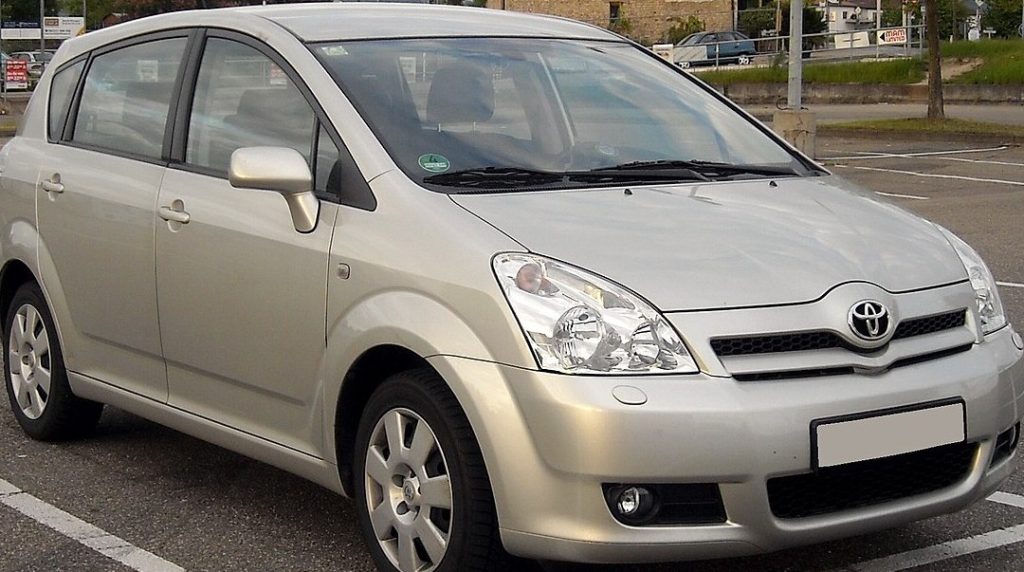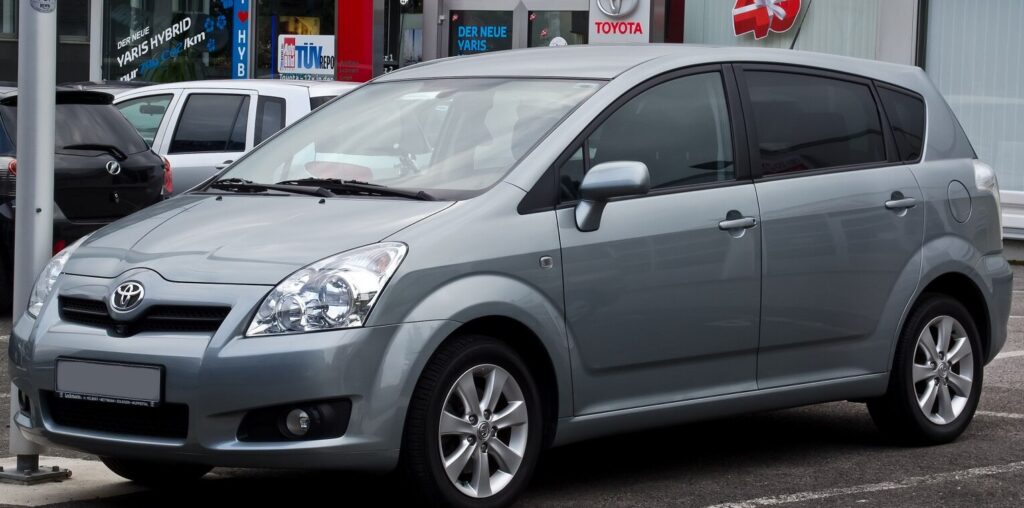
The Toyota Corolla Verso II 2.2 D-CAT (177 hp), produced from 2007 to 2009, represents a significant iteration of Toyota’s compact MPV offering. This variant, designated as part of the AR10 series and benefitting from a 2007 facelift, aimed to provide a practical and efficient seven-seat vehicle for European families. Positioned as a mid-to-upper trim level within the Verso II range, the 2.2 D-CAT offered a balance of performance and fuel economy, appealing to buyers needing space and reasonable running costs. It was a key model in Toyota’s strategy to compete in the increasingly popular multi-purpose vehicle segment.
Technical Specifications
| Brand | Toyota |
| Model | Corolla Verso |
| Generation | Corolla Verso II (AR10, facelift 2007) |
| Type (Engine) | 2.2 D-CAT (177 Hp) |
| Start of production | 2007 |
| End of production | 2009 |
| Powertrain Architecture | Internal Combustion engine |
| Body type | MPV |
| Seats | 7 |
| Doors | 5 |
| Fuel consumption (economy) – urban (NEDC) | 8.5 l/100 km (27.7 US mpg, 33.2 UK mpg, 11.8 km/l) |
| Fuel consumption (economy) – extra urban (NEDC) | 5.8 l/100 km (40.6 US mpg, 48.7 UK mpg, 17.2 km/l) |
| Fuel consumption (economy) – combined (NEDC) | 6.8 l/100 km (34.6 US mpg, 41.5 UK mpg, 14.7 km/l) |
| CO2 emissions (NEDC) | 178 g/km |
| Fuel Type | Diesel |
| Acceleration 0 – 100 km/h | 9 sec |
| Acceleration 0 – 62 mph | 9 sec |
| Acceleration 0 – 60 mph | 8.6 sec |
| Maximum speed | 205 km/h (127.38 mph) |
| Emission standard | Euro 4 |
| Weight-to-power ratio | 8.6 kg/Hp, 116.8 Hp/tonne |
| Weight-to-torque ratio | 3.8 kg/Nm, 264 Nm/tonne |
| Power | 177 Hp @ 3600 rpm |
| Power per litre | 79.3 Hp/l |
| Torque | 400 Nm @ 2000-2800 rpm (295.02 lb.-ft. @ 2000-2800 rpm) |
| Engine layout | Front, Transverse |
| Engine Model/Code | 2AD-FHV |
| Engine displacement | 2231 cm3 (136.14 cu. in.) |
| Number of cylinders | 4 |
| Engine configuration | Inline |
| Cylinder Bore | 86 mm (3.39 in.) |
| Piston Stroke | 96 mm (3.78 in.) |
| Compression ratio | 15.8:1 |
| Number of valves per cylinder | 4 |
| Fuel injection system | Diesel Commonrail |
| Engine aspiration | Turbocharger, Intercooler |
| Valvetrain | DOHC |
| Engine oil capacity | 5.9 l (6.23 US qt, 5.19 UK qt) |
| Coolant | 8 l (8.45 US qt, 7.04 UK qt) |
| Kerb Weight | 1515-1570 kg (3340 – 3461.26 lbs.) |
| Max. weight | 2165 kg (4773.01 lbs.) |
| Max load | 595-650 kg (1311.75 – 1433 lbs.) |
| Trunk (boot) space – minimum | 63 l (2.22 cu. ft.) |
| Trunk (boot) space – maximum | 1785 l (63.04 cu. ft.) |
| Fuel tank capacity | 55 l (14.53 US gal, 12.1 UK gal) |
| Max. roof load | 100 kg (220.46 lbs.) |
| Permitted trailer load with brakes (12%) | 1300 kg (2866.01 lbs.) |
| Permitted trailer load without brakes | 450 kg (992.08 lbs.) |
| Permitted towbar download | 55 kg (121.25 lbs.) |
| Length | 4370 mm (172.05 in.) |
| Width | 1770 mm (69.69 in.) |
| Height | 1625 mm (63.98 in.) |
| Wheelbase | 2750 mm (108.27 in.) |
| Front track | 1505 mm (59.25 in.) |
| Rear (Back) track | 1495 mm (58.86 in.) |
| Ride height (ground clearance) | 152 mm (5.98 in.) |
| Drag coefficient (Cd) | 0.30 |
| Minimum turning circle (turning diameter) | 12.2 m (40.03 ft.) |
| Drivetrain Architecture | The Internal combustion engine (ICE) drives the front wheels of the vehicle. |
| Drive wheel | Front wheel drive |
| Number of gears and type of gearbox | 6 gears, manual transmission |
| Front suspension | Independent type McPherson |
| Rear suspension | Torsion |
| Front brakes | Ventilated discs |
| Rear brakes | Disc |
| Assisting systems | ABS (Anti-lock braking system) |
| Steering type | Steering rack and pinion |
| Power steering | Hydraulic Steering |
| Tires size | 215/50 R17 |
| Wheel rims size | 7J x 17 |
INTRODUCTION
The Toyota Corolla Verso II, launched in 2001 and facelifted in 2007, was Toyota’s entry into the compact MPV market, primarily aimed at European consumers. The 2.2 D-CAT variant, introduced with the 2007 refresh, offered a diesel engine option designed to balance performance with fuel efficiency. This model year saw updates to the exterior styling, interior materials, and safety features. The Verso II competed with vehicles like the Renault Scenic, Citroën C4 Picasso, and Opel/Vauxhall Zafira, offering a seven-seat configuration in a relatively compact package. The 2.2 D-CAT was positioned as a step up from the lower-powered petrol engines, appealing to those who frequently carried passengers or needed to tow trailers.
Powertrain & Engine Architecture
The heart of the Corolla Verso II 2.2 D-CAT is the 2AD-FHV engine, a 2.2-liter inline-four cylinder diesel. This engine utilizes a common rail direct injection system, delivering fuel directly into the combustion chamber at extremely high pressure for improved efficiency and reduced emissions. The engine also features a turbocharger with an intercooler, boosting power output and torque. The D-CAT designation refers to the Diesel Clean Advanced Technology, incorporating a Diesel Particulate Filter (DPF) to reduce soot emissions and meet Euro 4 standards. The engine produces 177 horsepower at 3600 rpm and a substantial 400 Nm (295 lb-ft) of torque between 2000 and 2800 rpm. This torque band provides strong pulling power, especially useful for a seven-seat MPV. The engine employs a double overhead camshaft (DOHC) valvetrain with four valves per cylinder, optimizing gas flow for improved performance. The 2AD-FHV is known for its relatively robust construction, but the DPF system requires regular maintenance to prevent clogging and ensure optimal performance.
Driving Characteristics
The 2.2 D-CAT equipped Corolla Verso II offers a noticeable improvement in performance compared to the lower-powered petrol variants. The ample torque allows for effortless acceleration, even when fully loaded with passengers and luggage. While not a sports car, the Verso II 2.2 D-CAT provides sufficient power for highway cruising and overtaking maneuvers. The six-speed manual transmission (the only transmission option for this engine) is well-matched to the engine’s characteristics, offering smooth gear changes and allowing the driver to keep the engine within its optimal torque band. Compared to the 1.8L petrol engine, the diesel offers significantly more low-end grunt, making it easier to manage in everyday driving situations. However, the diesel engine is noticeably louder and exhibits more vibration than the petrol counterpart. The suspension is tuned for comfort, providing a reasonably smooth ride, but body roll is present during cornering due to the vehicle’s higher center of gravity.
Equipment & Trim Levels
The 2.2 D-CAT variant typically came with a generous level of standard equipment. Features included air conditioning, power windows, central locking, an audio system with CD player, and ABS brakes. Higher trim levels added features such as alloy wheels, fog lights, a multi-function steering wheel, and upgraded interior trim. The interior typically featured cloth upholstery, with options for leather available on higher-spec models. The Verso II’s interior is designed with practicality in mind, offering flexible seating arrangements and ample storage compartments. The third-row seats are best suited for children or shorter adults, and accessing them requires folding the second-row seats. Optional extras included a sunroof, parking sensors, and a navigation system.
Chassis & Braking
The Corolla Verso II utilizes a front-wheel-drive layout with an independent McPherson strut suspension at the front and a torsion beam suspension at the rear. This setup provides a good balance of ride comfort and handling. The front brakes are ventilated discs, while the rear brakes are solid discs, providing adequate stopping power for the vehicle’s weight. ABS (Anti-lock Braking System) is standard, enhancing safety during emergency braking situations. The steering is a hydraulic rack and pinion system, offering precise and responsive steering feel. The Verso II’s chassis is designed to accommodate the seven-seat configuration and provide a stable platform for carrying passengers and cargo.
Market Reception & Comparison
The Corolla Verso II 2.2 D-CAT was generally well-received by automotive critics, who praised its spacious interior, fuel efficiency, and strong diesel engine. However, some critics noted the engine’s noise and vibration compared to petrol alternatives. Compared to the 1.8L petrol version, the 2.2 D-CAT offered significantly better fuel economy and more torque, making it a more practical choice for long-distance driving and towing. The 2.2 D-CAT was also more expensive than the petrol variants, reflecting the higher cost of diesel technology. Against competitors like the Renault Scenic and Citroën C4 Picasso, the Verso II offered a similar level of practicality and comfort, with Toyota’s reputation for reliability being a key selling point.
Legacy
The 2AD-FHV engine, while generally reliable, is known to require diligent maintenance, particularly regarding the DPF system. Regular servicing and the use of high-quality diesel fuel are crucial to prevent DPF clogging and ensure long-term engine health. Today, used examples of the Corolla Verso II 2.2 D-CAT can be found at relatively affordable prices. They remain a practical and spacious option for families, but potential buyers should be aware of the potential maintenance costs associated with the DPF system. The Verso II 2.2 D-CAT represents a solid effort from Toyota to provide a versatile and efficient MPV for the European market, and its reputation for reliability continues to make it a popular choice in the used car market.