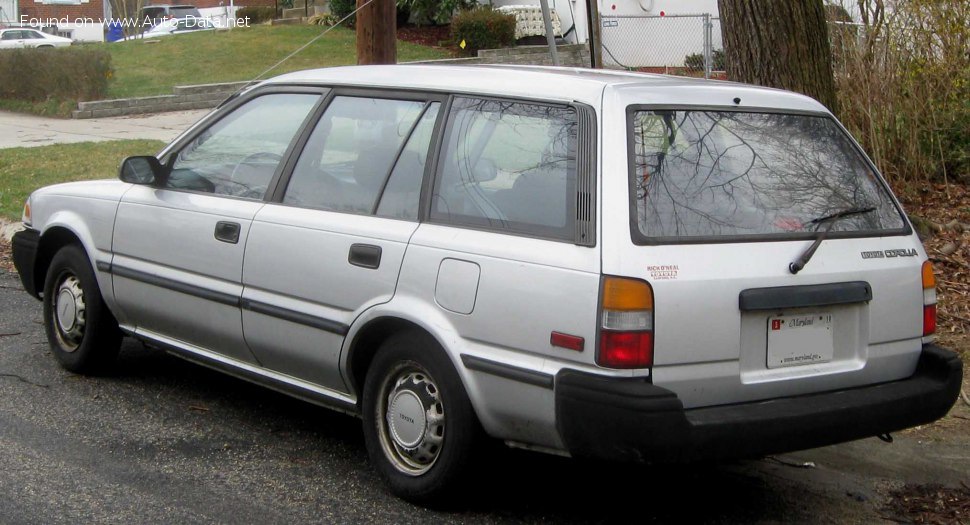
The Toyota Corolla Wagon VI (E90) 1.3, designated model EE90, was a station wagon variant produced between 1987 and 1989. It represented an entry-level offering within the broader E90 Corolla range, which spanned sedan, liftback, and wagon body styles. This particular 1.3-liter engine and transmission combination was aimed at buyers prioritizing fuel efficiency and practicality over outright performance, serving as a family-oriented vehicle in a competitive segment. The E90 generation Corolla, built on Toyota’s platform, offered a significant update in styling and features compared to its predecessor, the E80 series.
The 1.3L (EE90) Corolla Wagon: Positioning and Overview
The EE90 1.3L Corolla Wagon occupied the base trim level within the E90 wagon lineup. Above it sat models with larger engines, such as the 1.6-liter variants, which offered increased power and were often equipped with more features. The 1.3L model was specifically designed to appeal to budget-conscious buyers and those who primarily used their vehicle for commuting and everyday errands. Its focus was on providing reliable transportation with a reasonable purchase price and good fuel economy. The wagon body style itself was popular in many markets, offering increased cargo capacity compared to the sedan and liftback versions of the Corolla.
Powertrain & Engine Architecture
The heart of the EE90 Corolla Wagon was the 2E-E engine, a 1.3-liter (1298 cc) inline-four cylinder gasoline engine. This engine was naturally aspirated and featured a single overhead camshaft (SOHC) valvetrain with eight valves. The 2E-E engine was known for its simplicity and durability, characteristics that contributed to the Corolla’s reputation for reliability. Fuel delivery was managed by a carburetor system, a common feature for vehicles of this era and price point. The carburetor provided a relatively simple and cost-effective method of fuel injection. The engine produced 75 horsepower (hp) at 6,000 rpm and 88 lb-ft of torque at 3,600 rpm.
The EE90 1.3L Corolla Wagon was typically equipped with a three-speed automatic transmission. This transmission was designed for smooth operation and ease of use, further enhancing the vehicle’s appeal to drivers who preferred not to operate a manual gearbox. The automatic transmission featured a torque converter, which provided smooth launches and improved low-speed drivability. Gear ratios were optimized for fuel efficiency and everyday driving conditions, rather than aggressive acceleration. The transmission was a relatively simple design, contributing to its reliability and ease of maintenance.
Driving Characteristics
The driving experience in the EE90 1.3L Corolla Wagon was characterized by its smooth and predictable nature. Acceleration was modest, with the 75 hp engine providing adequate power for city driving and highway cruising, but not excelling in quick overtaking maneuvers. The three-speed automatic transmission contributed to a relaxed driving style, with smooth gear changes and a focus on maintaining fuel efficiency. Compared to the 1.6-liter Corolla Wagons, the 1.3L model felt noticeably slower, particularly when fully loaded with passengers and cargo. The gear ratios were spaced to prioritize fuel economy, meaning the engine often operated at higher rpm during acceleration. Handling was typical for a wagon of this era – comfortable and stable, but not particularly sporty. The suspension was tuned for ride comfort, absorbing bumps and imperfections in the road surface effectively.
Equipment & Trim Levels
The EE90 1.3L Corolla Wagon typically came with a fairly basic level of standard equipment. Interior upholstery was usually cloth, with a simple and durable design. The dashboard featured analog gauges for speed, fuel level, coolant temperature, and a basic odometer. Power steering was not always standard, and air conditioning was often an optional extra. Other common features included a basic AM/FM radio, manual windows, and manual door locks. Optional extras could include upgraded audio systems, alloy wheels, and a sunroof. The trim level was generally focused on functionality and affordability, with minimal emphasis on luxury features. The interior space was a key selling point, offering ample room for passengers and cargo.
Chassis & Braking
The E90 Corolla Wagon utilized a front-engine, rear-wheel-drive (FR) layout. The suspension consisted of independent MacPherson struts at the front and a semi-trailing arm suspension at the rear. This suspension setup provided a good balance between ride comfort and handling. The EE90 1.3L model typically featured drum brakes on the rear wheels and disc brakes on the front wheels. This configuration was common for vehicles in this price range during the late 1980s. The braking system was adequate for everyday driving, but lacked the stopping power of more advanced systems found on higher-end vehicles. Stabilizer bars were often omitted on the base model to reduce cost, which slightly impacted handling performance. The chassis was designed for durability and longevity, with a focus on providing a safe and reliable driving experience.
Market Reception & Comparison
The EE90 1.3L Corolla Wagon was generally well-received by critics and consumers as a practical and affordable family vehicle. It was praised for its reliability, fuel efficiency, and spacious interior. However, its modest performance was often noted as a drawback, particularly when compared to the more powerful 1.6-liter models. Compared to competitors such as the Nissan Sunny Wagon and the Mitsubishi Mirage Wagon, the Corolla Wagon offered a similar level of practicality and affordability, but often benefited from Toyota’s strong reputation for quality and reliability. Fuel economy was a key selling point, with the 1.3L engine achieving respectable mileage for its time. Maintenance costs were also relatively low, thanks to the engine’s simple design and the widespread availability of spare parts.
Technical Specifications
| Engine Code | 2E-E |
| Engine Type | Inline-4, Naturally Aspirated |
| Displacement | 1.3 L (1298 cc) |
| Horsepower | 75 hp @ 6,000 rpm |
| Torque | 88 lb-ft @ 3,600 rpm |
| Fuel System | Carburetor |
| Valvetrain | SOHC, 8 Valves |
| Transmission | 3-Speed Automatic |
| Drivetrain | Rear-Wheel Drive |
| Fuel Tank Capacity | 50 L (13.21 US gal) |
| Engine Oil Capacity | 3.2 L (3.38 US qt) |
| Coolant Capacity | 4.9 L (5.18 US qt) |
| Curb Weight | Approximately 1,150 kg (2,535 lbs) |
Legacy
The EE90 1.3L Corolla Wagon, while not the most powerful or feature-rich variant of the E90 Corolla, has proven to be a remarkably durable and reliable vehicle. Many examples are still on the road today, a testament to Toyota’s engineering and build quality. In the used car market, these wagons are often sought after by enthusiasts and collectors who appreciate their simplicity, affordability, and classic styling. The 2E-E engine is known for its longevity and relatively low maintenance requirements. However, due to its age, potential buyers should be aware of common issues associated with older vehicles, such as rust, worn suspension components, and carburetor problems. The EE90 1.3L Corolla Wagon represents a significant piece of automotive history, embodying the values of practicality, reliability, and affordability that have made the Corolla one of the best-selling cars of all time.