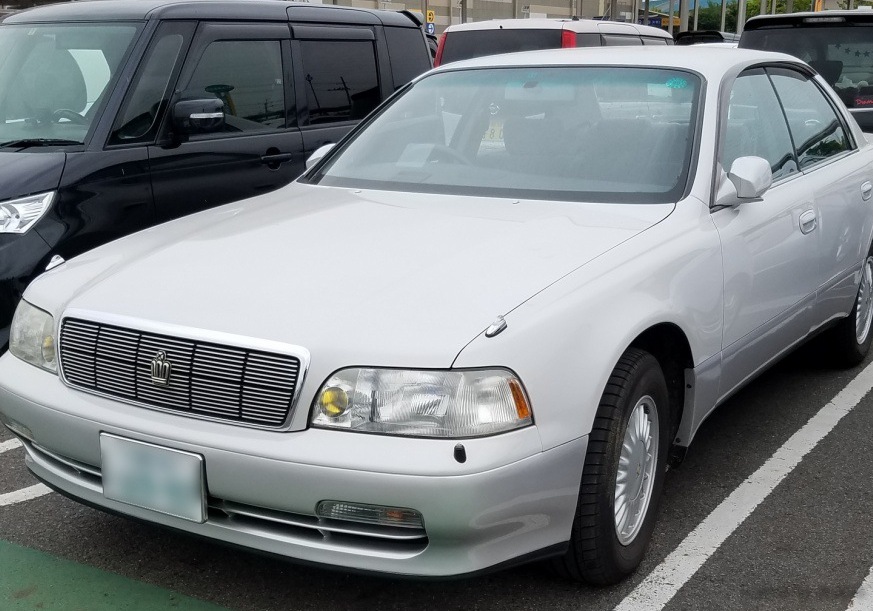
The Toyota Crown Majesta, launched in 1991, represented Toyota’s ambition to create a luxury sedan specifically for the Japanese domestic market (JDM). The first generation, designated S140, underwent a facelift in 1993, refining its styling and features. The 3.0i V6 24V variant, produced from 1993 to 1995, was a key model within the Majesta lineup, positioned as a premium offering with a focus on comfort and refined performance. It served as a direct competitor to the Nissan Cima and Honda Inspire, aiming to provide a luxurious experience at a competitive price point within Japan.
Technical Specifications
| Brand | Toyota |
| Model | Crown Majesta |
| Generation | Crown Majesta I (S140, facelift 1993) |
| Type (Engine) | 3.0i V6 24V (230 Hp) Automatic |
| Start of production | 1993 |
| End of production | 1995 |
| Powertrain Architecture | Internal Combustion engine |
| Body type | Sedan |
| Seats | 5 |
| Doors | 4 |
| Fuel Type | Petrol (Gasoline) |
| Weight-to-power ratio | 7 kg/Hp, 143.8 Hp/tonne |
| Weight-to-torque ratio | 5.6 kg/Nm, 177.5 Nm/tonne |
| Power | 230 Hp @ 6000 rpm |
| Power per litre | 76.7 Hp/l |
| Torque | 284 Nm @ 4800 rpm, 209.47 lb.-ft. @ 4800 rpm |
| Engine layout | Front, Longitudinal |
| Engine Model/Code | 2JZ-GE |
| Engine displacement | 2997 cm3, 182.89 cu. in. |
| Number of cylinders | 6 |
| Engine configuration | Inline |
| Cylinder Bore | 86 mm, 3.39 in. |
| Piston Stroke | 86 mm, 3.39 in. |
| Compression ratio | 10:1 |
| Number of valves per cylinder | 4 |
| Fuel injection system | Multi-port manifold injection |
| Engine aspiration | Naturally aspirated engine |
| Valvetrain | DOHC |
| Engine oil capacity | 5.4 l, 5.71 US qt | 4.75 UK qt |
| Kerb Weight | 1600 kg, 3527.4 lbs |
| Fuel tank capacity | 80 l, 21.13 US gal | 17.6 UK gal |
| Length | 4900 mm, 192.91 in |
| Width | 1800 mm, 70.87 in |
| Height | 1445 mm, 56.89 in |
| Wheelbase | 2780 mm, 109.45 in |
| Front track | 1535 mm, 60.43 in |
| Rear (Back) track | 1510 mm, 59.45 in |
| Ride height (ground clearance) | 150 mm, 5.91 in |
| Minimum turning circle (turning diameter) | 11.0 m, 36.09 ft |
| Drivetrain Architecture | The Internal combustion engine (ICE) drives the rear wheels of the vehicle. |
| Drive wheel | Rear wheel drive |
| Number of gears and type of gearbox | 4 gears, automatic transmission |
| Front suspension | Double wishbone |
| Rear suspension | Double wishbone |
| Front brakes | Ventilated discs |
| Rear brakes | Ventilated discs |
| Assisting systems | ABS (Anti-lock braking system) |
| Steering type | Steering rack and pinion |
| Power steering | Hydraulic Steering |
| Tires size | 215/65 R15 |
| Wheel rims size | 15 |
Powertrain & Engine Architecture
The heart of the 3.0i Majesta was the 2JZ-GE engine, a 3.0-liter inline-six cylinder powerplant. This engine was renowned for its smoothness and reliability. The 2JZ-GE featured a double overhead camshaft (DOHC) valvetrain with four valves per cylinder, contributing to its strong performance across the rev range. It utilized a multi-port fuel injection system, ensuring precise fuel delivery for optimal combustion. The engine produced 230 horsepower at 6000 rpm and 284 Nm (209.47 lb-ft) of torque at 4800 rpm. The engine’s longitudinal mounting and rear-wheel-drive configuration were typical of Japanese luxury cars of the era. Paired with the 2JZ-GE was a four-speed automatic transmission, designed for smooth and effortless shifting. This transmission was not known for its sportiness, prioritizing comfort and refinement over aggressive gear changes.
Driving Characteristics
The 3.0i automatic Majesta offered a comfortable and relaxed driving experience. The automatic transmission, while not particularly quick-shifting, provided seamless gear changes, making it ideal for city driving and long highway journeys. The engine delivered ample power for overtaking and cruising, but it wasn’t designed for spirited acceleration. Compared to the manual transmission versions, the automatic suffered a slight performance penalty due to the transmission’s inherent efficiency losses. The rear-wheel-drive layout provided a balanced feel, although it wasn’t as engaging as some of its European competitors. The suspension, tuned for comfort, absorbed bumps and imperfections in the road effectively, contributing to a smooth ride.
Equipment & Trim Levels
The 3.0i Majesta was well-equipped for its time. Standard features typically included power windows, power locks, power seats, air conditioning, and a high-quality audio system. The interior was characterized by its luxurious materials, including wood trim and comfortable leather upholstery. Optional extras included a sunroof, upgraded audio systems, and a navigation system (a relatively new technology at the time). The Majesta aimed to provide a premium experience, and the level of standard equipment reflected this ambition. The trim level generally sat in the mid-to-upper range of the Majesta lineup, offering a balance of luxury and performance.
Chassis & Braking
The Majesta utilized a double wishbone suspension system at both the front and rear, providing a comfortable and controlled ride. Ventilated disc brakes were fitted on all four wheels, offering adequate stopping power for the vehicle’s weight and performance. An Anti-lock Braking System (ABS) was standard, enhancing safety by preventing wheel lockup during hard braking. The steering was a rack and pinion system with hydraulic power assistance, providing light and precise steering feel. The car rode on 215/65 R15 tires, mounted on 15-inch wheels.
Market Reception & Comparison
The Toyota Crown Majesta 3.0i was generally well-received in the Japanese market. Critics praised its comfortable ride, luxurious interior, and smooth engine. However, some noted that the automatic transmission lacked the responsiveness of the manual version. Compared to other trims in the Majesta lineup, the 3.0i offered a significant performance upgrade over the smaller displacement engines, while remaining more affordable than the top-of-the-line models. Fuel economy was reasonable for a vehicle of its size and class, but not exceptional. Reliability was a strong point, as expected from a Toyota product.
Legacy
The Toyota Crown Majesta I (S140) established the Majesta as a serious contender in the Japanese luxury car market. The 2JZ-GE engine, in particular, gained a reputation for its durability and longevity. Today, the 3.0i variant remains a sought-after classic among JDM enthusiasts. Well-maintained examples are relatively rare outside of Japan, and they command a premium price. The powertrain is known for its ability to withstand high mileage with proper maintenance. The Majesta’s blend of luxury, comfort, and reliability has ensured its enduring appeal in the used car market.