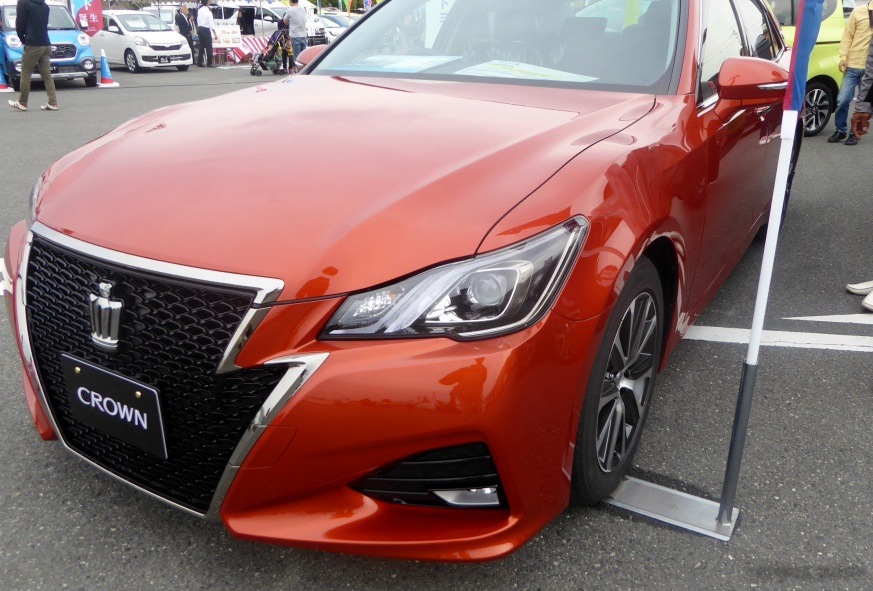
The Toyota Crown XIV Athlete (S210, facelifted in 2016) 2.5 Four Hybrid 4WD e-CVT represents a significant iteration of Toyota’s flagship sedan, primarily aimed at the Japanese domestic market (JDM). Produced from 2016 to 2018, this variant occupied a middle-ground position within the Athlete sub-series, offering a blend of performance, efficiency, and luxury. The S210 generation, and particularly the facelifted models, sought to modernize the Crown’s image while retaining its traditional qualities of comfort and refinement. This specific 2.5-liter hybrid powertrain combined a gasoline engine with an electric motor, delivering all-wheel drive capability through Toyota’s e-CVT transmission.
Technical Specifications
| Brand | Toyota |
| Model | Crown |
| Generation | Crown XIV Athlete (S210, facelift 2016) |
| Type (Engine) | 2.5 Four (178+143 Hp) Hybrid 4WD e-CVT |
| Start of production | 2016 |
| End of production | 2018 |
| Powertrain Architecture | FHEV (Full Hybrid Electric Vehicle) |
| Body type | Sedan |
| Seats | 5 |
| Doors | 4 |
| Fuel Type | Petrol (Gasoline) |
| Weight-to-power ratio | 9.8 kg/Hp, 102.3 Hp/tonne |
| Weight-to-torque ratio | 7.9 kg/Nm, 127 Nm/tonne |
| Battery technology | Nickel-metal hydride (NiMH) |
| Battery location | Behind the back wall of the passenger cabin |
| Electric motor power | 143 Hp |
| Electric motor Torque | 300 Nm (221.27 lb.-ft.) |
| Electric motor model/code | 1KM |
| Electric motor location | Integrated into the transmission |
| Electric motor type | Synchronous |
| Power | 178 Hp @ 6000 rpm |
| Power per litre | 71.4 Hp/l |
| Torque | 221 Nm @ 4200-4800 rpm (163 lb.-ft. @ 4200-4800 rpm) |
| Engine layout | Front, Longitudinal |
| Engine Model/Code | 2AR-FSE |
| Engine displacement | 2493 cm3 (152.13 cu. in.) |
| Number of cylinders | 4 |
| Engine configuration | Inline |
| Cylinder Bore | 90 mm (3.54 in.) |
| Piston Stroke | 98 mm (3.86 in.) |
| Compression ratio | 13:1 |
| Number of valves per cylinder | 4 |
| Fuel injection system | Direct injection and Multi-port manifold injection |
| Engine aspiration | Naturally aspirated engine |
| Valvetrain | DOHC |
| Engine oil capacity | 4.5 l (4.76 US qt | 3.96 UK qt) |
| Coolant | 8.2 l (8.66 US qt | 7.21 UK qt) |
| Kerb Weight | 1740 kg (3836.04 lbs.) |
| Max. weight | 2015 kg (4442.31 lbs.) |
| Max load | 275 kg (606.27 lbs.) |
| Fuel tank capacity | 65 l (17.17 US gal | 14.3 UK gal) |
| Length | 4895 mm (192.72 in.) |
| Width | 1800 mm (70.87 in.) |
| Height | 1465 mm (57.68 in.) |
| Wheelbase | 2850 mm (112.2 in.) |
| Front track | 1545 mm (60.83 in.) |
| Rear (Back) track | 1545 mm (60.83 in.) |
| Ride height (ground clearance) | 145 mm (5.71 in.) |
| Minimum turning circle (turning diameter) | 10.8 m (35.43 ft.) |
| Drive wheel | All wheel drive (4×4) |
| Number of gears and type of gearbox | automatic transmission e-CVT |
| Front suspension | Double wishbone |
| Rear suspension | Independent multi-link suspension |
| Front brakes | Ventilated discs |
| Rear brakes | Disc |
| Assisting systems | ABS (Anti-lock braking system) |
| Steering type | Steering rack and pinion |
| Power steering | Electric Steering |
| Tires size | 215/60 R16; 215/55 R17; 225/45 R18 |
| Wheel rims size | 7J x 16; 7J x 17; 7.5J x 17; 8J x 18 |
INTRODUCTION
The Toyota Crown XIV Athlete (S210) 2.5 Four Hybrid 4WD e-CVT, introduced with the 2016 facelift, represents a sophisticated evolution of Toyota’s long-running Crown lineage. The S210 generation, launched in 2012, aimed to appeal to a younger demographic while upholding the Crown’s reputation for luxury and reliability. The Athlete trim level, in particular, emphasized a sportier aesthetic and slightly more dynamic driving experience. This 2.5-liter hybrid variant was a key offering, balancing fuel efficiency with adequate performance for everyday driving. It was primarily sold within Japan, where the Crown held a prestigious position as a premium sedan.
Powertrain & Engine Architecture
At the heart of this Crown Athlete lies Toyota’s 2AR-FSE 2.5-liter inline-four cylinder gasoline engine. This engine utilizes a combination of direct injection (D-4S) and port injection to optimize combustion efficiency and power delivery. The 2AR-FSE produces 178 horsepower at 6000 rpm and 221 Nm (163 lb-ft) of torque between 4200-4800 rpm. Complementing this is a 143 horsepower electric motor, powered by a nickel-metal hydride (NiMH) battery pack located behind the rear seats. This configuration allows for all-electric driving at low speeds and assists the gasoline engine during acceleration. The powertrain is managed by Toyota’s Hybrid Synergy Drive system, which seamlessly blends the power from both sources. The e-CVT (electronically controlled continuously variable transmission) is integral to this system, providing smooth, stepless gear changes and optimizing fuel efficiency. Unlike traditional CVTs, Toyota’s e-CVT doesn’t rely on belts; instead, it uses a planetary gearset to distribute power between the engine, electric motor, and wheels.
Driving Characteristics
The 2.5 Four Hybrid 4WD e-CVT delivers a comfortable and refined driving experience. The combined output of the engine and electric motor provides adequate acceleration for typical urban and highway driving. While not overtly sporty, the powertrain offers a responsive feel, particularly during moderate acceleration. The e-CVT contributes to a smooth and seamless driving experience, eliminating the stepped gear changes of a conventional automatic transmission. The all-wheel-drive system enhances traction and stability, particularly in inclement weather conditions. Compared to the more powerful 3.5-liter V6 variants of the Crown Athlete, this 2.5-liter hybrid offers a more fuel-efficient and environmentally friendly option, albeit with slightly less overall performance. Manual transmission options were not available for this powertrain.
Equipment & Trim Levels
The Crown Athlete 2.5 Four Hybrid 4WD e-CVT came well-equipped as standard. Features typically included leather upholstery, power-adjustable front seats, automatic climate control, a touchscreen infotainment system with navigation, and a suite of safety features such as ABS, traction control, and multiple airbags. Optional extras could include a premium sound system, adaptive cruise control, lane departure warning, and a sunroof. The Athlete trim also featured unique exterior styling cues, such as a mesh grille, sportier bumpers, and alloy wheels. Interior trim options varied, with choices in woodgrain or metallic accents.
Chassis & Braking
The Crown Athlete utilizes a double wishbone suspension setup at the front and an independent multi-link suspension at the rear, providing a comfortable and controlled ride. The suspension is tuned to prioritize comfort over outright sportiness, but it still offers decent handling characteristics. Braking duties are handled by ventilated discs at the front and solid discs at the rear. The ABS (Anti-lock Braking System) provides enhanced stopping power and stability during emergency braking situations. Steering is rack and pinion with electric power assistance, offering a light and precise feel.
Market Reception & Comparison
The Toyota Crown XIV Athlete 2.5 Four Hybrid 4WD e-CVT was generally well-received in the Japanese market. Critics praised its fuel efficiency, comfortable ride, and refined interior. Compared to the 3.5-liter V6 models, the hybrid variant offered significantly better fuel economy, making it an attractive option for environmentally conscious buyers. However, some reviewers noted that the 2.5-liter engine lacked the outright power and responsiveness of the V6. Reliability was a strong point, as expected from a Toyota product, with few reported issues with the hybrid powertrain.
Legacy
The Toyota Crown XIV Athlete 2.5 Four Hybrid 4WD e-CVT remains a popular choice in the used car market in Japan. Its reputation for reliability, fuel efficiency, and comfortable ride continues to attract buyers. The hybrid powertrain has proven to be durable and long-lasting, with many examples exceeding 200,000 kilometers without major issues. The S210 generation Crown, and this variant in particular, represents a transitional period for the model, bridging the gap between traditional luxury sedans and more modern, technologically advanced vehicles. It stands as a testament to Toyota’s commitment to innovation and quality.