
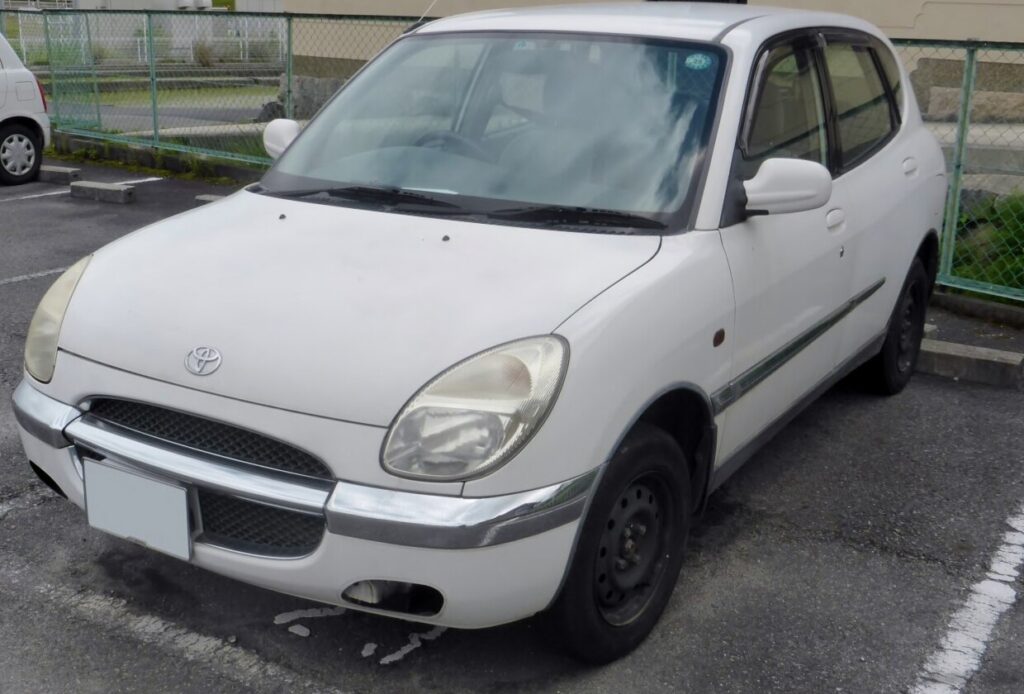
The Toyota Duet, known as the Daihatsu Charade in some markets, is a supermini car produced by Toyota from February 1998 to June 2004. This generation, designated the M10 series, represented a collaborative effort between Toyota and Daihatsu, leveraging Daihatsu’s expertise in small vehicle engineering. The 1.0 i 12V variant, equipped with a 989cc engine producing 60 horsepower, served as the entry-level model in many markets, particularly in Europe and Japan, offering an affordable and economical transportation option. It was positioned as a practical city car, emphasizing fuel efficiency and ease of maneuverability over outright performance.
Technical Specifications
| Brand | Toyota |
| Model | Duet |
| Generation | Duet (M10) |
| Type (Engine) | 1.0 i 12V (60 Hp) |
| Start of production | February, 1998 |
| End of production | June, 2004 |
| Powertrain Architecture | Internal Combustion engine |
| Body type | Hatchback |
| Seats | 5 |
| Doors | 5 |
| Fuel consumption (urban) | 6 l/100 km (39.2 US mpg, 47.1 UK mpg, 16.7 km/l) |
| Fuel Type | Petrol (Gasoline) |
| Weight-to-power ratio | 14.2 kg/Hp, 70.6 Hp/tonne |
| Weight-to-torque ratio | 9 kg/Nm, 110.6 Nm/tonne |
| Power | 60 Hp @ 6000 rpm |
| Power per litre | 60.7 Hp/l |
| Torque | 94 Nm @ 3600 rpm (69.33 lb.-ft. @ 3600 rpm) |
| Engine layout | Front, Longitudinal |
| Engine Model/Code | EJ-VE |
| Engine displacement | 989 cm3 (60.35 cu. in.) |
| Number of cylinders | 3 |
| Engine configuration | Inline |
| Cylinder Bore | 72 mm (2.83 in.) |
| Piston Stroke | 81 mm (3.19 in.) |
| Compression ratio | 10:1 |
| Number of valves per cylinder | 4 |
| Fuel injection system | Multi-port manifold injection |
| Engine aspiration | Naturally aspirated engine |
| Valvetrain | DOHC |
| Engine oil capacity | 2.3 l (2.43 US qt | 2.02 UK qt) |
| Coolant | 3 l (3.17 US qt | 2.64 UK qt) |
| Kerb Weight | 850 kg (1873.93 lbs.) |
| Max. weight | 1125 kg (2480.2 lbs.) |
| Max load | 275 kg (606.27 lbs.) |
| Trunk (boot) space – minimum | 235 l (8.3 cu. ft.) |
| Trunk (boot) space – maximum | 525 l (18.54 cu. ft.) |
| Fuel tank capacity | 40 l (10.57 US gal | 8.8 UK gal) |
| Length | 3660 mm (144.09 in.) |
| Width | 1600 mm (62.99 in.) |
| Height | 1450 mm (57.09 in.) |
| Wheelbase | 2370 mm (93.31 in.) |
| Front track | 1395 mm (54.92 in.) |
| Rear (Back) track | 1365 mm (53.74 in.) |
| Minimum turning circle | 8.6 m (28.22 ft.) |
| Drivetrain Architecture | Front wheel drive |
| Number of gears | 5 gears, manual transmission |
| Front suspension | Spring Strut |
| Rear suspension | Torsion |
| Front brakes | Disc |
| Rear brakes | Drum |
| Assisting systems | ABS (Anti-lock braking system) |
| Steering type | Steering rack and pinion |
| Power steering | Hydraulic Steering |
| Tires size | 165/65 R14 |
Powertrain & Engine Architecture
The heart of the Duet 1.0 i 12V is the Toyota EJ-VE engine, a 989cc inline-three cylinder petrol engine. This engine utilizes a multi-port fuel injection system and a double overhead camshaft (DOHC) valvetrain, contributing to its relatively efficient operation. The 12-valve configuration (four valves per cylinder) aids in improved breathing and power delivery. The engine’s longitudinal mounting within the front-wheel-drive chassis was a common layout for this class of vehicle, optimizing space utilization. The 5-speed manual transmission was the standard offering, providing a balance between fuel economy and drivability. The EJ-VE engine, while not known for its high output, was praised for its reliability and relatively smooth operation for a three-cylinder unit.
Driving Characteristics
The 60 horsepower output of the 1.0 i 12V Duet translates to modest performance. Acceleration is best described as adequate for urban driving, with a 0-60 mph time estimated around 14-16 seconds. The engine’s torque peak of 94 Nm (69.33 lb-ft) at 3600 rpm provides sufficient pulling power for everyday driving situations, but overtaking maneuvers require careful planning. The 5-speed manual transmission allows drivers to keep the engine within its optimal power band. Compared to potential higher-spec variants (which were not widely available in many markets), the 1.0 i 12V prioritizes fuel economy over outright speed. The gear ratios are tuned for efficiency, resulting in a comfortable cruising experience at highway speeds, although engine noise can become noticeable.
Equipment & Trim Levels
The Duet 1.0 i 12V typically came equipped with basic but functional features. Standard equipment generally included power steering, central locking, and front airbags. Interior upholstery was typically cloth, with a simple and durable dashboard layout. Optional extras, depending on the market, could include air conditioning, electric windows, and a radio/cassette player. The trim level was generally considered the base model, focusing on affordability and practicality. It was aimed at buyers seeking a no-frills, economical city car.
Chassis & Braking
The Duet’s chassis features a front strut suspension and a rear torsion beam suspension. This setup provides a reasonable balance between ride comfort and handling. The front brakes are discs, offering adequate stopping power, while the rear brakes are drums, a cost-saving measure common in this segment. Anti-lock Braking System (ABS) was often included as standard equipment, enhancing safety. The relatively lightweight construction of the Duet (850 kg / 1873.93 lbs) contributes to its nimble handling characteristics. Stabilizer bars were typically absent on the base model, further emphasizing comfort over sporty handling.
Market Reception & Comparison
The Toyota Duet 1.0 i 12V was generally well-received as an affordable and economical city car. Critics praised its fuel efficiency and ease of parking, making it ideal for urban environments. However, its limited power output was often noted as a drawback. Compared to other superminis of the time, such as the Fiat Punto or the Renault Clio, the Duet offered a more basic driving experience but often at a lower price point. Its reliability, a hallmark of Toyota vehicles, was also a significant selling point. Fuel economy figures consistently ranked among the best in its class.
Legacy
The Toyota Duet 1.0 i 12V, while not a performance icon, has proven to be a remarkably durable and reliable vehicle. In the used car market, these models are often sought after for their affordability and low running costs. The EJ-VE engine is known for its longevity, and with proper maintenance, can provide many years of service. While parts availability may become more challenging over time, the Duet’s simple mechanical design makes it relatively easy to repair. It remains a popular choice for first-time car buyers or those seeking a dependable and economical mode of transportation.
