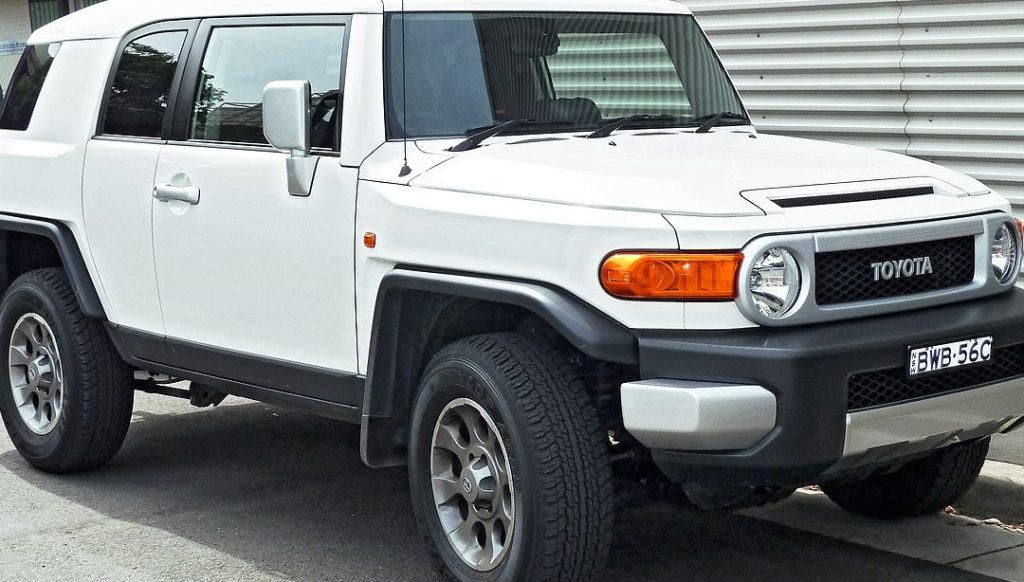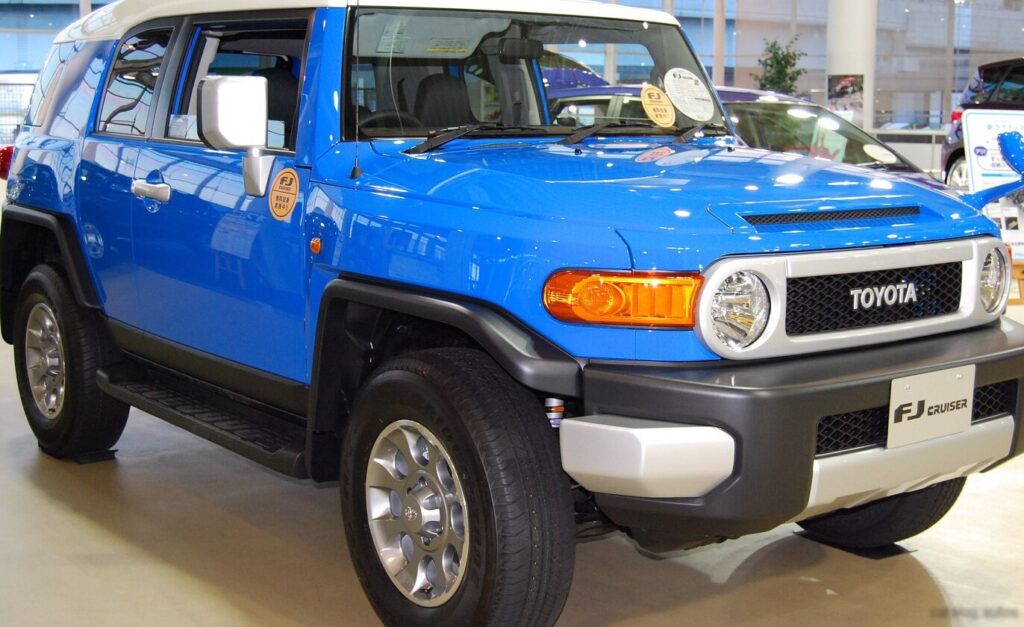
The Toyota FJ Cruiser 4.0 V6 4WD, produced from 2006 to 2009, represents a distinctive and intentionally retro-styled SUV from Toyota. Inspired by the classic Toyota Land Cruiser FJ40, the FJ Cruiser aimed to recapture some of that legendary off-road capability and rugged aesthetic for a new generation. It was primarily marketed in North America, Australia, and parts of the Middle East, offering a unique alternative in a segment dominated by more conventional SUVs. The FJ Cruiser was built on a modified version of the Toyota J150 platform, shared with the Prado, but with a focus on off-road performance and a distinctive, utilitarian design.
Technical Specifications
| Brand | Toyota |
| Model | FJ Cruiser |
| Generation | FJ Cruiser |
| Type (Engine) | 4.0 V6 (239 Hp) 4WD |
| Start of production | 2006 |
| End of production | 2009 |
| Powertrain Architecture | Internal Combustion engine |
| Body type | Off-road vehicle, SUV |
| Seats | 5 |
| Doors | 5 |
| Fuel consumption (economy) – urban | 14.7 l/100 km (16 US mpg, 19.2 UK mpg, 6.8 km/l) |
| Fuel consumption (economy) – extra urban | 12.4 l/100 km (19 US mpg, 22.8 UK mpg, 8.1 km/l) |
| Fuel Type | Petrol (Gasoline) |
| Acceleration 0 – 100 km/h | 7.8 sec |
| Acceleration 0 – 62 mph | 7.8 sec |
| Acceleration 0 – 60 mph | 7.4 sec |
| Emission standard | Euro 4 |
| Power | 239 Hp @ 5200 rpm |
| Power per litre | 59.8 Hp/l |
| Torque | 278 Nm @ 3700 rpm (205.04 lb.-ft. @ 3700 rpm) |
| Engine Model/Code | 1GR-FE |
| Engine displacement | 4000 cm3 (244.09 cu. in.) |
| Number of cylinders | 6 |
| Engine configuration | V-engine |
| Number of valves per cylinder | 4 |
| Fuel injection system | Multi-port manifold injection |
| Engine aspiration | Naturally aspirated engine |
| Valvetrain | DOHC |
| Engine oil capacity | 6.1 l (6.45 US qt | 5.37 UK qt) |
| Coolant | 9.8 l (10.36 US qt | 8.62 UK qt) |
| Fuel tank capacity | 72 l (19.02 US gal | 15.84 UK gal) |
| Length | 4671 mm (183.9 in.) |
| Width | 1894 mm (74.57 in.) |
| Height | 1829 mm (72.01 in.) |
| Wheelbase | 2700 mm (106.3 in.) |
| Front track | 1605 mm (63.19 in.) |
| Rear track | 1615 mm (63.58 in.) |
| Minimum turning circle | 12.8 m (41.99 ft.) |
| Drive wheel | All wheel drive (4×4) |
| Number of gears and type of gearbox | 6 gears, manual transmission |
| Front suspension | Double wishbone |
| Rear suspension | Double wishbone |
| Assisting systems | ABS (Anti-lock braking system) |
| Tires size | 265/70 R17 |
Powertrain & Engine Architecture
The heart of the FJ Cruiser 4.0 V6 is the 1GR-FE engine, a 4.0-liter (244.09 cubic inches) naturally aspirated V6. This engine is a member of Toyota’s GR family, known for its durability and relatively simple design. It features a cast iron block and aluminum cylinder heads, with dual overhead camshafts (DOHC) operating four valves per cylinder. The 1GR-FE utilizes a multi-port fuel injection system, delivering fuel directly into the intake ports. The engine produces 239 horsepower at 5200 rpm and 278 Nm (205.04 lb.-ft.) of torque at 3700 rpm. The six-speed manual transmission was the standard offering, providing a direct connection to the engine’s power. The transmission’s gear ratios were tuned to balance on-road drivability with off-road crawling capability.
Driving Characteristics
The FJ Cruiser 4.0 V6 with the manual transmission offered a surprisingly capable and engaging driving experience. While not a sports car, the engine provided ample power for both highway cruising and tackling challenging off-road terrain. The 0-60 mph time of around 7.4 seconds was respectable for an SUV of its size and intended purpose. The manual transmission allowed for precise control, particularly useful when navigating difficult trails. The gear ratios were well-chosen, providing sufficient torque in lower gears for rock crawling and steep inclines. Compared to a hypothetical automatic version (which wasn’t widely available in the US market), the manual offered a more direct and connected feel, enhancing the off-road experience. The relatively high center of gravity, inherent to the FJ Cruiser’s body-on-frame construction, did result in some body roll during cornering.
Equipment & Trim Levels
The FJ Cruiser was relatively sparsely equipped, reflecting its utilitarian focus. Standard features included air conditioning, power windows and locks, and a basic audio system. The interior was designed to be durable and easy to clean, with water-resistant seat fabrics and rubber flooring. Optional extras included a rear parking sonar, a premium audio system with a subwoofer, and various off-road accessories such as a roof rack and rock rails. The interior color scheme was typically a two-tone design, with contrasting colors for the dashboard and seats. The FJ Cruiser didn’t offer a wide range of trim levels; it was largely sold as a single, well-equipped model with a few optional packages.
Chassis & Braking
The FJ Cruiser utilized a traditional body-on-frame construction, providing a robust and durable platform for off-road adventures. It featured a double wishbone suspension at both the front and rear, designed to absorb bumps and maintain wheel control on uneven surfaces. The braking system consisted of ventilated disc brakes at the front and drum brakes at the rear. Anti-lock brakes (ABS) were standard, enhancing safety during emergency braking situations. The tires, typically 265/70 R17 all-terrain tires, provided good grip on a variety of surfaces. The FJ Cruiser’s relatively short wheelbase and wide track contributed to its stability and maneuverability.
Market Reception & Comparison
The FJ Cruiser received generally positive reviews from automotive critics, who praised its unique styling, off-road capability, and rugged construction. However, some criticized its on-road ride quality, limited rear visibility, and relatively small cargo area. Compared to other SUVs in its class, such as the Jeep Wrangler, the FJ Cruiser offered a more comfortable and refined driving experience, but lacked the Wrangler’s open-air freedom. Fuel economy was a notable weakness, with the 4.0-liter V6 consuming a significant amount of gasoline. Reliability was generally good, consistent with Toyota’s reputation for building durable vehicles.
Legacy
The Toyota FJ Cruiser, despite its relatively short production run, has gained a devoted following among off-road enthusiasts and collectors. Its distinctive styling and capable performance have made it a popular choice for customization and overlanding. The 1GR-FE engine is known for its longevity and reliability, and with proper maintenance, can provide many years of service. On the used car market, FJ Cruisers in good condition command relatively high prices, reflecting their desirability and limited availability. The FJ Cruiser stands as a unique and memorable vehicle in Toyota’s history, representing a bold departure from conventional SUV design and a return to the brand’s roots in rugged off-road vehicles.