
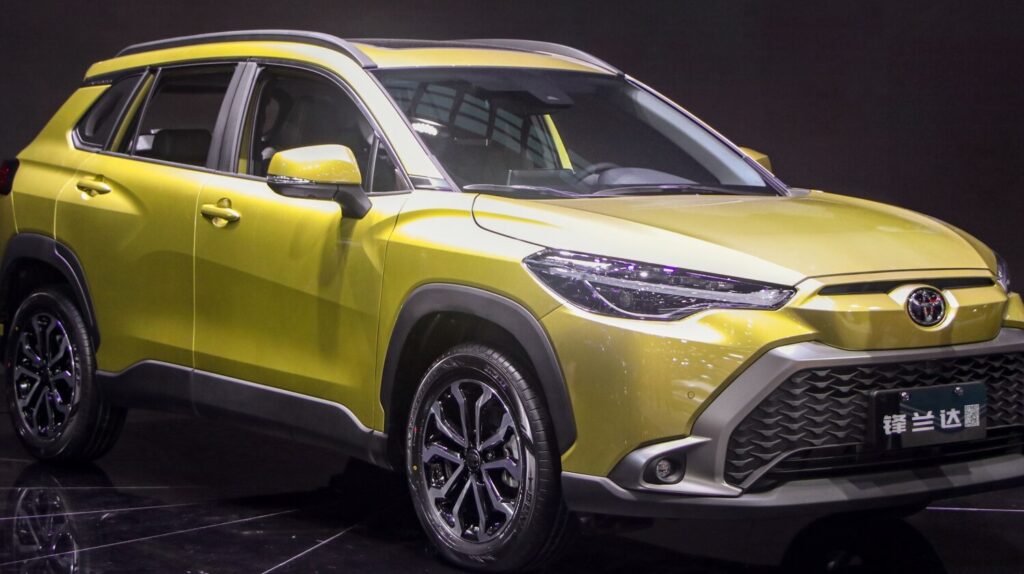
The Toyota Frontlander 2.0 (171 Hp) CVT, introduced in 2022, represents Toyota’s entry into the compact SUV segment, primarily targeted towards the Chinese automotive market. Positioned as a practical and fuel-efficient option, the Frontlander is built upon the GA-C platform, shared with other Toyota and Lexus models. This variant, equipped with the 2.0-liter inline-four engine and a continuously variable transmission (CVT), aims to balance performance with affordability, offering a comfortable and accessible driving experience for families and urban commuters. It serves as a key model in Toyota’s strategy to expand its SUV offerings and cater to the growing demand for crossovers in China.
Technical Specifications
| Brand | Toyota |
| Model | Frontlander |
| Type (Engine) | 2.0 (171 Hp) CVT |
| Start of production | 2022 |
| Powertrain Architecture | Internal Combustion engine |
| Body type | SUV |
| Seats | 5 |
| Doors | 5 |
| Fuel consumption (combined) | 5.8 l/100 km (40.6 US mpg, 48.7 UK mpg, 17.2 km/l) |
| Fuel Type | Petrol (Gasoline) |
| Maximum speed | 180 km/h (111.85 mph) |
| Emission standard | China VI |
| Weight-to-power ratio | 8.2 kg/Hp, 122.6 Hp/tonne |
| Weight-to-torque ratio | 6.8 kg/Nm, 147 Nm/tonne |
| Power | 171 Hp @ 6600 rpm |
| Power per litre | 86.1 Hp/l |
| Torque | 205 Nm @ 4600-5000 rpm (151.2 lb.-ft. @ 4600-5000 rpm) |
| Engine layout | Front, Transverse |
| Engine Model/Code | M20C |
| Engine displacement | 1987 cm3 (121.25 cu. in.) |
| Number of cylinders | 4 |
| Engine configuration | Inline |
| Compression ratio | 13:1 |
| Number of valves per cylinder | 4 |
| Fuel injection system | Multi-port manifold injection |
| Engine aspiration | Naturally aspirated engine |
| Engine oil capacity | 4.6 l (4.86 US qt | 4.05 UK qt) |
| Coolant capacity | 6.3 l (6.66 US qt | 5.54 UK qt) |
| Kerb Weight | 1395-1450 kg (3075.45 – 3196.7 lbs.) |
| Trunk (boot) space – minimum | 438 l (15.47 cu. ft.) |
| Fuel tank capacity | 47 l (12.42 US gal | 10.34 UK gal) |
| Length | 4485 mm (176.57 in.) |
| Width | 1825 mm (71.85 in.) |
| Height | 1620 mm (63.78 in.) |
| Wheelbase | 2640 mm (103.94 in.) |
| Drivetrain Architecture | Front wheel drive, Internal Combustion engine (ICE) |
| Number of gears and type of gearbox | automatic transmission CVT |
| Front suspension | McPherson |
| Rear suspension | Torsion |
| Front brakes | Ventilated discs |
| Rear brakes | Disc |
| Steering type | Steering rack and pinion |
| Power steering | Electric Steering |
| Tires size | 215/60 R17; 225/50 R18 |
| Wheel rims size | 17; 18 |
Powertrain & Engine Architecture
The Toyota Frontlander 2.0 CVT is powered by the M20C engine, a 1.987-liter (121.25 cubic inches) inline-four cylinder gasoline engine. This engine utilizes a naturally aspirated configuration and multi-port fuel injection, delivering a balance between fuel efficiency and adequate power. The engine boasts a compression ratio of 13:1, contributing to its thermal efficiency. The engine is paired with a continuously variable transmission (CVT), designed to provide smooth and seamless gear changes, optimizing fuel economy and drivability. The CVT lacks fixed gear ratios, instead utilizing a belt-and-pulley system to provide an infinite number of ratios within its operating range. This allows the engine to operate at its most efficient RPM for any given speed and load.
Driving Characteristics
The 171 horsepower and 151.2 lb.-ft. of torque produced by the 2.0-liter engine and CVT combination provide adequate performance for everyday driving. Acceleration is linear and predictable, though not particularly sporty. The CVT prioritizes fuel efficiency over rapid acceleration, resulting in a slightly less engaging driving experience compared to models equipped with traditional automatic transmissions or manual gearboxes. The CVT’s programming is tuned for smooth transitions and minimizes the “rubber band” effect often associated with these transmissions. In real-world conditions, the Frontlander 2.0 CVT offers comfortable cruising and sufficient power for overtaking maneuvers, making it well-suited for urban and highway driving.
Equipment & Trim Levels
The Frontlander 2.0 CVT typically comes standard with a range of features designed to enhance comfort and convenience. These include air conditioning, power windows and locks, a touchscreen infotainment system with smartphone integration (Apple CarPlay and Android Auto), and a rearview camera. Higher trim levels may add features such as leather upholstery, a panoramic sunroof, automatic climate control, and advanced driver-assistance systems (ADAS) like adaptive cruise control and lane departure warning. Interior upholstery is generally cloth on base models, with leather options available on higher trims. The dashboard layout is modern and functional, with a focus on ease of use.
Chassis & Braking
The Frontlander 2.0 CVT utilizes a McPherson strut front suspension and a torsion beam rear suspension. This setup provides a comfortable ride quality and predictable handling characteristics. The front brakes are ventilated discs, offering good stopping power, while the rear brakes are solid discs. The vehicle is equipped with an Anti-lock Braking System (ABS) as standard, enhancing safety during emergency braking situations. Electric power steering provides light and responsive steering feel, making it easy to maneuver in tight spaces. Tire sizes vary depending on the trim level, with 215/60 R17 and 225/50 R18 options commonly available.
Market Reception & Comparison
The Toyota Frontlander 2.0 CVT has been generally well-received in the Chinese market, praised for its fuel efficiency, comfortable ride, and Toyota’s reputation for reliability. Critics have noted that its performance is adequate but not exceptional, and that the CVT transmission may not appeal to drivers seeking a more engaging driving experience. Compared to other trims in the Frontlander lineup, the 2.0 CVT offers a good balance between price and features. It sits in the mid-range of the lineup, offering more power and refinement than the base models but at a lower price point than the higher-end trims.
Legacy
The Toyota Frontlander 2.0 CVT, while relatively new to the market, is expected to benefit from Toyota’s long-standing reputation for reliability and durability. The M20C engine is a proven design, and the CVT transmission, while requiring proper maintenance, is generally considered reliable. As the vehicle ages, its long-term reliability will become more apparent, but early indications suggest that it will hold its value well in the used car market. The Frontlander’s success will likely depend on Toyota’s continued commitment to improving its technology and addressing any potential issues that may arise over time.
