
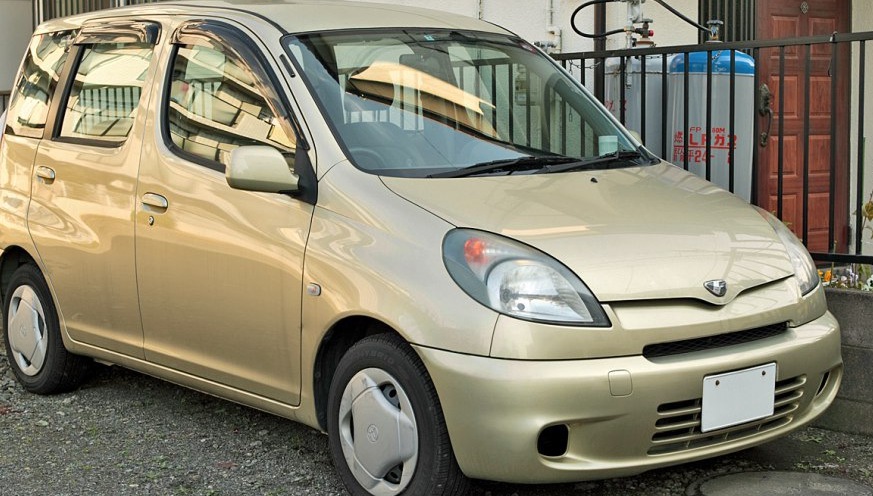
The Toyota Funcargo 1.3i 16V, produced between 1997 and 2005, was a compact, five-door minivan primarily aimed at the Japanese domestic market (JDM). Positioned as a practical and versatile vehicle, the Funcargo offered a unique blend of hatchback and minivan characteristics. This particular 1.3-liter, 86 horsepower variant represented an entry-level offering within the Funcargo lineup, prioritizing fuel efficiency and affordability over outright performance. It was part of the first generation Funcargo (NCP20/21 series), known for its distinctive styling and spacious interior for its size. The Funcargo never received a significant US market release, remaining largely a JDM-specific model, though examples have been imported through grey market channels.
Technical Specifications
| Brand | Toyota |
| Model | Funcargo |
| Generation | Funcargo |
| Type (Engine) | 1.3i 16V (86 Hp) |
| Start of production | 1997 |
| End of production | 2005 |
| Powertrain Architecture | Internal Combustion engine |
| Body type | Minivan |
| Seats | 5 |
| Doors | 5 |
| Fuel consumption (urban) | 8.2 l/100 km (28.7 US mpg) |
| Fuel consumption (extra urban) | 5.5 l/100 km (42.8 US mpg) |
| Fuel consumption (combined) | 6.5 l/100 km (36.2 US mpg) |
| Fuel Type | Petrol (Gasoline) |
| Acceleration 0 – 100 km/h | 11.9 sec |
| Acceleration 0 – 62 mph | 11.9 sec |
| Acceleration 0 – 60 mph | 11.3 sec |
| Maximum speed | 165 km/h (102.53 mph) |
| Weight-to-power ratio | 12.3 kg/Hp |
| Weight-to-torque ratio | 8.5 kg/Nm |
| Power | 86 Hp @ 6000 rpm |
| Torque | 124 Nm @ 4400 rpm (91.46 lb.-ft. @ 4400 rpm) |
| Engine layout | Front, Longitudinal |
| Engine Model/Code | 2NZ-FE |
| Engine displacement | 1299 cm3 (79.27 cu. in.) |
| Number of cylinders | 4 |
| Engine configuration | Inline |
| Cylinder Bore | 75 mm (2.95 in.) |
| Piston Stroke | 73.5 mm (2.89 in.) |
| Compression ratio | 10.5:1 |
| Number of valves per cylinder | 4 |
| Fuel injection system | Multi-port manifold injection |
| Engine aspiration | Naturally aspirated |
| Engine oil capacity | 3.7 l (3.91 US qt | 3.26 UK qt) |
| Coolant capacity | 4.4 l (4.65 US qt | 3.87 UK qt) |
| Kerb Weight | 1055 kg (2325.88 lbs.) |
| Max. weight | 1500 kg (3306.93 lbs.) |
| Max load | 445 kg (981.06 lbs.) |
| Trunk (boot) space – minimum | 390 l (13.77 cu. ft.) |
| Trunk (boot) space – maximum | 1930 l (68.16 cu. ft.) |
| Fuel tank capacity | 45 l (11.89 US gal | 9.9 UK gal) |
| Length | 3890 mm (153.15 in.) |
| Width | 1690 mm (66.54 in.) |
| Height | 1680 mm (66.14 in.) |
| Wheelbase | 2500 mm (98.43 in.) |
| Front track | 1440 mm (56.69 in.) |
| Rear track | 1420 mm (55.91 in.) |
| Drivetrain | Front wheel drive |
| Number of gears | 5 |
| Gearbox type | Manual transmission |
| Front suspension | Spring Strut |
| Rear suspension | Coil spring |
| Front brakes | Ventilated discs |
| Rear brakes | Drum |
| Assisting systems | ABS (Anti-lock braking system) |
| Steering type | Steering rack and pinion |
| Power steering | Hydraulic |
| Tires size | 175/65 R14 T |
| Wheel rims size | 14 |
Powertrain & Engine Architecture
The heart of the Funcargo 1.3i 16V is the 2NZ-FE engine, a 1.3-liter inline-four cylinder gasoline engine. This engine is part of Toyota’s NZ engine family, known for its compact size, lightweight construction, and relatively simple design. The “16V” designation indicates the engine features four valves per cylinder, enhancing breathing and contributing to its modest power output. The 2NZ-FE utilizes a multi-port fuel injection system, delivering fuel directly into the intake ports, and a double overhead camshaft (DOHC) valvetrain for improved valve control. The engine’s longitudinal mounting within the front-wheel-drive chassis was a common layout for Toyota vehicles of this era. Paired with this engine was a five-speed manual transmission, offering a balance between fuel economy and driver control. An automatic transmission was also available, but the manual was favored by those seeking slightly better performance and responsiveness.
Driving Characteristics
The 1.3i 16V Funcargo, with its 86 horsepower and 124 Nm of torque, wasn’t designed for blistering acceleration. Zero to 60 mph took approximately 11.3 seconds, and top speed was around 102.53 mph. However, its strength lay in its usability and efficiency. The five-speed manual transmission allowed drivers to keep the engine in its optimal power band, making it feel more responsive than its specifications might suggest. Compared to higher-spec Funcargo models equipped with larger engines (like the 1.5-liter), the 1.3i felt noticeably less powerful, particularly when fully loaded or tackling inclines. The gear ratios were tuned for economy, meaning the engine could feel strained at higher speeds. The steering was light and precise, making it easy to maneuver in urban environments, and the suspension provided a comfortable, if somewhat unremarkable, ride.
Equipment & Trim Levels
The 1.3i 16V Funcargo typically came with a fairly basic level of equipment, reflecting its position as the entry-level model. Standard features generally included power steering, central locking, and an AM/FM radio. Interior upholstery was typically cloth, and the dashboard featured a simple, functional design. Optional extras included air conditioning, power windows, and upgraded audio systems. Higher trim levels offered features like alloy wheels, color-coded bumpers, and more luxurious interior appointments. The Funcargo’s interior was notable for its clever use of space, with a versatile seating arrangement and a large cargo area when the rear seats were folded down.
Chassis & Braking
The Funcargo’s chassis was a typical monocoque construction, providing a good balance of rigidity and weight. Front suspension utilized a MacPherson strut setup, while the rear employed a coil spring arrangement. Braking consisted of ventilated discs on the front wheels and drum brakes on the rear. Anti-lock Braking System (ABS) was often included as standard equipment, enhancing safety. The suspension was tuned for comfort rather than sporty handling, prioritizing a smooth ride over sharp cornering. The relatively lightweight nature of the 1.3i model helped to compensate for the modest braking performance.
Market Reception & Comparison
The Toyota Funcargo 1.3i 16V was well-received in Japan as a practical and economical family vehicle. Critics praised its spacious interior, fuel efficiency, and ease of use. However, some noted its lack of outright performance and relatively basic equipment levels. Compared to other compact minivans available in Japan at the time, such as the Honda Mobilio and the Nissan Serena, the Funcargo offered a unique blend of hatchback-like handling and minivan versatility. The 1.5-liter Funcargo offered a noticeable performance upgrade, but at a higher price point. The 1.3i’s fuel economy was generally superior to that of the larger-engined models.
Legacy
The Toyota Funcargo, while not widely known outside of Japan, has developed a cult following among enthusiasts of JDM vehicles. The 2NZ-FE engine is known for its reliability and durability, and with proper maintenance, can provide many years of service. Used examples of the 1.3i 16V are relatively affordable and readily available in Japan, and are increasingly being imported to other countries. While not a performance icon, the Funcargo 1.3i 16V remains a testament to Toyota’s commitment to building practical, reliable, and fuel-efficient vehicles.
