
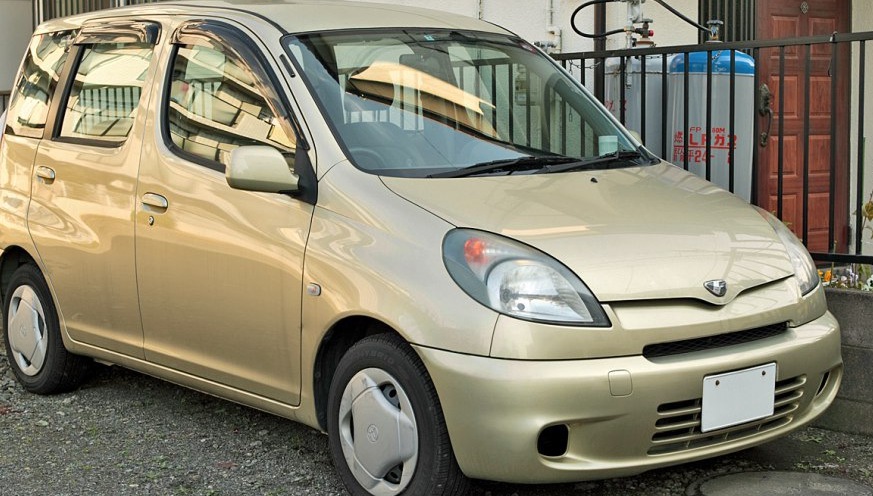
The Toyota Funcargo 1.3i 16V Automatic, produced between 1997 and 2005, was a compact, five-door minivan primarily aimed at the Japanese domestic market (JDM). Positioned as an affordable and practical family vehicle, the Funcargo offered a unique blend of hatchback and minivan characteristics. This particular variant, equipped with the 2NZ-FE 1.3-liter engine and a four-speed automatic transmission, represented an entry-level option within the Funcargo lineup, prioritizing fuel efficiency and ease of use over outright performance. It was part of the first generation Funcargo (NCP20/21 series), sharing its platform with other Toyota models like the Vitz/Yaris and Platz.
Technical Specifications
| Brand | Toyota |
| Model | Funcargo |
| Generation | Funcargo |
| Type (Engine) | 1.3i 16V (86 Hp) Automatic |
| Start of production | 1997 |
| End of production | 2005 |
| Powertrain Architecture | Internal Combustion engine |
| Body type | Minivan |
| Seats | 5 |
| Doors | 5 |
| Fuel consumption (urban) | 8.9 l/100 km (26.4 US mpg, 31.7 UK mpg, 11.2 km/l) |
| Fuel consumption (extra urban) | 5.8 l/100 km (40.6 US mpg, 48.7 UK mpg, 17.2 km/l) |
| Fuel consumption (combined) | 6.5 l/100 km (36.2 US mpg, 43.5 UK mpg, 15.4 km/l) |
| Fuel Type | Petrol (Gasoline) |
| Acceleration 0 – 100 km/h | 13.9 sec |
| Acceleration 0 – 62 mph | 13.9 sec |
| Acceleration 0 – 60 mph | 13.2 sec |
| Maximum speed | 155 km/h (96.31 mph) |
| Weight-to-power ratio | 12.3 kg/Hp, 81.5 Hp/tonne |
| Weight-to-torque ratio | 8.5 kg/Nm, 117.5 Nm/tonne |
| Power | 86 Hp @ 6000 rpm |
| Power per litre | 66.2 Hp/l |
| Torque | 124 Nm @ 4400 rpm (91.46 lb.-ft. @ 4400 rpm) |
| Engine layout | Front, Longitudinal |
| Engine Model/Code | 2NZ-FE |
| Engine displacement | 1299 cm3 (79.27 cu. in.) |
| Number of cylinders | 4 |
| Engine configuration | Inline |
| Cylinder Bore | 75 mm (2.95 in.) |
| Piston Stroke | 73.5 mm (2.89 in.) |
| Compression ratio | 10.5:1 |
| Number of valves per cylinder | 4 |
| Fuel injection system | Multi-port manifold injection |
| Engine aspiration | Naturally aspirated engine |
| Valvetrain | DOHC |
| Engine oil capacity | 3.7 l (3.91 US qt | 3.26 UK qt) |
| Coolant capacity | 4.4 l (4.65 US qt | 3.87 UK qt) |
| Kerb Weight | 1055 kg (2325.88 lbs.) |
| Max. weight | 1500 kg (3306.93 lbs.) |
| Max load | 445 kg (981.06 lbs.) |
| Trunk (boot) space – minimum | 390 l (13.77 cu. ft.) |
| Trunk (boot) space – maximum | 1930 l (68.16 cu. ft.) |
| Fuel tank capacity | 45 l (11.89 US gal | 9.9 UK gal) |
| Length | 3890 mm (153.15 in.) |
| Width | 1690 mm (66.54 in.) |
| Height | 1680 mm (66.14 in.) |
| Wheelbase | 2500 mm (98.43 in.) |
| Front track | 1440 mm (56.69 in.) |
| Rear track | 1420 mm (55.91 in.) |
| Drivetrain Architecture | Front wheel drive |
| Number of gears | 4 |
| Gearbox type | Automatic transmission |
| Front suspension | Spring Strut |
| Rear suspension | Coil spring |
| Front brakes | Ventilated discs |
| Rear brakes | Drum |
| Assisting systems | ABS (Anti-lock braking system) |
| Steering type | Steering rack and pinion |
| Power steering | Hydraulic Steering |
| Tires size | 175/65 R14 T |
| Wheel rims size | 14 |
Powertrain & Engine Architecture
The heart of the Funcargo 1.3i Automatic is the 2NZ-FE engine, a 1.3-liter inline-four cylinder gasoline engine. This engine is part of Toyota’s NZ engine family, known for its compact size, lightweight construction, and relatively good fuel economy. The 2NZ-FE utilizes a multi-port fuel injection system and a double overhead camshaft (DOHC) valvetrain with four valves per cylinder, contributing to its modest power output. The engine’s 10.5:1 compression ratio was a standard figure for naturally aspirated engines of the era. Paired with this engine is a four-speed automatic transmission, chosen for its convenience and ease of use, particularly appealing to the target demographic of families and less experienced drivers. This transmission wasn’t known for sporty shifts, but rather smooth and predictable operation.
Driving Characteristics
The 1.3i Automatic Funcargo wasn’t designed for spirited driving. With 86 horsepower and 124 Nm (91.46 lb-ft) of torque, acceleration was leisurely, taking approximately 13.9 seconds to reach 62 mph. The four-speed automatic transmission, while providing smooth shifts, had relatively wide gear ratios, prioritizing fuel economy over quick acceleration. In real-world conditions, the Funcargo felt adequate for city driving and highway cruising, but struggled with overtaking maneuvers or climbing steep hills. Compared to the more powerful 1.5-liter variants, or even manual transmission versions of the 1.3, this model offered a noticeably slower driving experience. However, the trade-off was a more relaxed and fuel-efficient ride.
Equipment & Trim Levels
The 1.3i Automatic trim level typically included basic amenities such as power steering, air conditioning, and a basic audio system. Interior upholstery was usually cloth, with a functional, rather than luxurious, design. Optional extras included power windows, central locking, and upgraded audio systems. The dashboard layout was simple and straightforward, prioritizing usability. The Funcargo’s defining feature was its spacious interior and versatile seating arrangement, with rear seats that could be folded flat or even removed entirely to maximize cargo space.
Chassis & Braking
The Funcargo utilized a front-wheel-drive layout with a relatively simple suspension setup. The front suspension consisted of MacPherson strut springs, while the rear employed a coil spring setup. Braking was handled by ventilated discs on the front wheels and drum brakes on the rear. ABS (Anti-lock Braking System) was often included as standard equipment, enhancing safety. The suspension was tuned for comfort rather than sporty handling, providing a smooth ride over uneven surfaces. Stabilizer bars were present, but relatively thin, contributing to a noticeable degree of body roll during cornering.
Market Reception & Comparison
The Toyota Funcargo 1.3i Automatic was generally well-received in the Japanese market for its practicality, fuel efficiency, and affordability. Critics praised its spacious interior and versatile seating arrangement, making it a popular choice for small families. However, the 1.3-liter engine and automatic transmission were often criticized for their lack of performance. Compared to the 1.5-liter variants, the 1.3i offered significantly less power and a slower driving experience. The 1.5-liter models, while more expensive, provided a more enjoyable driving experience and were better suited for highway driving. Fuel economy was a strong point for the 1.3i, consistently achieving around 36.2 US mpg in combined driving conditions.
Legacy
The Toyota Funcargo, particularly the 1.3i Automatic variant, has developed a cult following among enthusiasts of JDM cars. While not known for its performance, the Funcargo is appreciated for its unique styling, practicality, and reliability. The 2NZ-FE engine is generally considered to be a durable and long-lasting unit, with many examples still running reliably today. However, like any older vehicle, maintenance is key to ensuring its continued longevity. Parts availability can be a challenge outside of Japan, but a growing aftermarket support network is emerging. In the used car market, the Funcargo 1.3i Automatic remains an affordable and practical option for those seeking a unique and reliable compact minivan.
