
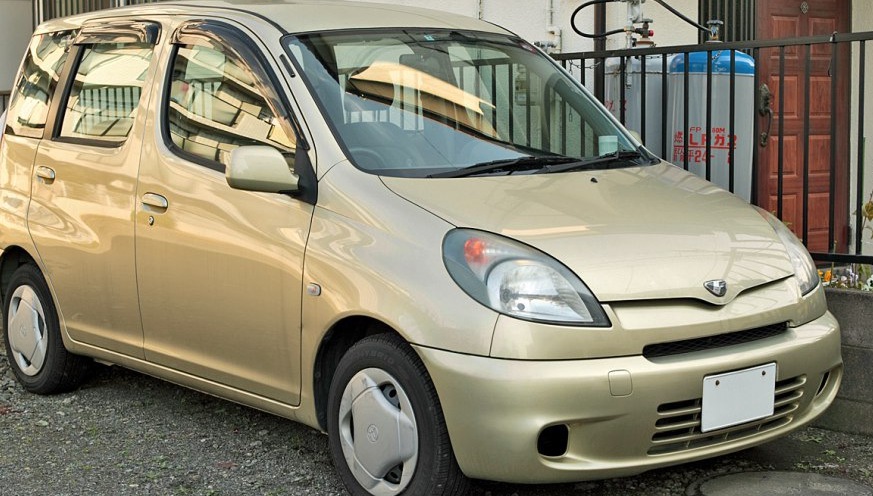
The Toyota Funcargo 1.5 i 16V, produced between 1997 and 2005, was a unique and practical compact MPV (Multi-Purpose Vehicle) primarily aimed at the Japanese domestic market (JDM). Distinct for its asymmetrical rear door arrangement – a single large door on one side and a smaller, hinged door on the other – the Funcargo offered a blend of spaciousness and maneuverability ideal for urban environments. This particular 1.5-liter, 106 horsepower variant occupied a middle ground in the Funcargo lineup, offering a balance between affordability and acceptable performance. It served as a popular choice for small families and individuals seeking a versatile vehicle.
Technical Specifications
| Brand | Toyota |
| Model | Funcargo |
| Generation | Funcargo |
| Type (Engine) | 1.5 i 16V (106 Hp) |
| Start of production | 1997 |
| End of production | 2005 |
| Powertrain Architecture | Internal Combustion engine |
| Body type | Minivan |
| Seats | 5 |
| Doors | 5 |
| Fuel consumption (urban) | 8.2 l/100 km (28.7 US mpg) |
| Fuel consumption (extra urban) | 5.7 l/100 km (41.3 US mpg) |
| Fuel consumption (combined) | 6.7 l/100 km (35.1 US mpg) |
| Fuel Type | Petrol (Gasoline) |
| Acceleration 0 – 100 km/h | 11.2 sec |
| Acceleration 0 – 62 mph | 11.2 sec |
| Acceleration 0 – 60 mph | 10.6 sec |
| Maximum speed | 175 km/h (108.74 mph) |
| Weight-to-power ratio | 10.1 kg/Hp |
| Weight-to-torque ratio | 7.4 kg/Nm |
| Power | 106 Hp @ 6000 rpm |
| Torque | 145 Nm @ 4200 rpm (106.95 lb.-ft. @ 4200 rpm) |
| Engine layout | Front, Transverse |
| Engine Model/Code | 1NZ-FE |
| Engine displacement | 1497 cm3 (91.35 cu. in.) |
| Number of cylinders | 4 |
| Engine configuration | Inline |
| Cylinder Bore | 75 mm (2.95 in.) |
| Piston Stroke | 84.7 mm (3.33 in.) |
| Compression ratio | 10.5:1 |
| Number of valves per cylinder | 4 |
| Fuel injection system | Multi-port manifold injection |
| Engine aspiration | Naturally aspirated engine |
| Valvetrain | DOHC |
| Engine oil capacity | 3.7 l (3.91 US qt | 3.26 UK qt) |
| Coolant capacity | 4.3 l (4.54 US qt | 3.78 UK qt) |
| Kerb Weight | 1075 kg (2369.97 lbs.) |
| Max. weight | 1530 kg (3373.07 lbs.) |
| Max load | 455 kg (1003.1 lbs.) |
| Trunk (boot) space – minimum | 390 l (13.77 cu. ft.) |
| Trunk (boot) space – maximum | 1930 l (68.16 cu. ft.) |
| Fuel tank capacity | 45 l (11.89 US gal | 9.9 UK gal) |
| Length | 3860 mm (151.97 in.) |
| Width | 1660 mm (65.35 in.) |
| Height | 1680 mm (66.14 in.) |
| Wheelbase | 2500 mm (98.43 in.) |
| Front track | 1440 mm (56.69 in.) |
| Rear track | 1420 mm (55.91 in.) |
| Drivetrain Architecture | Front wheel drive |
| Number of gears | 5 |
| Gearbox type | Manual transmission |
| Front suspension | Spring Strut |
| Rear suspension | Coil spring |
| Front brakes | Ventilated discs |
| Rear brakes | Drum |
| Assisting systems | ABS (Anti-lock braking system) |
| Steering type | Steering rack and pinion |
| Power steering | Hydraulic Steering |
| Tires size | 175/65 R14T |
Powertrain & Engine Architecture
The heart of the Funcargo 1.5 i 16V is the 1NZ-FE engine, a 1.5-liter inline-four cylinder gasoline engine. This engine is a member of Toyota’s NZ engine family, known for its reliability and fuel efficiency. The 1NZ-FE utilizes a multi-port fuel injection system, delivering fuel directly to each intake port for optimized combustion. It features a double overhead camshaft (DOHC) valvetrain, operating 16 valves (four per cylinder) to enhance volumetric efficiency and power output. The engine’s 106 horsepower at 6000 rpm and 145 Nm (107 lb-ft) of torque at 4200 rpm were considered adequate for the vehicle’s weight and intended use. The engine is transversely mounted, driving the front wheels. The standard transmission for this variant was a 5-speed manual, although a 4-speed automatic transmission was also available, impacting performance slightly.
Driving Characteristics
The Funcargo 1.5 i 16V with the 5-speed manual transmission offered a reasonably engaging driving experience. Acceleration to 60 mph took around 10.6 seconds, and top speed was approximately 109 mph. While not particularly sporty, the engine provided sufficient power for everyday driving and highway merging. The manual gearbox allowed for precise control, and the relatively light weight of the vehicle contributed to its nimble handling. The automatic transmission version, while offering convenience, resulted in slightly slower acceleration and a less direct feel. Gear ratios were tuned for fuel economy and drivability rather than outright performance. The suspension, consisting of struts up front and a coil spring setup in the rear, provided a comfortable ride, absorbing bumps and imperfections in the road effectively.
Equipment & Trim Levels
The 1.5 i 16V trim level typically included basic amenities such as power steering, air conditioning, and a basic audio system. Interior upholstery was generally cloth, with a functional, if somewhat spartan, dashboard layout. Optional extras included power windows, power door locks, and upgraded audio systems. The asymmetrical rear door configuration was standard, providing easy access to the cargo area. Safety features were relatively basic for the era, typically including ABS (Anti-lock Braking System) as standard equipment.
Chassis & Braking
The Funcargo’s chassis was a monocoque construction, providing a good balance of rigidity and weight. The front suspension utilized MacPherson strut springs, while the rear employed a torsion beam setup. Braking consisted of ventilated discs on the front wheels and drum brakes on the rear. The ABS system helped to maintain steering control during hard braking. The steering was rack and pinion, providing responsive and accurate handling. The vehicle rode on 14-inch tires, offering a comfortable ride and adequate grip.
Market Reception & Comparison
The Toyota Funcargo 1.5 i 16V was well-received in Japan for its practicality, fuel efficiency, and unique design. Critics praised its spacious interior and versatile cargo area. Compared to other compact MPVs of the time, such as the Honda Mobilio, the Funcargo offered a more distinctive styling and a slightly more affordable price point. The 1.5-liter engine provided adequate performance for most drivers, but some reviewers noted that it could feel strained when fully loaded. The automatic transmission version was often criticized for its sluggishness. Fuel economy was a strong point, with combined figures around 35 mpg.
Legacy
The Toyota Funcargo, while not widely exported outside of Japan, has gained a cult following among enthusiasts for its quirky design and reliable Toyota engineering. The 1NZ-FE engine is known for its durability and longevity, and well-maintained examples of the Funcargo 1.5 i 16V continue to be seen on the road today. In the used car market, these vehicles are often sought after for their affordability and practicality. The Funcargo represents a unique chapter in Toyota’s history, showcasing the company’s willingness to experiment with innovative designs and cater to the specific needs of the Japanese market.
