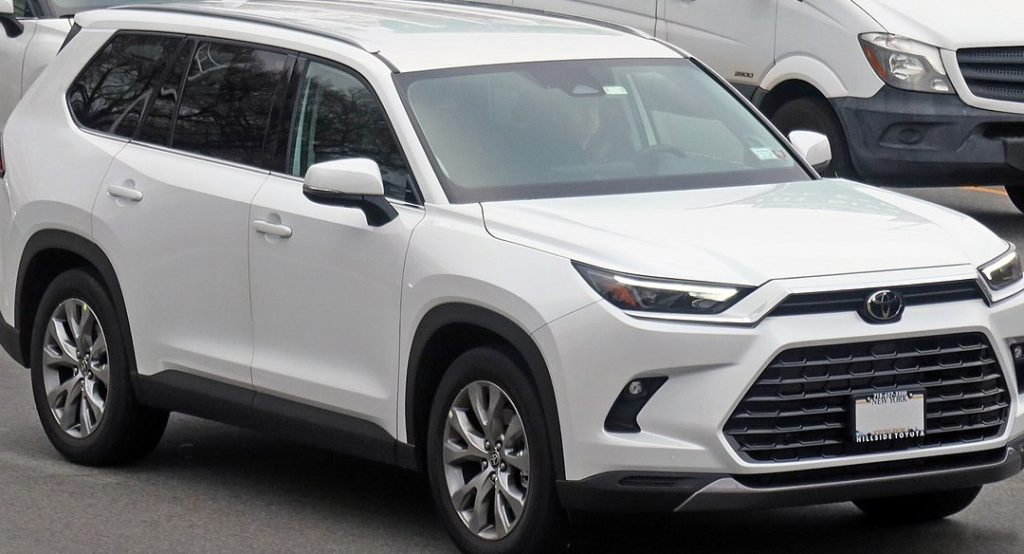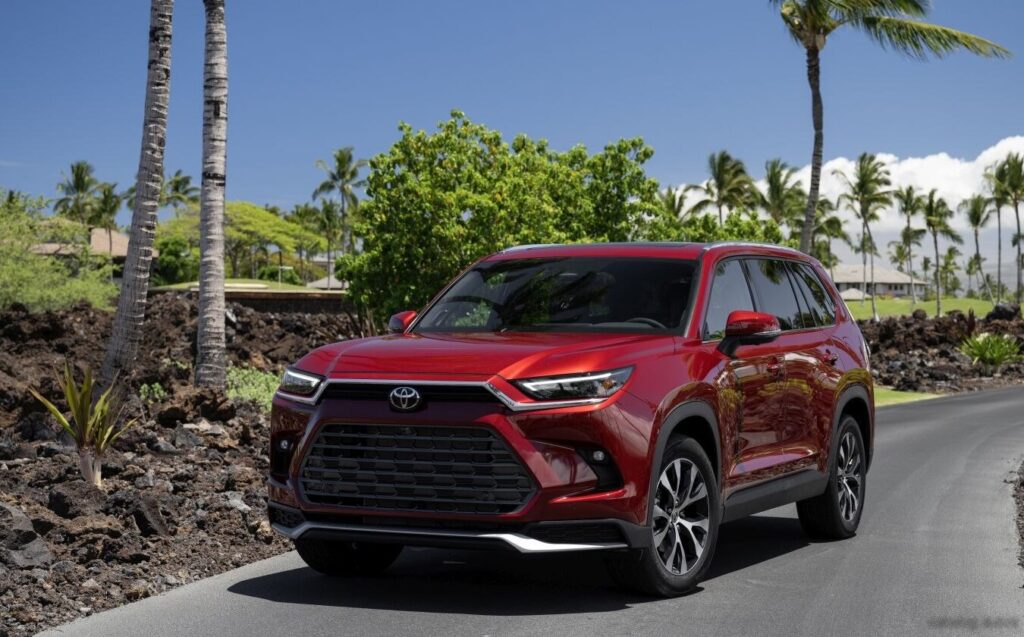
The Toyota Grand Highlander 2.5 Hybrid, introduced in August 2023, represents Toyota’s entry into the three-row mid-size SUV segment, positioned above the Highlander. This variant, equipped with a 2.5-liter four-cylinder engine paired with an e-CVT transmission and hybrid system, delivers a combined system output of 245 horsepower. It’s designed to offer a balance of fuel efficiency, spaciousness, and family-oriented features, targeting buyers seeking a practical and comfortable SUV with hybrid technology. The Grand Highlander aims to address the growing demand for larger SUVs without sacrificing Toyota’s reputation for reliability and fuel economy.
Technical Specifications
| Brand | Toyota |
| Model | Grand Highlander |
| Generation | Grand Highlander |
| Type (Engine) | 2.5 (245 Hp) Hybrid e-CVT |
| Start of production | August, 2023 |
| Powertrain Architecture | FHEV (Full Hybrid Electric Vehicle) |
| Body type | SUV |
| Seats | 7-8 |
| Doors | 5 |
| Fuel consumption (economy) – urban (EPA) | 6.4-6.5 l/100 km (36.8 – 36.2 US mpg) |
| Fuel consumption (economy) – extra urban (EPA) | 6.9-7.4 l/100 km (34.1 – 31.8 US mpg) |
| Fuel consumption (economy) – combined (EPA) | 6.5-6.9 l/100 km (36.2 – 34.1 US mpg) |
| Fuel Type | Petrol (Gasoline) |
| Emission standard | SULEV 30 |
| Weight-to-power ratio | 8.2 kg/Hp, 121.2 Hp/tonne |
| Weight-to-torque ratio | 8.4 kg/Nm, 118.8 Nm/tonne |
| Gross battery capacity | 1.3 kWh |
| Battery voltage | 259.2 V |
| Battery technology | Nickel-metal hydride (NiMH) |
| Battery location | Under the rear seats |
| Electric motor power | 182 Hp |
| Electric motor Torque | 270 Nm (199.14 lb.-ft.) |
| Electric motor location | Integrated into the transmission |
| Electric motor type | Synchronous |
| System power | 245 Hp @ 6000 rpm |
| Internal combustion engine power | 187 Hp @ 6000 rpm |
| Power per litre | 75.2 Hp/l |
| Torque | 240 Nm @ 4300-4500 rpm (177.01 lb.-ft. @ 4300-4500 rpm) |
| Engine layout | Front, Transverse |
| Engine Model/Code | A25A-FXS |
| Engine displacement | 2487 cm3 (151.77 cu. in.) |
| Number of cylinders | 4 |
| Engine configuration | Inline |
| Cylinder Bore | 87.5 mm (3.44 in.) |
| Piston Stroke | 103.4 mm (4.07 in.) |
| Compression ratio | 14:1 |
| Number of valves per cylinder | 4 |
| Fuel injection system | Direct injection and Multi-port manifold injection |
| Engine aspiration | Naturally aspirated engine |
| Valvetrain | DOHC |
| Engine oil capacity | 4.3 l (4.54 US qt | 3.78 UK qt) |
| Coolant | 10.2 l (10.78 US qt | 8.97 UK qt) |
| Kerb Weight | 2021 kg (4455.54 lbs.) |
| Max. weight | 2735 kg (6029.64 lbs.) |
| Max load | 714 kg (1574.1 lbs.) |
| Trunk (boot) space – minimum | 583 l (20.59 cu. ft.) |
| Trunk (boot) space – maximum | 2761 l (97.5 cu. ft.) |
| Fuel tank capacity | 65 l (17.17 US gal | 14.3 UK gal) |
| Permitted trailer load with brakes (12%) | 1588 kg (3500.94 lbs.) |
| Permitted towbar download | 159 kg (350.53 lbs.) |
| Length | 5115 mm (201.38 in.) |
| Width | 1990 mm (78.35 in.) |
| Height | 1780 mm (70.08 in.) |
| Wheelbase | 2950 mm (116.14 in.) |
| Front track | 1705-1715 mm (67.13 – 67.52 in.) |
| Rear (Back) track | 1715-1725 mm (67.52 – 67.91 in.) |
| Ride height (ground clearance) | 203 mm (7.99 in.) |
| Minimum turning circle (turning diameter) | 11.6 m (38.06 ft.) |
| Approach angle | 16.9° |
| Departure angle | 22.3° |
| Ramp-over (brakeover) angle | 16.8° |
| Drivetrain Architecture | The Internal combustion engine (ICE) and electric motor drive the front wheels of the car with the ability to work in full electric or mixed mode. |
| Drive wheel | Front wheel drive |
| Number of gears and type of gearbox | automatic transmission e-CVT |
| Front suspension | Independent, type McPherson with coil spring and anti-roll bar |
| Rear suspension | Independent multi-link spring suspension with stabilizer |
| Front brakes | Ventilated discs, 340 mm |
| Rear brakes | Ventilated discs, 338 mm |
| Assisting systems | ABS (Anti-lock braking system) |
| Steering type | Steering rack and pinion |
| Power steering | Electric Steering |
| Tires size | 255/65 R18; 255/50 R20 |
| Wheel rims size | 7.5J x 18; 8J x 20 |
Powertrain & Engine Architecture
The Grand Highlander 2.5 Hybrid utilizes Toyota’s A25A-FXS 2.5-liter inline-four engine. This engine employs a direct injection and multi-port fuel injection system, optimizing combustion efficiency and reducing emissions. The engine boasts a high compression ratio of 14:1, contributing to its power output. The hybrid system incorporates a nickel-metal hydride (NiMH) battery pack located under the rear seats, providing 1.3 kWh of gross capacity. The electric motor, a synchronous type, delivers 182 horsepower and 270 Nm (199.14 lb-ft) of torque. The e-CVT (electronically controlled continuously variable transmission) seamlessly integrates the power from both the engine and the electric motor, providing smooth and efficient acceleration. Toyota’s Hybrid Synergy Drive system intelligently manages the power flow between the engine, motor, and battery, prioritizing fuel efficiency and minimizing emissions.
Driving Characteristics
The 245-horsepower hybrid powertrain delivers adequate performance for everyday driving. While not as quick as higher-trim Grand Highlander models with the turbocharged 2.4-liter engine, the 2.5 Hybrid offers smooth and responsive acceleration. The e-CVT contributes to a seamless driving experience, eliminating the gear shifts associated with traditional automatic transmissions. The hybrid system allows for brief periods of electric-only driving at low speeds, further enhancing fuel efficiency. The Grand Highlander’s weight, at 2021 kg (4455.54 lbs), is noticeable, but the combined output of the engine and electric motor provides sufficient power for highway merging and passing maneuvers. The e-CVT is programmed for efficiency, prioritizing fuel economy over aggressive acceleration.
Equipment & Trim Levels
The Grand Highlander 2.5 Hybrid is typically offered in several trim levels, including XLE, Limited, and Platinum. Standard features generally include Toyota Safety Sense 3.0, which encompasses a suite of advanced driver-assistance systems such as pre-collision system with pedestrian detection, lane departure alert with lane tracing assist, and dynamic radar cruise control. Interior features typically include an 8-inch touchscreen display, Apple CarPlay and Android Auto compatibility, and comfortable seating for up to eight passengers. Higher trim levels add features such as a larger 12.3-inch touchscreen, premium audio systems, leather upholstery, and panoramic sunroofs.
Chassis & Braking
The Grand Highlander features an independent McPherson strut front suspension and an independent multi-link rear suspension, providing a comfortable and controlled ride. Stabilizer bars are included on both axles to minimize body roll during cornering. The braking system consists of ventilated discs on all four wheels, measuring 340 mm at the front and 338 mm at the rear. Anti-lock braking system (ABS) is standard. The vehicle’s relatively high weight necessitates a robust braking system to ensure adequate stopping power.
Market Reception & Comparison
The Toyota Grand Highlander 2.5 Hybrid has been well-received by critics for its spacious interior, comfortable ride, and excellent fuel economy. Compared to the standard Highlander, the Grand Highlander offers significantly more third-row legroom and cargo space. The hybrid powertrain delivers competitive fuel economy figures, exceeding those of many non-hybrid competitors in the mid-size SUV segment. However, some reviewers have noted that the 2.5-liter engine can feel underpowered when fully loaded with passengers and cargo. Compared to the turbocharged 2.4-liter engine option, the hybrid offers less overall power but superior fuel efficiency.
Legacy
The Toyota Grand Highlander 2.5 Hybrid is expected to be a reliable and durable vehicle, building upon Toyota’s reputation for quality and longevity. The hybrid powertrain, with its proven technology and robust components, should provide years of trouble-free operation. As a relatively new model, long-term reliability data is still emerging, but early indications suggest that the Grand Highlander will hold its value well in the used car market. The combination of fuel efficiency, spaciousness, and Toyota’s brand reputation positions the Grand Highlander 2.5 Hybrid as a compelling choice for families seeking a practical and reliable SUV.