
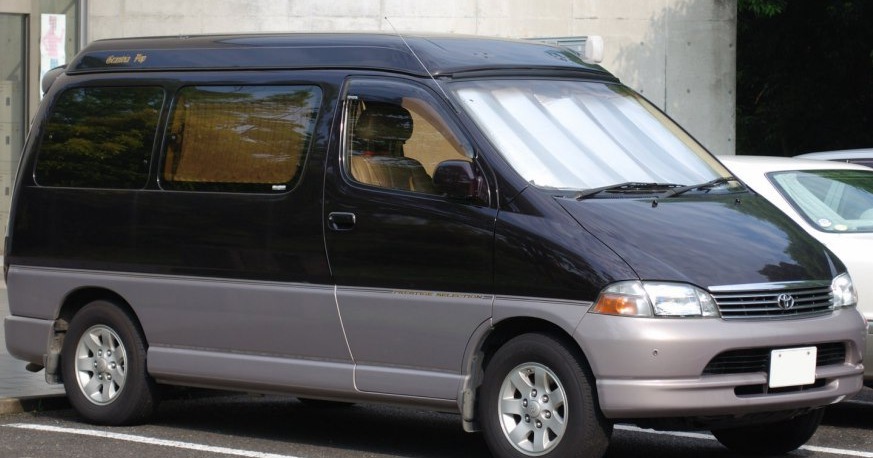
The Toyota Granvia 2.7i, produced from 1995 to 2002, represented a significant offering in the full-size minivan segment, particularly in markets outside of North America. Positioned as a more premium and spacious alternative to smaller vans, the Granvia aimed to provide comfortable transportation for families and businesses. This specific 2.7-liter, 152 horsepower variant, equipped with an automatic transmission, served as a popular mid-range option within the Granvia lineup, balancing affordability with a respectable level of performance and features. It was primarily sold in Asia, Australia, and parts of Europe, where large MPVs were in demand.
Technical Specifications
| Brand | Toyota |
| Model | Granvia |
| Generation | Granvia |
| Type (Engine) | 2.7 i (152 Hp) |
| Start of production | 1995 |
| End of production | 2002 |
| Powertrain Architecture | Internal Combustion engine |
| Body type | Minivan |
| Seats | 7-8 |
| Doors | 4 |
| Fuel Type | Petrol (Gasoline) |
| Power | 152 Hp @ 4800 rpm |
| Power per litre | 56.4 Hp/l |
| Torque | 240 Nm @ 4000 rpm / 177.01 lb.-ft. @ 4000 rpm |
| Engine layout | Front, Longitudinal |
| Engine Model/Code | 3RZ-FE |
| Engine displacement | 2694 cm3 / 164.4 cu. in. |
| Number of cylinders | 4 |
| Engine configuration | Inline |
| Cylinder Bore | 95 mm / 3.74 in. |
| Piston Stroke | 95 mm / 3.74 in. |
| Compression ratio | 9.5:1 |
| Number of valves per cylinder | 4 |
| Fuel injection system | Multi-port manifold injection |
| Engine aspiration | Naturally aspirated engine |
| Valvetrain | DOHC |
| Engine oil capacity | 4.7 l / 4.97 US qt | 4.14 UK qt |
Powertrain & Engine Architecture
The heart of the Granvia 2.7i is the 3RZ-FE engine, a 2.7-liter inline-four cylinder gasoline engine. This engine is a member of Toyota’s ‘RZ’ family, known for its durability and relatively simple design. The 3RZ-FE utilizes a cast iron block and an aluminum cylinder head, contributing to its robust nature. It features a double overhead camshaft (DOHC) valvetrain with four valves per cylinder, optimizing airflow for improved performance. Fuel delivery is managed by a multi-port fuel injection system, providing precise fuel metering for efficient combustion. The engine’s 9.5:1 compression ratio strikes a balance between power output and fuel economy. The automatic transmission paired with this engine was typically a four-speed unit, designed for smooth and comfortable shifting. While not a performance-oriented transmission, it was well-suited to the Granvia’s intended role as a family hauler.
Driving Characteristics
The Granvia 2.7i with the automatic transmission offered a comfortable, if not particularly sporty, driving experience. With 152 horsepower and 177 lb-ft of torque, acceleration was adequate for everyday driving, but it wasn’t designed for quick bursts of speed. The four-speed automatic transmission provided smooth gear changes, but the gear ratios were geared more towards fuel efficiency and cruising comfort than outright performance. Compared to the available manual transmission, the automatic resulted in a slight decrease in fuel economy and a less engaging driving experience. Against other Granvia variants, such as those with larger engines (though none were significantly more powerful), the 2.7i automatic felt less responsive, particularly when fully loaded with passengers and luggage. However, the automatic transmission made it a more accessible option for drivers who preferred the convenience of not having to shift gears.
Equipment & Trim Levels
The 2.7i trim level of the Granvia typically included a reasonable level of standard equipment. Interior features generally included cloth upholstery, power windows, power door locks, and air conditioning. Depending on the market and optional packages, features like a CD player, upgraded sound system, and woodgrain interior trim were available. Higher trim levels offered leather upholstery, sunroofs, and more advanced audio systems. The Granvia’s interior was designed with practicality in mind, offering ample space for passengers and cargo. The seating configuration could vary, with options for seven or eight seats, and the rear seats often featured folding or removable functionality to maximize cargo space. Safety features were relatively basic for the era, typically including seatbelts for all passengers and, in some markets, airbags.
Chassis & Braking
The Granvia utilized a body-on-frame construction, which contributed to its robust feel and durability. The suspension system consisted of independent front suspension with coil springs and a rear suspension with leaf springs. This setup prioritized ride comfort over sporty handling. The braking system typically featured disc brakes on the front wheels and drum brakes on the rear wheels. Anti-lock brakes (ABS) were available as an option on some models, enhancing safety during emergency braking situations. The Granvia’s chassis was designed to handle the weight of a full passenger load and cargo, providing a stable and predictable driving experience. Stabilizer bars were included to reduce body roll during cornering, but the Granvia was not intended to be a cornering machine.
Market Reception & Comparison
The Toyota Granvia 2.7i was generally well-received in its target markets. Critics praised its spacious interior, comfortable ride, and Toyota’s reputation for reliability. However, some reviewers noted that the 2.7-liter engine felt underpowered when the van was fully loaded, and the automatic transmission wasn’t as responsive as the manual option. Compared to other minivans available at the time, the Granvia offered a more premium feel and a larger interior, but it often came at a higher price point. Fuel economy was reasonable for a vehicle of its size and weight, but it wasn’t a standout performer in this area. Reliability was a key strength of the Granvia, with the 3RZ-FE engine proving to be exceptionally durable and long-lasting.
Legacy
The Toyota Granvia, and specifically the 2.7i variant, has developed a reputation for long-term reliability and durability. Many examples are still on the road today, a testament to the quality of Toyota’s engineering. In the used car market, the Granvia 2.7i is often sought after by those looking for a spacious, reliable, and affordable minivan. The 3RZ-FE engine is known for its ability to withstand high mileage with minimal maintenance, making it a popular choice for budget-conscious buyers. While it may not offer the latest technology or features, the Granvia 2.7i remains a practical and dependable vehicle for families and businesses alike. Its simple design and robust construction contribute to its continued appeal and make it a relatively easy vehicle to maintain and repair.
