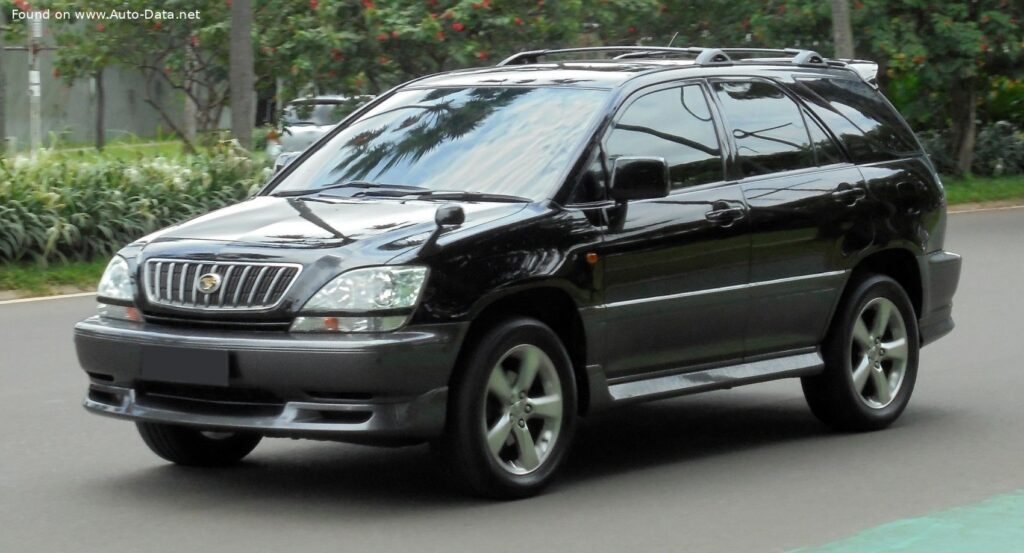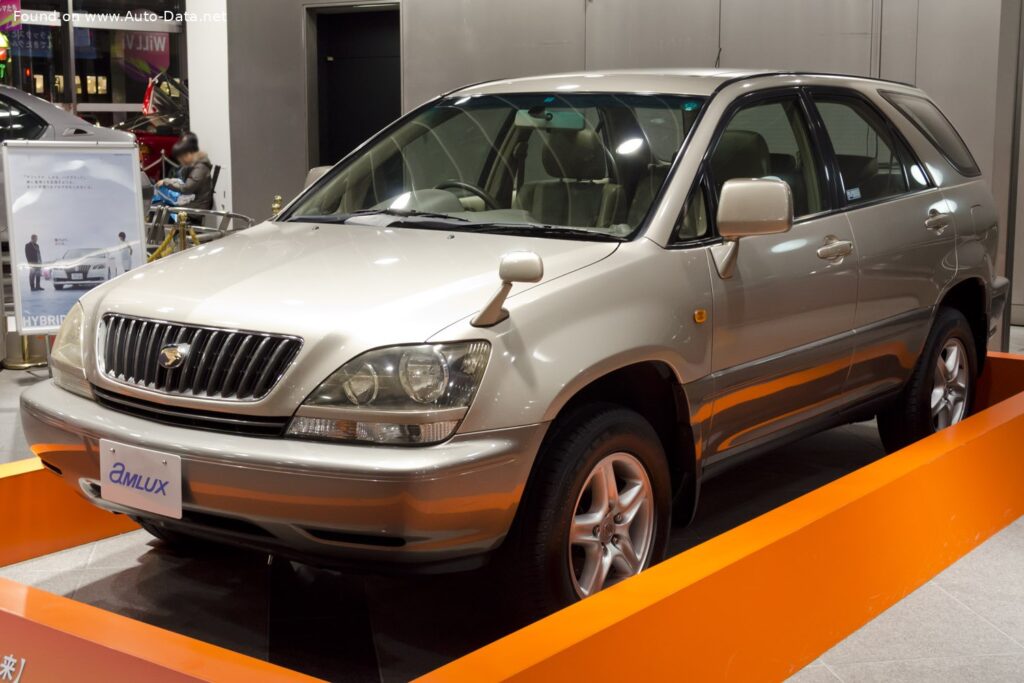
The Toyota Harrier I (XU10) represents a significant milestone in the evolution of the modern crossover SUV. Launched in Japan in 1997, the first-generation Harrier was a pioneering vehicle, effectively blending the utility and elevated driving position of an SUV with the comfort, handling, and refinement of a luxury sedan. While not directly sold under the Toyota brand in the United States, this vehicle served as the foundation for the original Lexus RX 300, which made its highly successful debut in the American market. The specific variant under review, the 2.4 16V (160 Hp) Automatic, was introduced in 2000, signifying a mid-cycle refresh that brought an updated powertrain option to the lineup. This model, produced until 2003, cemented the Harrier’s reputation in its primary Asian markets as a premium, versatile, and well-engineered family vehicle, laying the groundwork for a segment that would explode in popularity worldwide.
The Harrier I (XU10) was revolutionary for its time, challenging traditional automotive categories. Built on a modified platform shared with the Toyota Camry, it offered a car-like unibody construction rather than the body-on-frame design typical of traditional SUVs. This approach resulted in superior ride quality, reduced noise, and more car-like handling characteristics, making it an attractive option for consumers seeking SUV practicality without the compromises of truck-based platforms. Its success, both as the Harrier in Asia and the Lexus RX in North America, demonstrated Toyota’s foresight in identifying a burgeoning market for what would become known as the “crossover” segment.
Engine & Performance: The Toyota Harrier I (XU10) Powertrain
The heart of the 2000-2003 Toyota Harrier I (XU10) 2.4 16V Automatic variant was its robust 2.4-liter, 16-valve inline-four engine, designated as the 2AZ-FE. This naturally aspirated unit was a staple in many Toyota vehicles of the era, known for its reliability and smooth operation. Featuring a Double Overhead Camshaft (DOHC) valvetrain and multi-port manifold injection, the engine was designed for a balance of power, efficiency, and durability. It produced a respectable 160 horsepower at 5600 rpm, delivering a power-per-liter output of 67.7 horsepower, which was competitive for a non-turbocharged four-cylinder engine of its size.
Torque output for the 2.4-liter engine stood at 221 Newton-meters, or approximately 163 pound-feet, peaking at 4000 rpm. This ample torque, available at a relatively accessible engine speed, contributed to the Harrier’s confident acceleration and responsiveness in everyday driving conditions. Mated to a 4-speed automatic transmission, the powertrain directed its power to the front wheels, emphasizing efficiency and on-road comfort. While an all-wheel-drive option was available for the Harrier I generation, this particular variant specified front-wheel drive, further enhancing its car-like feel and fuel economy.
In terms of performance, the Harrier 2.4 16V Automatic was not designed for blistering speed but offered adequate acceleration for its class. It could sprint from 0 to 60 mph in a calculated 11.4 seconds (0-100 km/h in 12 seconds) and achieved a maximum speed of 105.63 mph (170 km/h). These figures underscored its role as a practical family vehicle rather than a performance machine. Fuel economy was rated at an estimated 25 US mpg combined, with urban consumption around 18.1 US mpg and extra-urban (highway) figures reaching 26.1 US mpg, which were respectable numbers for an SUV/crossover of its size and weight at the turn of the millennium. The 65-liter (17.17 US gallon) fuel tank provided a decent cruising range.
Design & Features: The Iconic Crossover Form
The design of the Toyota Harrier I (XU10) was groundbreaking, establishing a new aesthetic for SUVs that prioritized sleekness and aerodynamic efficiency over rugged, boxy proportions. As an SUV/Crossover with 5 doors and 5 seats, it offered a practical and comfortable cabin for passengers and cargo. Its dimensions – 180.12 inches in length, 71.46 inches in width, and 65.55 inches in height – provided a substantial road presence without being overly cumbersome. The 102.95-inch wheelbase contributed to a stable ride and generous interior space.
Inside, the Harrier I (XU10) offered a well-appointed interior, reflecting its premium aspirations. While specific luxury features varied by market and trim level, common amenities included automatic climate control, power windows and mirrors, and a quality audio system. Safety was addressed with standard features such as ABS (Anti-lock Braking System), a crucial assisting system for emergency braking scenarios. The steering system utilized a hydraulic power steering rack and pinion setup, providing a natural and connected feel to the road. The vehicle rode on 215/70 R16 tires, mounted on 6.5J x 16 ET35 wheels, offering a comfortable ride and adequate grip.
The cargo capacity was another strong suit, with a minimum trunk space of 30.37 cubic feet (860 liters) that could expand to an impressive 75.22 cubic feet (2130 liters) with the rear seats folded down. This flexibility made the Harrier an ideal choice for families, offering ample room for luggage, groceries, or sports equipment. The suspension system, featuring Spring Struts at the front and a Trailing Arm setup at the rear, was tuned for passenger comfort and refined handling, further distinguishing it from more utilitarian, truck-based SUVs. Ventilated disc brakes at the front and disc brakes at the rear ensured confident stopping power.
Toyota Harrier I (XU10) Technical Specifications
| Category | Specification |
| General Information | |
| Brand | Toyota |
| Model | Harrier |
| Generation | Harrier I (XU10) |
| Type (Engine) | 2.4 16V (160 Hp) Automatic |
| Start of Production | 2000 year |
| End of Production | 2003 year |
| Powertrain Architecture | Internal Combustion engine |
| Body Type | SUV, Crossover |
| Seats | 5 |
| Doors | 5 |
| Performance Specs | |
| Fuel Consumption (Urban) | 13 l/100 km (18.1 US mpg) |
| Fuel Consumption (Extra Urban) | 9 l/100 km (26.1 US mpg) |
| Fuel Consumption (Combined) | 9.4 l/100 km (25 US mpg) |
| Fuel Type | Petrol (Gasoline) |
| Acceleration 0-60 mph | 11.4 sec |
| Acceleration 0-100 km/h | 12 sec |
| Maximum Speed | 170 km/h (105.63 mph) |
| Weight-to-Power Ratio | 9.9 kg/Hp (100.6 Hp/tonne) |
| Weight-to-Torque Ratio | 7.2 kg/Nm (139 Nm/tonne) |
| Engine Specs | |
| Power | 160 Hp @ 5600 rpm |
| Power per Liter | 67.7 Hp/l |
| Torque | 221 Nm @ 4000 rpm (163 lb.-ft. @ 4000 rpm) |
| Engine Layout | Front, Transverse |
| Engine Model/Code | 2AZ-FE |
| Engine Displacement | 2364 cm3 (2.4 liters / 144.26 cu. in.) |
| Number of Cylinders | 4 |
| Engine Configuration | Inline |
| Cylinder Bore | 88.5 mm (3.48 in.) |
| Piston Stroke | 96 mm (3.78 in.) |
| Compression Ratio | 9.6:1 |
| Number of Valves per Cylinder | 4 |
| Fuel Injection System | Multi-port manifold injection |
| Engine Aspiration | Naturally aspirated engine |
| Valvetrain | DOHC |
| Engine Oil Capacity | 3.8 l (4.02 US qt) |
| Space, Volume and Weights | |
| Kerb Weight | 1590 kg (3505.35 lbs.) |
| Trunk (Boot) Space – Minimum | 860 l (30.37 cu. ft.) |
| Trunk (Boot) Space – Maximum | 2130 l (75.22 cu. ft.) |
| Fuel Tank Capacity | 65 l (17.17 US gal) |
| Dimensions | |
| Length | 4575 mm (180.12 in.) |
| Width | 1815 mm (71.46 in.) |
| Height | 1665 mm (65.55 in.) |
| Wheelbase | 2615 mm (102.95 in.) |
Legacy and Market Impact
The Toyota Harrier I (XU10), particularly in its 2.4 16V Automatic configuration, holds a significant place in automotive history, primarily for its pioneering role in the luxury crossover segment. While the Harrier nameplate itself was not officially sold in the United States, its identical twin, the Lexus RX 300, achieved monumental success in the North American market, effectively creating and dominating the luxury crossover category for years. This dual branding strategy allowed Toyota to cater to different market preferences while leveraging a single, highly innovative platform.
In its primary markets, such as Japan and other parts of Asia, the Harrier I (XU10) quickly gained a reputation for its sophisticated design, comfortable ride, and Toyota’s hallmark reliability. It appealed to consumers who desired the practicality of an SUV but were unwilling to compromise on the refinement and driving dynamics of a premium sedan. Its car-like handling, combined with a spacious and versatile interior, made it a popular choice among urban and suburban families.
The Harrier’s competitors in its regional markets included vehicles like the Honda CR-V and the Nissan X-Trail, though the Harrier positioned itself as a more upscale offering, often bridging the gap between mainstream compact SUVs and larger, more traditional luxury SUVs. Its success prompted other manufacturers to develop their own car-based SUVs, ultimately leading to the proliferation of the crossover segment that is so prevalent today.
The 2.4-liter 2AZ-FE engine, in particular, contributed to the Harrier’s long-term appeal. Known for its robust construction and ease of maintenance, it provided a dependable and reasonably efficient powertrain option. This engine’s widespread use across various Toyota models further solidified its reputation for reliability, translating into strong resale values for the Harrier.
Overall, the Toyota Harrier I (XU10) was more than just another vehicle; it was a trendsetter. Its innovative concept, combining the best attributes of sedans and SUVs, redefined consumer expectations and laid the foundation for an entirely new class of vehicles. Its legacy is evident in the countless crossovers that populate roads worldwide, all tracing their lineage, in part, back to this groundbreaking Toyota model.