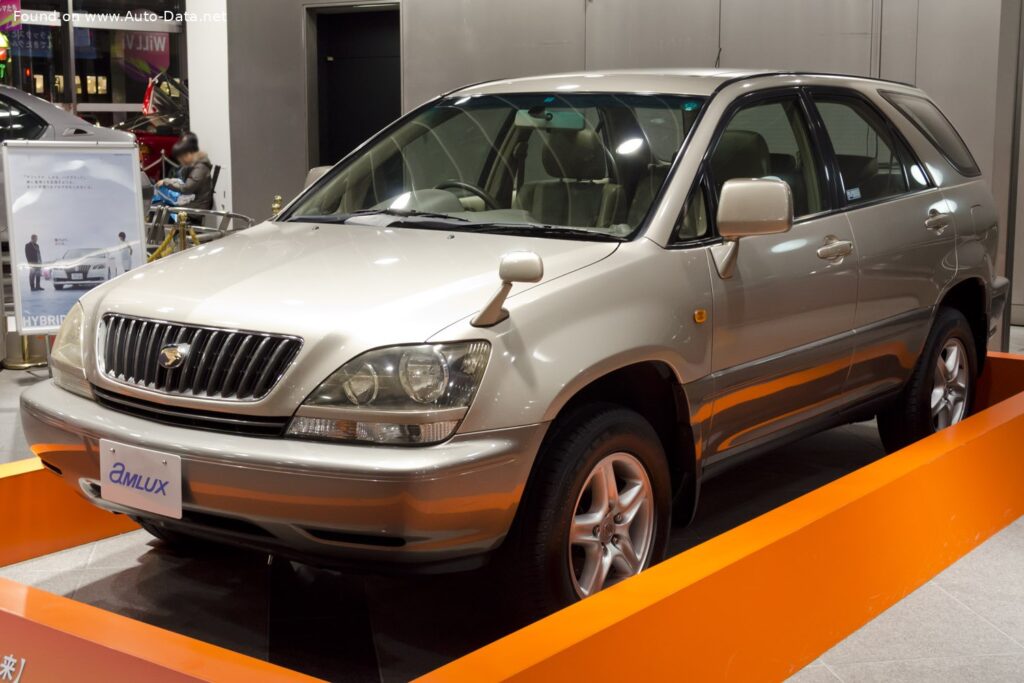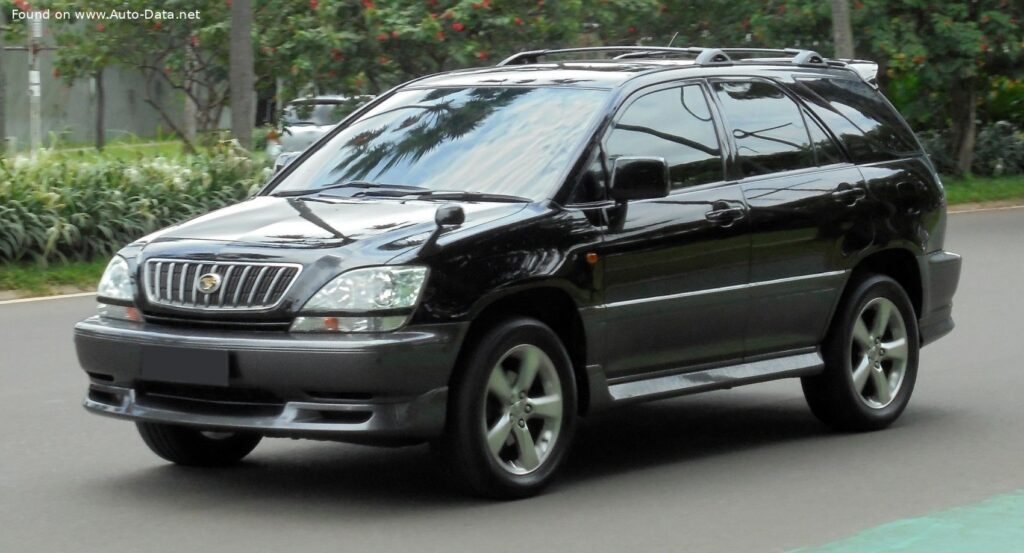
The Toyota Harrier I (XU10, facelift 2000) represents a pivotal moment in automotive history, particularly in the evolution of the sport utility vehicle (SUV) and the emergence of the modern crossover. While not directly sold under the “Harrier” nameplate in the United States, this vehicle served as the foundational platform for the hugely successful Lexus RX 300, which introduced the luxury crossover concept to the North American market. Primarily developed for the Japanese domestic market (JDM) and other Asian regions, the Harrier, especially in its refreshed XU10 guise from 2000 to 2002, offered a groundbreaking combination of car-like comfort and handling with the elevated driving position and utility of an SUV. This specific variant, the 2.2i 16V with 140 horsepower and an automatic transmission, was a popular choice, embodying the model’s philosophy of refined practicality.
The Toyota Harrier I (XU10, facelift 2000): A Pioneering Crossover
The Harrier I (XU10) arrived during a period of significant change in the automotive landscape. Consumers were increasingly seeking vehicles that offered the versatility of an SUV but without the compromises often associated with traditional, truck-based designs. Toyota recognized this demand and responded with the Harrier, a vehicle that seamlessly blended the best aspects of both worlds. The 2000 facelift brought subtle but important refinements to the exterior and interior, enhancing its appeal and solidifying its position as a leader in the burgeoning crossover segment. Its influence extended far beyond Japan, laying the groundwork for the Lexus RX series, which would become a cornerstone of the luxury brand’s success.
Engine & Performance
The 2000 Toyota Harrier I (XU10) 2.2i 16V was powered by the Toyota 5S-FE engine, a 2.2-liter (2166 cm³ or 132.18 cu. in.) inline-four cylinder powerplant. This engine featured a Double Overhead Camshaft (DOHC) valvetrain with 16 valves, optimizing airflow for improved efficiency and power delivery. As a naturally aspirated engine utilizing multi-port fuel injection, it produced 140 horsepower at 5600 rpm and 143.82 lb.-ft. (195 Nm) of torque at 4400 rpm. This output provided sufficient power for everyday driving and light hauling tasks.
Power was delivered to the front wheels through a smooth-shifting 4-speed automatic transmission. The transverse engine mounting, a characteristic of front-wheel-drive passenger cars, contributed to the Harrier’s car-like handling and improved space utilization. Performance figures were respectable for the era and segment. Acceleration from 0 to 60 mph was achieved in approximately 11.8 seconds (0-100 km/h in 12.4 seconds), with a top speed of 99.42 mph (160 km/h). Fuel economy was a strong suit, with Toyota quoting a combined consumption of 7.1 liters per 100 kilometers (33.1 US mpg). Urban driving yielded 10 l/100 km (23.5 US mpg), while highway figures were as low as 6.1 l/100 km (38.6 US mpg). This balance of performance and efficiency made the Harrier an attractive option for cost-conscious buyers.
Design & Features
The Toyota Harrier I (XU10, facelift 2000) showcased a contemporary and aerodynamic design that bridged the gap between a traditional sedan and an SUV. Classified as an SUV/Crossover, its five-door, five-seat body style offered a sleek profile that contrasted sharply with the boxy SUVs of the time. The facelifted model featured subtle exterior enhancements, maintaining a fresh and modern aesthetic. The vehicle measured 180.12 inches (4575 mm) in length, 71.46 inches (1815 mm) in width, and 65.55 inches (1665 mm) in height, with a wheelbase of 102.95 inches (2615 mm).
The interior prioritized comfort, spaciousness, and practicality. The cabin comfortably accommodated five passengers, offering ample headroom and legroom. Cargo capacity was a significant asset, with a minimum of 30.37 cu. ft. (860 liters) expanding to a generous 75.22 cu. ft. (2130 liters) with the rear seats folded. Interior materials and build quality reflected Toyota’s commitment to durability and ergonomics. The chassis featured a front spring strut suspension and a rear trailing arm setup, providing a comfortable and controlled ride. Ventilated front disc brakes and rear disc brakes, coupled with an Anti-lock Braking System (ABS), ensured safe and reliable stopping power. Hydraulic power steering, utilizing a rack and pinion system, offered light and responsive steering feel. The vehicle was equipped with 215/70 R16 tires mounted on 6.5J x 16 ET35 alloy wheels.
Technical Specifications: Toyota Harrier I (XU10, facelift 2000) 2.2i 16V (140 Hp) Automatic
| Category | Specification |
| Brand | Toyota |
| Model | Harrier |
| Generation | Harrier I (XU10, facelift 2000) |
| Type (Engine) | 2.2i 16V (140 Hp) Automatic |
| Start of Production | 2000 year |
| End of Production | 2002 year |
| Powertrain Architecture | Internal Combustion engine |
| Body Type | SUV, Crossover |
| Seats | 5 |
| Doors | 5 |
| Fuel Consumption (Urban) | 10 l/100 km (23.5 US mpg) |
| Fuel Consumption (Extra Urban) | 6.1 l/100 km (38.6 US mpg) |
| Fuel Consumption (Combined) | 7.1 l/100 km (33.1 US mpg) |
| Fuel Type | Petrol (Gasoline) |
| Acceleration 0 – 60 mph | 11.8 sec |
| Acceleration 0 – 100 km/h | 12.4 sec |
| Maximum Speed | 99.42 mph (160 km/h) |
| Weight-to-Power Ratio | 11.4 kg/Hp (88.1 Hp/tonne) |
| Weight-to-Torque Ratio | 8.2 kg/Nm (122.6 Nm/tonne) |
| Power | 140 Hp @ 5600 rpm |
| Power per Liter | 64.6 Hp/l |
| Torque | 143.82 lb.-ft. (195 Nm) @ 4400 rpm |
| Engine Layout | Front, Transverse |
| Engine Model/Code | 5S-FE |
| Engine Displacement | 2166 cm³ (132.18 cu. in.) |
| Number of Cylinders | 4 |
| Engine Configuration | Inline |
| Cylinder Bore | 3.43 in. (87 mm) |
| Piston Stroke | 3.58 in. (91 mm) |
| Compression Ratio | 9.8:1 |
| Number of Valves per Cylinder | 4 |
| Fuel Injection System | Multi-port manifold injection |
| Engine Aspiration | Naturally aspirated engine |
| Valvetrain | DOHC |
| Engine Oil Capacity | 3.6 l (3.8 US qt) |
| Coolant Capacity | 8.3 l (8.77 US qt) |
| Kerb Weight | 3505.35 lbs. (1590 kg) |
| Trunk (Boot) Space – Minimum | 30.37 cu. ft. (860 l) |
| Trunk (Boot) Space – Maximum | 75.22 cu. ft. (2130 l) |
| Fuel Tank Capacity | 19.81 US gal (75 l) |
| Length | 180.12 in. (4575 mm) |
| Width | 71.46 in. (1815 mm) |
| Height | 65.55 in. (1665 mm) |
| Wheelbase | 102.95 in. (2615 mm) |
| Front Track | 61.61 in. (1565 mm) |
| Rear (Back) Track | 61.02 in. (1550 mm) |
| Ride Height (Ground Clearance) | 7.09 in. (180 mm) |
| Drivetrain Architecture | The Internal combustion engine (ICE) drives the front wheels of the vehicle. |
| Drive Wheel | Front wheel drive |
| Number of Gears and Type of Gearbox | 4 gears, automatic transmission |
| Front Suspension | Spring Strut |
| Rear Suspension | Trailing arm |
| Front Brakes | Ventilated discs |
| Rear Brakes | Disc |
| Assisting Systems | ABS (Anti-lock braking system) |
| Steering Type | Steering rack and pinion |
| Power Steering | Hydraulic Steering |
| Tires Size | 215/70 R16 99S |
| Wheel Rims Size | 6.5J x 16 ET35 |
Legacy and Market Impact
The Toyota Harrier I (XU10), particularly in its facelifted 2000-2002 iteration, holds a significant place in automotive history as a trailblazer in the luxury crossover segment. Its most profound impact in the global automotive landscape stems from its dual identity: while known as the Harrier in Japan and other Asian markets, it was rebadged and launched as the Lexus RX 300 in North America and Europe. This strategic move by Toyota effectively created the luxury crossover segment in the crucial US market, proving that consumers desired a vehicle offering the practicality and elevated seating of an SUV without the ruggedness, poor fuel economy, and truck-like ride of traditional body-on-frame models.
In its primary markets, the Harrier was highly regarded for its blend of Toyota’s legendary reliability, sophisticated styling, comfortable interior, and smooth driving characteristics. It successfully carved out a niche for itself, appealing to buyers who sought a premium vehicle that was practical for city driving and capable enough for occasional light duty. Competitors in its segment were somewhat nascent; while smaller crossovers like the Honda CR-V existed, the Harrier offered a more upscale experience. Its direct competitors would eventually emerge from other luxury brands, but the Harrier/RX was among the very first to define this new category. The Harrier’s car-based unibody construction, refined independent suspension, and V6 engine options (though not present in this specific 2.2L variant) contributed to its excellent on-road manners, which were a revelation for SUV buyers. This approach marked a fundamental shift in vehicle design, influencing countless models that followed. The success of the Harrier/RX demonstrated a clear market demand for vehicles that prioritized comfort, safety, and efficiency alongside utility. Its legacy is evident in the proliferation of crossovers and luxury SUVs today, many of which can trace their conceptual roots back to this pioneering Toyota model. The 2000 Harrier I (XU10) 2.2i 16V Automatic, therefore, stands as a testament to Toyota’s foresight and engineering prowess, a vehicle that, despite its regional branding, profoundly shaped the global automotive industry.