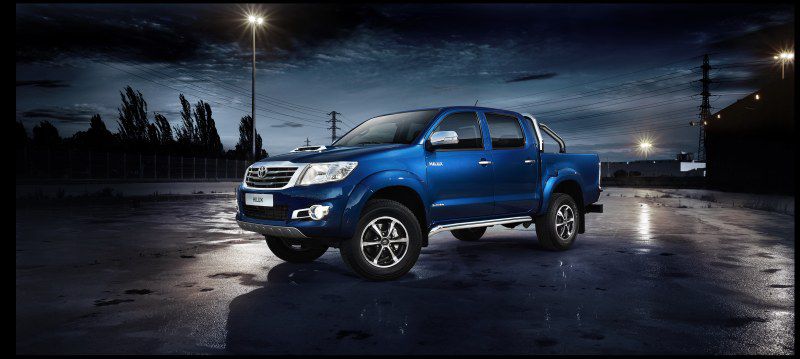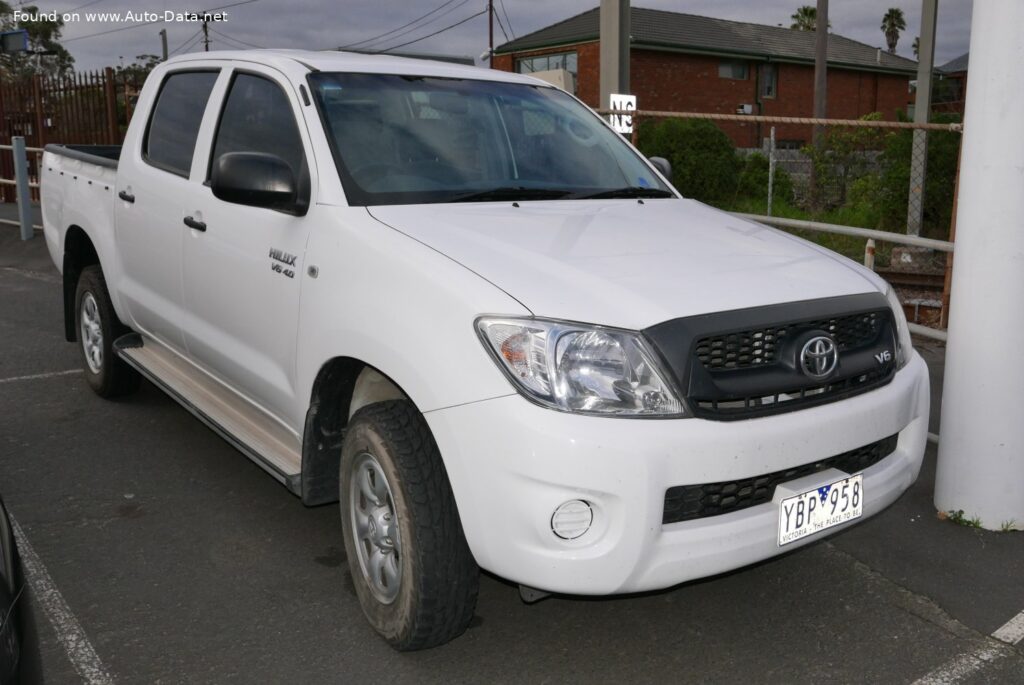
The Toyota Hilux Double Cab VII, specifically the facelifted version introduced in 2008, represents a significant iteration of Toyota’s globally renowned pickup truck. This generation, produced from 2005 to 2011 (with the facelift spanning 2008-2011), was designed to balance robust workhorse capability with increased comfort and practicality for family use, particularly through the addition of a four-door “Double Cab” configuration. While not initially a major seller in the United States – Toyota focused on larger, American-style pickups for that market – the Hilux held immense popularity in Europe, Asia, Australia, and Latin America, where its durability, reliability, and off-road prowess were highly valued. The 3.0 D-4D variant, equipped with a 171 horsepower diesel engine and four-wheel drive, was a common configuration, offering a blend of performance and fuel efficiency.
Toyota Hilux Double Cab VII (2008-2011): A Global Workhorse
The Hilux Double Cab VII facelift built upon the success of its predecessor, refining both its aesthetics and mechanical components. The facelift brought subtle styling updates, primarily to the front fascia, and improvements to interior trim and equipment levels. The core appeal of the Hilux remained its rugged construction, dependable diesel engines, and versatile body style. The Double Cab configuration, offering seating for five passengers, broadened the Hilux’s appeal beyond commercial users, making it a viable option for families and individuals needing a practical vehicle capable of both work and leisure.
Engine & Performance
The 2008-2011 Toyota Hilux Double Cab VII 3.0 D-4D is powered by the 1KD-FTV engine, a 2.982-liter (181.97 cubic inches) inline-four cylinder diesel engine. This engine produces 171 horsepower at 3600 rpm and 343 Nm (252.98 lb-ft) of torque between 1400 and 3200 rpm. The engine utilizes a diesel common rail fuel injection system and is equipped with a turbocharger and intercooler to enhance performance and efficiency. Power is delivered to all four wheels via a five-speed manual transmission, providing a robust and controllable drivetrain. Acceleration from 0 to 100 km/h (0-62 mph) takes approximately 12 seconds, while 0 to 60 mph is achieved in around 11.4 seconds. The vehicle has a maximum speed of 170 km/h (105.63 mph). The engine’s longitudinal mounting and the 4×4 drivetrain contribute to its off-road capabilities and stability.
Design & Features
The Hilux Double Cab VII is a four-door pickup truck with a body-on-frame construction, emphasizing durability and load-carrying capacity. The Double Cab configuration provides ample space for five occupants, making it suitable for both work and family transportation. The vehicle’s design prioritizes practicality and functionality, with a focus on robust build quality and off-road capability. Key features include a spacious cargo bed, a comfortable interior (for its class), and a comprehensive four-wheel-drive system. Safety features, while not as advanced as contemporary passenger cars, included ABS (Anti-lock Braking System) as standard. The Hilux’s high ground clearance (292 mm / 11.5 inches) and impressive approach, departure, and ramp-over angles (30°, 25°, and 19° respectively) contribute to its off-road prowess. The wading depth of 700 mm (27.56 inches) further enhances its ability to traverse challenging terrain. The vehicle’s design reflects a balance between utilitarian functionality and a degree of modern styling, appealing to a broad range of buyers.
Technical Specifications
| Brand | Toyota |
| Model | Hilux |
| Generation | Hilux Double Cab VII (facelift 2008) |
| Type (Engine) | 3.0 D-4D (171 Hp) 4×4 |
| Start of production | 2008 |
| End of production | 2011 |
| Powertrain Architecture | Internal Combustion engine |
| Body type | Pick-up |
| Seats | 5 |
| Doors | 4 |
| Fuel consumption (urban) | 10.3 l/100 km (22.8 US mpg / 27.4 UK mpg) |
| Fuel consumption (extra urban) | 7.1 l/100 km (33.1 US mpg / 39.8 UK mpg) |
| Fuel consumption (combined) | 8.3 l/100 km (28.3 US mpg / 34 UK mpg) |
| CO2 emissions | 219 g/km |
| Fuel Type | Diesel |
| Acceleration 0 – 100 km/h | 12 sec |
| Acceleration 0 – 62 mph | 12 sec |
| Acceleration 0 – 60 mph | 11.4 sec |
| Maximum speed | 170 km/h (105.63 mph) |
| Emission standard | Euro 4 |
| Weight-to-power ratio | 11.5 kg/Hp |
| Weight-to-torque ratio | 5.7 kg/Nm |
| Power | 171 Hp @ 3600 rpm |
| Torque | 343 Nm @ 1400-3200 rpm (252.98 lb.-ft.) |
| Engine layout | Front, Longitudinal |
| Engine Model/Code | 1KD-FTV |
| Engine displacement | 2982 cm3 (181.97 cu. in.) |
| Number of cylinders | 4 |
| Engine configuration | Inline |
| Cylinder Bore | 96 mm (3.78 in.) |
| Piston Stroke | 103 mm (4.06 in.) |
| Compression ratio | 17.9:1 |
| Number of valves per cylinder | 4 |
| Fuel injection system | Diesel Commonrail |
| Engine aspiration | Turbocharger, Intercooler |
| Valvetrain | DOHC |
| Engine oil capacity | 6.9 l (7.29 US qt | 6.07 UK qt) |
| Coolant capacity | 9 l (9.51 US qt | 7.92 UK qt) |
| Kerb Weight | 1970 kg (4343.11 lbs.) |
| Max. weight | 2760 kg (6084.76 lbs.) |
| Max load | 790 kg (1741.65 lbs.) |
| Fuel tank capacity | 80 l (21.13 US gal | 17.6 UK gal) |
| Max. roof load | 50 kg (110.23 lbs.) |
| Permitted trailer load (braked) | 2250 kg (4960.4 lbs.) |
| Permitted trailer load (unbraked) | 750 kg (1653.47 lbs.) |
| Permitted towbar download | 90 kg (198.42 lbs.) |
| Length | 5255 mm (206.89 in.) |
| Width | 1835 mm (72.24 in.) |
| Height | 1810 mm (71.26 in.) |
| Wheelbase | 3085 mm (121.46 in.) |
| Front track | 1540 mm (60.63 in.) |
| Rear track | 1540 mm (60.63 in.) |
| Ride height (ground clearance) | 292 mm (11.5 in.) |
| Minimum turning circle | 13.2 m (43.31 ft.) |
| Front suspension | Double wishbone, Transverse stabilizer |
| Rear suspension | Rigid axle suspension, Leaf spring |
| Front brakes | Ventilated discs |
| Rear brakes | Drum |
| Steering type | Steering rack and pinion |
| Power steering | Hydraulic |
| Tires size | 265/65 R17 |
| Wheel rims size | 7.5J x 17 |