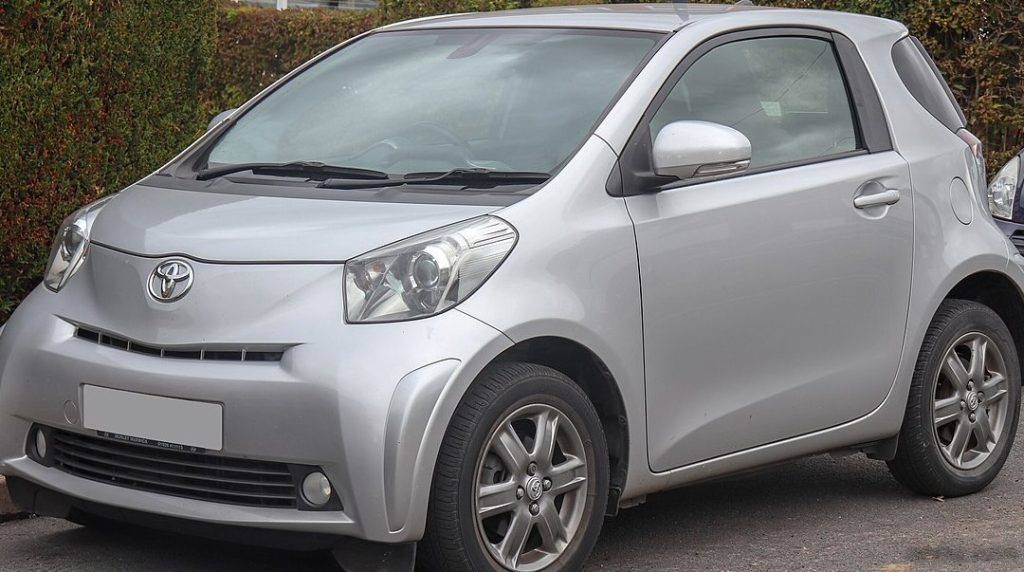
The Toyota iQ is a distinctive city car produced by Toyota from 2008 to 2015. Marketed as a premium compact vehicle, the iQ prioritized interior space efficiency within a remarkably small exterior footprint. While not officially sold in the United States, the iQ found a niche market in Europe and Japan, appealing to urban drivers seeking maneuverability and a unique design. The vehicle’s most notable feature was its asymmetrical interior design, which allowed for four adult occupants in a space typically reserved for two. The 1.0 VVT-i model, powered by a 68 horsepower engine, represented the entry point into the iQ range, focusing on fuel efficiency and low running costs.
Toyota iQ 1.0 VVT-i: A Detailed Overview
The Toyota iQ was conceived as a response to the growing demand for smaller, more efficient vehicles in densely populated urban environments. Toyota aimed to challenge conventional automotive design by maximizing interior space without significantly increasing the vehicle’s external dimensions. The iQ’s design philosophy centered around a “premium interior in a compact package,” and it achieved this through innovative packaging and a focus on essential features. The 1.0 VVT-i variant, with its modest power output, was specifically tailored for city driving, prioritizing fuel economy and ease of parking over outright performance. It was a popular choice for first-time car buyers and those seeking a practical and stylish urban runabout.
Engine & Performance
The Toyota iQ 1.0 VVT-i is powered by the 1KR-FE, a 998cc inline three-cylinder gasoline engine. This engine, part of Toyota’s ‘KR’ family of small displacement engines, is known for its fuel efficiency and reliability. It produces 64 horsepower at 6000 rpm and 91 Nm (67.12 lb.-ft.) of torque at 4800 rpm. While not a powerhouse, the engine provides adequate performance for urban driving conditions. The engine utilizes a multi-port fuel injection system and a Double Overhead Camshaft (DOHC) valvetrain with four valves per cylinder, contributing to its efficiency and smooth operation. The engine is transversely mounted at the front of the vehicle, driving the front wheels. The 1KR-FE engine is naturally aspirated, meaning it does not employ a turbocharger or supercharger. This simplicity contributes to its reliability and lower maintenance costs. The engine’s power-to-weight ratio, while modest, is sufficient for navigating city streets and highways at moderate speeds. The iQ 1.0 VVT-i prioritizes fuel economy, achieving respectable mileage for its class.
Design & Features
The Toyota iQ’s most striking feature is its exterior design. Despite its small size – measuring just under 3 meters in length – the iQ manages to accommodate four passengers. This is achieved through a clever asymmetrical dashboard design, which positions the instrument panel further forward, creating more legroom for the front passenger and allowing the driver to sit slightly offset. The exterior styling is characterized by a short, high cabin and a long wheelbase, giving the iQ a distinctive and modern appearance. The three-door hatchback configuration provides easy access to the rear seats, although space is limited. The iQ’s interior is well-appointed for its class, with a focus on quality materials and a minimalist design. Standard features typically included air conditioning, power windows, and a basic audio system. Safety features, while not as comprehensive as those found in larger vehicles, included multiple airbags and anti-lock brakes. The iQ’s compact size makes it exceptionally easy to maneuver and park in tight urban spaces. The vehicle’s design also prioritized pedestrian safety, with a high-mounted hood and a reinforced bumper.
Technical Specifications
| Brand | Toyota |
| Model | iQ |
| Generation | iQ |
| Type (Engine) | 1.0 VVT-i (68 Hp) |
| Start of production | November, 2008 |
| End of production | December, 2015 |
| Powertrain Architecture | Internal Combustion engine |
| Body type | Hatchback |
| Seats | 4 |
| Doors | 3 |
| Fuel Type | Petrol (Gasoline) |
| Power | 64 Hp @ 6000 rpm |
| Power per litre | 64.1 Hp/l |
| Torque | 91 Nm @ 4800 rpm / 67.12 lb.-ft. @ 4800 rpm |
| Engine layout | Front, Transverse |
| Engine Model/Code | 1KR-FE |
| Engine displacement | 998 cm3 / 60.9 cu. in. |
| Number of cylinders | 3 |
| Engine configuration | Inline |
| Cylinder Bore | 71 mm / 2.8 in. |
| Piston Stroke | 84 mm / 3.31 in. |
| Compression ratio | 10.5:1 |
| Number of valves per cylinder | 4 |
| Fuel injection system | Multi-port manifold injection |
| Engine aspiration | Naturally aspirated engine |
| Valvetrain | DOHC |
| Engine oil capacity | 3.1 l / 3.28 US qt | 2.73 UK qt |
| Fuel tank capacity | 32 l / 8.45 US gal | 7.04 UK gal |
| Coolant | 4.3 l / 4.54 US qt | 3.78 UK qt |
In conclusion, the Toyota iQ 1.0 VVT-i was a unique and innovative city car that offered a compelling combination of compactness, efficiency, and style. While not available in the US market, it proved popular in Europe and Japan as a practical and well-equipped urban vehicle. Its clever interior packaging and fuel-efficient engine made it an ideal choice for drivers navigating congested city streets.