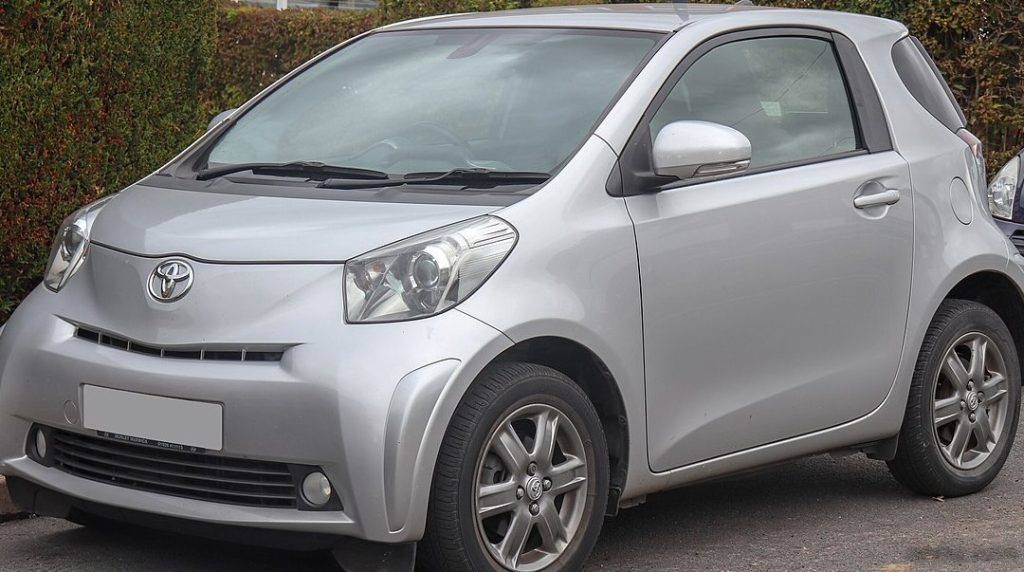
The Toyota iQ is a unique city car produced by Toyota from 2009 to 2015. Designed as a minimalist, three-door hatchback, the iQ prioritized compactness and efficient use of space. While not officially sold in the United States, the iQ found a niche market in Europe and Japan, appealing to urban drivers seeking a small, maneuverable, and fuel-efficient vehicle. The iQ’s most notable feature was its unconventional interior packaging, which allowed it to accommodate four adults despite its incredibly small footprint. This article details the 1.33 Dual VVT-i version, producing 98 horsepower.
Toyota iQ 1.33 Dual VVT-i: An Overview
The iQ represented a departure from conventional small car design. Toyota aimed to create a vehicle that was significantly smaller than existing superminis, while still offering a usable interior space. The result was a car that measured just under 3 meters (approximately 9.8 feet) in length. The 1.33 Dual VVT-i model, powered by Toyota’s 1NR-FE engine, was a mainstay of the iQ lineup, offering a balance of performance and economy. It was positioned as a premium city car, competing with vehicles like the Fiat 500 and Mini Cooper, though offering a distinctly different approach to space and practicality.
Engine & Performance
The Toyota iQ 1.33 Dual VVT-i is powered by the 1NR-FE, a 1.329-liter (81.1 cubic inch) inline-four cylinder gasoline engine. This engine produces 98 horsepower at 6000 rpm and 123 Nm (90.72 lb-ft) of torque at 4400 rpm. The engine utilizes Toyota’s Dual VVT-i (Variable Valve Timing-intelligence) technology, which optimizes valve timing for improved performance, fuel efficiency, and reduced emissions. Power is delivered to the front wheels via a six-speed manual transmission. The iQ 1.33 achieves a 0-100 km/h (0-62 mph) acceleration time of 11.8 seconds and a maximum speed of 170 km/h (105.63 mph). The engine’s power-to-weight ratio is 9.5 kg/Hp, and the torque-to-weight ratio is 7.6 kg/Nm. Fuel economy is a strong point, with combined cycle consumption rated at 4.9 l/100 km (48 US mpg or 57.6 UK mpg).
Design & Features
The iQ’s design is characterized by its short wheelbase, wide stance, and distinctive front-end styling. The three-door hatchback body style contributes to its compact dimensions. The interior is where the iQ truly stands out. Through clever packaging and a high-mounted dashboard, Toyota engineers managed to create space for four adults, a feat rarely achieved in a vehicle of this size. While rear legroom is limited, it is surprisingly usable for shorter journeys. Safety features included ABS (Anti-lock Braking System) as standard. The iQ’s interior appointments were generally focused on functionality and simplicity, with an emphasis on durable materials and a user-friendly layout. The vehicle’s small size made it exceptionally easy to maneuver in congested urban environments, and its relatively low weight contributed to its nimble handling. The trunk space, while modest at a minimum of 26 liters (0.92 cu. ft.), can be expanded to 363 liters (12.82 cu. ft.) with the rear seats folded down.
Technical Specifications
| Brand | Toyota |
| Model | iQ |
| Generation | iQ |
| Type (Engine) | 1.33 Dual VVT-i (98 Hp) |
| Start of production | May, 2009 |
| End of production | December, 2015 |
| Powertrain Architecture | Internal Combustion engine |
| Body type | Hatchback |
| Seats | 4 |
| Doors | 3 |
| Fuel consumption (urban) | 5.8 l/100 km (40.6 US mpg, 48.7 UK mpg, 17.2 km/l) |
| Fuel consumption (extra urban) | 4.4 l/100 km (53.5 US mpg, 64.2 UK mpg, 22.7 km/l) |
| Fuel consumption (combined) | 4.9 l/100 km (48 US mpg, 57.6 UK mpg, 20.4 km/l) |
| Fuel Type | Petrol (Gasoline) |
| Acceleration 0 – 100 km/h | 11.8 sec |
| Acceleration 0 – 62 mph | 11.8 sec |
| Acceleration 0 – 60 mph | 11.2 sec |
| Maximum speed | 170 km/h (105.63 mph) |
| Emission standard | Euro 5 |
| Weight-to-power ratio | 9.5 kg/Hp |
| Weight-to-torque ratio | 7.6 kg/Nm |
| Power | 98 Hp @ 6000 rpm |
| Torque | 123 Nm @ 4400 rpm (90.72 lb.-ft. @ 4400 rpm) |
| Engine layout | Front, Transverse |
| Engine Model/Code | 1NR-FE |
| Engine displacement | 1329 cm3 (81.1 cu. in.) |
| Number of cylinders | 4 |
| Engine configuration | Inline |
| Cylinder Bore | 72.5 mm (2.85 in.) |
| Piston Stroke | 80.5 mm (3.17 in.) |
| Compression ratio | 11.5:1 |
| Number of valves per cylinder | 4 |
| Fuel injection system | Multi-port manifold injection |
| Engine aspiration | Naturally aspirated engine |
| Valvetrain | DOHC – Dual VVT-i |
| Engine oil capacity | 3.5 l (3.7 US qt | 3.08 UK qt) |
| Coolant | 4.7 l (4.97 US qt | 4.14 UK qt) |
| Kerb Weight | 930 kg (2050.3 lbs.) |
| Max. weight | 1270 kg (2799.87 lbs.) |
| Max load | 340 kg (749.57 lbs.) |
| Trunk (boot) space – minimum | 26 l (0.92 cu. ft.) |
| Trunk (boot) space – maximum | 363 l (12.82 cu. ft.) |
| Fuel tank capacity | 32 l (8.45 US gal | 7.04 UK gal) |
| Length | 2985 mm (117.52 in.) |
| Width | 1680 mm (66.14 in.) |
| Height | 1500 mm (59.06 in.) |
| Wheelbase | 2000 mm (78.74 in.) |
| Front track | 1480 mm (58.27 in.) |
| Rear (Back) track | 1460 mm (57.48 in.) |
| Minimum turning circle | 7.8 m (25.59 ft.) |
| Drivetrain Architecture | Front wheel drive |
| Number of gears | 6 gears, manual transmission |
| Front suspension | Independent, type McPherson with coil spring and anti-roll bar |
| Rear suspension | Torsion |
| Front brakes | Ventilated discs |
| Rear brakes | Drum |
The Toyota iQ, while a niche vehicle, demonstrated Toyota’s willingness to innovate in the compact car segment. Its unique design and clever packaging made it a memorable and practical choice for urban drivers, particularly in markets where space is at a premium.