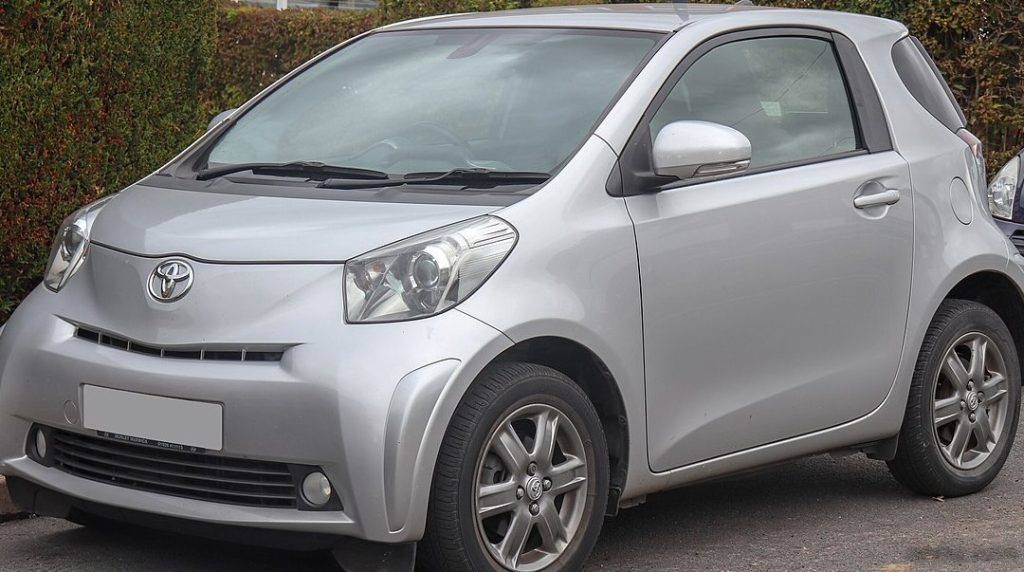
The Toyota iQ is a unique city car produced by Toyota from 2009 to 2015. Marketed as a premium compact vehicle, the iQ distinguished itself with its exceptionally small footprint and surprisingly spacious interior for its class. While not officially sold in the United States, the iQ found a niche market in Europe and Japan, appealing to urban drivers seeking maneuverability and fuel efficiency. The iQ represented a design departure for Toyota, prioritizing innovative packaging over traditional notions of vehicle size. This article details the technical specifications and characteristics of the 1.33 Dual VVT-i model with a Continuously Variable Transmission (CVT).
Toyota iQ: A Compact Revolution
The Toyota iQ, despite its diminutive size, aimed to provide comfortable seating for four adults. This was achieved through a clever design that moved many components traditionally located under the hood – such as the water pump and air conditioning compressor – to the engine bay’s sides and bottom. This innovative approach freed up space within the cabin, resulting in a surprisingly roomy interior for a vehicle measuring less than three meters in length. The iQ was positioned as a more upscale offering within the microcar segment, competing with vehicles like the Fiat 500 and Smart Fortwo, but offering a more practical four-seater configuration.
Engine & Performance
The 1.33 Dual VVT-i engine powering the Toyota iQ is a naturally aspirated, inline-four cylinder gasoline engine. Displacing 1329 cubic centimeters (81.1 cubic inches), it produces 98 horsepower at 6000 rpm and 123 Nm (90.72 lb.-ft.) of torque at 4400 rpm. The engine utilizes Toyota’s Dual Variable Valve Timing with intelligence (VVT-i) system, optimizing valve timing for improved performance and fuel efficiency across a wider range of engine speeds. This engine is paired with a six-speed Continuously Variable Transmission (CVT), which provides smooth and efficient power delivery. The iQ 1.33 achieves a 0-100 km/h (0-62 mph) acceleration time of 11.6 seconds and a maximum speed of 170 km/h (105.63 mph). Fuel economy is a key strength, with combined cycle consumption rated at 5.2 l/100 km (45.2 US mpg, 54.3 UK mpg).
Design & Features
The Toyota iQ is a three-door hatchback characterized by its distinctive, asymmetrical design. The front end features a bold grille and large headlights, while the rear is characterized by a steeply raked tailgate and vertically stacked taillights. The interior is designed with a focus on simplicity and functionality. Despite its small exterior dimensions, the iQ offers a relatively spacious cabin, particularly for front-seat occupants. Safety features included Anti-lock Braking System (ABS) and a comprehensive airbag system. The iQ’s compact size makes it exceptionally easy to maneuver in congested urban environments, and its relatively low weight contributes to its fuel efficiency. The trunk space, while limited at 26 liters (0.92 cu. ft.) with the rear seats up, can be expanded to 363 liters (12.82 cu. ft.) by folding them down. The iQ’s design prioritized a modern aesthetic and a practical, user-friendly interior.
Technical Specifications
| General Information | |
| Brand | Toyota |
| Model | iQ |
| Generation | iQ |
| Type (Engine) | 1.33 Dual VVT-i (98 Hp) CVT |
| Start of production | May, 2009 |
| End of production | December, 2015 |
| Powertrain Architecture | Internal Combustion engine |
| Body type | Hatchback |
| Seats | 4 |
| Doors | 3 |
| Performance Specs | |
| Fuel consumption (urban) | 6.4 l/100 km (36.8 US mpg, 44.1 UK mpg, 15.6 km/l) |
| Fuel consumption (extra urban) | 4.5 l/100 km (52.3 US mpg, 62.8 UK mpg, 22.2 km/l) |
| Fuel consumption (combined) | 5.2 l/100 km (45.2 US mpg, 54.3 UK mpg, 19.2 km/l) |
| Fuel Type | Petrol (Gasoline) |
| Acceleration 0 – 100 km/h | 11.6 sec |
| Acceleration 0 – 62 mph | 11.6 sec |
| Acceleration 0 – 60 mph | 11 sec |
| Maximum speed | 170 km/h (105.63 mph) |
| Emission standard | Euro 5 |
| Weight-to-power ratio | 9.5 kg/Hp, 105.4 Hp/tonne |
| Weight-to-torque ratio | 7.6 kg/Nm, 132.3 Nm/tonne |
| Engine Specs | |
| Power | 98 Hp @ 6000 rpm |
| Power per litre | 73.7 Hp/l |
| Torque | 123 Nm @ 4400 rpm (90.72 lb.-ft. @ 4400 rpm) |
| Engine layout | Front, Transverse |
| Engine Model/Code | 1NR-FE |
| Engine displacement | 1329 cm3 (81.1 cu. in.) |
| Number of cylinders | 4 |
| Engine configuration | Inline |
| Cylinder Bore | 72.5 mm (2.85 in.) |
| Piston Stroke | 80.5 mm (3.17 in.) |
| Compression ratio | 11.5:1 |
| Number of valves per cylinder | 4 |
| Fuel injection system | Multi-port manifold injection |
| Engine aspiration | Naturally aspirated engine |
| Valvetrain | DOHC – Dual VVT-i |
| Engine oil capacity | 3.5 l (3.7 US qt | 3.08 UK qt) |
| Coolant | 4.9 l (5.18 US qt | 4.31 UK qt) |
| Space, Volume and Weights | |
| Kerb Weight | 930 kg (2050.3 lbs.) |
| Max. weight | 1270 kg (2799.87 lbs.) |
| Max load | 340 kg (749.57 lbs.) |
| Trunk (boot) space – minimum | 26 l (0.92 cu. ft.) |
| Trunk (boot) space – maximum | 363 l (12.82 cu. ft.) |
| Fuel tank capacity | 32 l (8.45 US gal | 7.04 UK gal) |
| Dimensions | |
| Length | 2985 mm (117.52 in.) |
| Width | 1680 mm (66.14 in.) |
| Height | 1500 mm (59.06 in.) |
| Wheelbase | 2000 mm (78.74 in.) |
| Front track | 1480 mm (58.27 in.) |
| Rear track | 1460 mm (57.48 in.) |
| Minimum turning circle | 7.8 m (25.59 ft.) |
| Drivetrain, Brakes and Suspension | |
| Drivetrain Architecture | The Internal combustion engine (ICE) drives the front wheels of the vehicle. |
| Drive wheel | Front wheel drive |
| Number of gears and type of gearbox | 6 gears, automatic transmission CVT |
| Front suspension | Independent, type McPherson with coil spring and anti-roll bar |
| Rear suspension | Torsion |
| Front brakes | Ventilated discs |
| Rear brakes | Drum |
| Assisting systems | ABS (Anti-lock braking system) |
| Steering type | Steering rack and pinion |