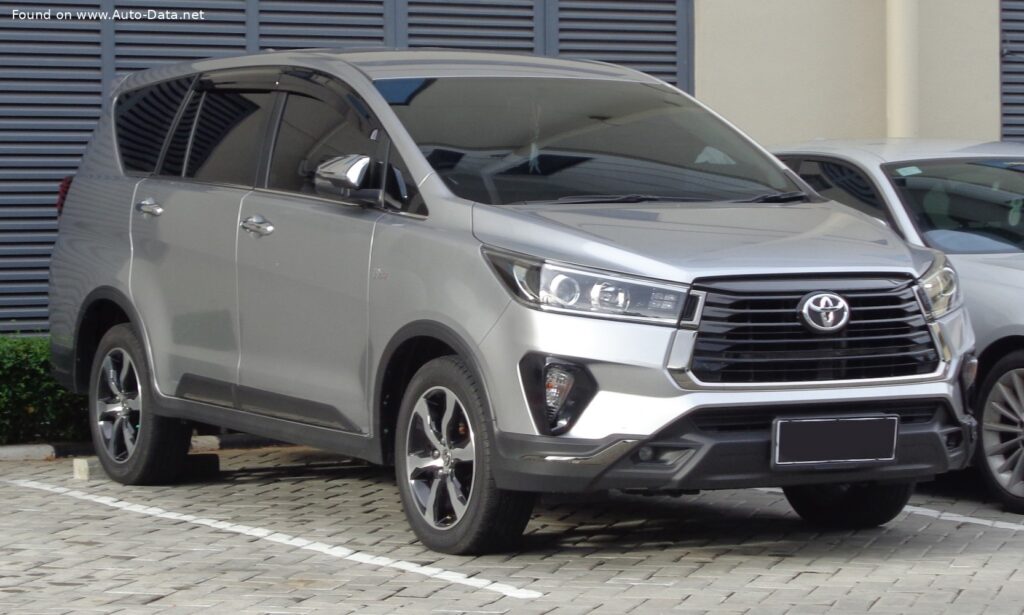
The Toyota Kijang Innova II (facelift 2020) 2.4d Automatic is a multi-purpose vehicle (MPV) primarily designed and sold in Southeast Asian markets, particularly Indonesia, Thailand, and the Philippines. While not officially sold in the United States, the Innova holds a significant position as a practical and affordable family vehicle in its target regions. The Kijang nameplate has a long and storied history in Indonesia, dating back to 1976, evolving from a rugged, utilitarian vehicle into the more comfortable and feature-rich MPV it is today. The Innova II, introduced in 2015 and facelifted in 2020, represents a substantial upgrade in terms of refinement, safety, and technology compared to its predecessors. This version, specifically the 2.4d Automatic, offers a balance of fuel efficiency, power, and passenger capacity, making it a popular choice for both private and commercial use.
Toyota Kijang Innova II (facelift 2020): An Overview
The 2020 facelift brought cosmetic updates to the exterior, including a redesigned front grille, headlights, and bumpers, as well as interior enhancements focused on improving comfort and convenience. The 2.4d variant is powered by a turbocharged diesel engine, offering a good compromise between performance and fuel economy. The Innova II caters to a market segment that prioritizes practicality, reliability, and space over outright performance or luxury. It’s commonly used for family transportation, tourism, and as a versatile vehicle for businesses requiring passenger or cargo carrying capabilities.
Engine & Performance
The heart of the Toyota Kijang Innova II 2.4d Automatic is the 2GD-FTV 2.4-liter inline-four cylinder diesel engine. This engine produces 149 horsepower at 3400 rpm and 360 Nm (265.52 lb.-ft.) of torque between 1200 and 2600 rpm. The torque curve is relatively flat, providing ample pulling power for carrying passengers and luggage, even when fully loaded. The engine features a turbocharger with an intercooler, enhancing power output and efficiency. Fuel is delivered via a diesel commonrail direct injection system, contributing to improved combustion and reduced emissions. Power is sent to the rear wheels through a six-speed automatic transmission with a Sport Sequential Switchmatic mode, allowing drivers to manually select gears for more control. The engine also incorporates a Start & Stop System, further improving fuel economy in urban driving conditions. The longitudinal engine layout contributes to efficient packaging within the vehicle’s chassis.
Design & Features
The Toyota Kijang Innova II is a five-door MPV typically configured to seat six or seven passengers. Its body-on-frame construction provides a robust and durable platform, suitable for handling varied road conditions. The 2020 facelift brought a more modern and aggressive exterior styling, with a prominent front grille and redesigned headlights. Inside, the Innova II offers a spacious and comfortable cabin, with ample headroom and legroom for all occupants. Features vary depending on the trim level, but generally include air conditioning, power windows, power steering, and an audio system. Safety features, particularly in the facelifted model, were enhanced to include Anti-lock Braking System (ABS) as standard. The interior design focuses on practicality and durability, with hard-wearing materials and easy-to-clean surfaces. The rear suspension utilizes an independent multi-link setup, contributing to a more comfortable ride quality. Available wheel sizes range from 16 to 17 inches, typically fitted with tires sized 205/65 R16 or 215/55 R17.
Technical Specifications
| Brand | Toyota |
| Model | Innova |
| Generation | Kijang Innova II (facelift 2020) |
| Type (Engine) | 2.4d (149 Hp) Automatic |
| Start of production | October, 2020 |
| End of production | November, 2022 |
| Powertrain Architecture | Internal Combustion engine |
| Body type | MPV |
| Seats | 6-7 |
| Doors | 5 |
| Fuel Type | Diesel |
| Power | 149 Hp @ 3400 rpm |
| Power per litre | 62.3 Hp/l |
| Torque | 360 Nm @ 1200-2600 rpm / 265.52 lb.-ft. @ 1200-2600 rpm |
| Engine layout | Front, Longitudinal |
| Engine Model/Code | 2GD-FTV |
| Engine displacement | 2393 cm3 / 146.03 cu. in. |
| Number of cylinders | 4 |
| Engine configuration | Inline |
| Cylinder Bore | 92 mm / 3.62 in. |
| Piston Stroke | 90 mm / 3.54 in. |
| Number of valves per cylinder | 4 |
| Fuel injection system | Diesel Commonrail |
| Engine aspiration | Turbocharger, Intercooler |
| Valvetrain | DOHC, VNT |
| Engine systems | Start & Stop System |
| Length | 4735 mm / 186.42 in. |
| Width | 1830 mm / 72.05 in. |
| Height | 1795 mm / 70.67 in. |
| Wheelbase | 2750 mm / 108.27 in. |
| Front track | 1540 mm / 60.63 in. |
| Rear (Back) track | 1540 mm / 60.63 in. |
| Drivetrain Architecture | ICE drives rear wheels |
| Drive wheel | Rear wheel drive |
| Number of gears and type of gearbox | 6 gears, automatic transmission Sport Sequential Switchmatic |
| Front suspension | Coil spring, Double wishbone, Transverse stabilizer |
| Rear suspension | Independent multi-link suspension |
| Front brakes | Ventilated discs |
| Rear brakes | Drum |
| Assisting systems | ABS (Anti-lock braking system) |
| Steering type | Steering rack and pinion |
| Power steering | Electric Steering |
| Tires size | 205/65 R16; 215/55 R17 |
| Wheel rims size | 16; 17 |
The Toyota Kijang Innova II (facelift 2020) 2.4d Automatic remains a popular choice in its target markets due to its blend of practicality, reliability, and affordability. While not available in the US market, it represents a significant vehicle in the Southeast Asian automotive landscape, catering to the needs of families and businesses alike. Its robust construction, efficient diesel engine, and spacious interior make it a versatile and dependable transportation solution.