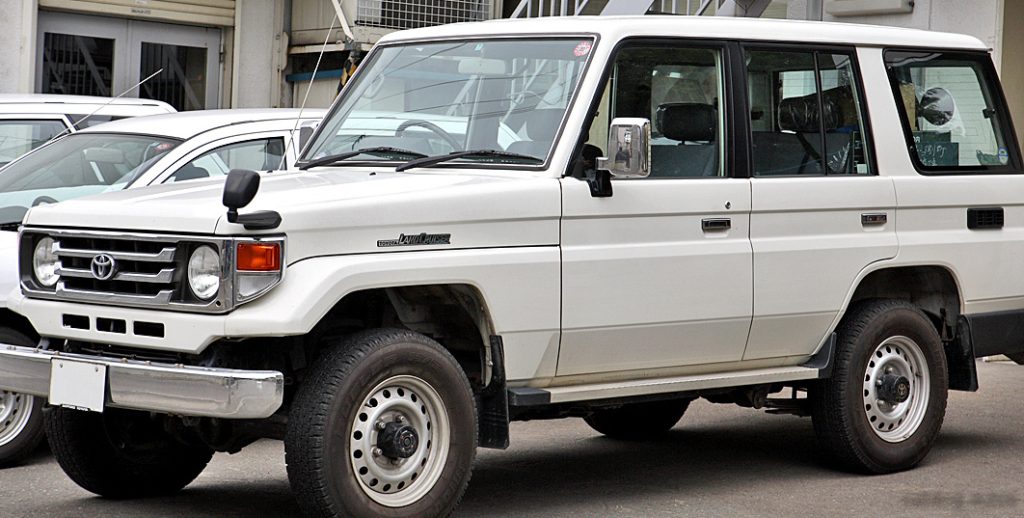
The Toyota Land Cruiser 70, specifically the 2.8L (204 hp) 4WD ECT variant, represents a continuation of a legendary lineage of off-road vehicles. Introduced in November 2023 for the Japanese domestic market (JDM), this iteration builds upon the enduring 70-series platform (J70) which dates back to 1982. While the Land Cruiser has evolved significantly in other markets with more luxurious iterations, the 70 series remains a steadfastly utilitarian and robust vehicle, prized for its exceptional off-road capability and durability. This particular 2.8L diesel variant occupies a middle ground in the 70 series lineup, offering a balance between performance, fuel efficiency, and practicality for both work and recreational use. It’s important to note that this model is not officially sold in the United States, making it a sought-after import for enthusiasts.
Technical Specifications
| Brand | Toyota |
| Model | Land Cruiser |
| Generation | Land Cruiser (70, Japan) |
| Type (Engine) | 2.8L (204 Hp) 4WD ECT |
| Start of production | November, 2023 |
| Powertrain Architecture | Internal Combustion engine |
| Body type | Off-road vehicle |
| Seats | 5 |
| Doors | 5 |
| Fuel consumption (economy) – urban (WLTC) | 12.5 l/100 km (18.8 US mpg, 22.6 UK mpg, 8 km/l) |
| Fuel consumption (economy) – extra urban (WLTC) | 9.1 l/100 km (25.8 US mpg, 31 UK mpg, 11 km/l) |
| Fuel consumption (economy) – combined (WLTC) | 9.9 l/100 km (23.8 US mpg, 28.5 UK mpg, 10.1 km/l) |
| Fuel Type | Diesel |
| Weight-to-power ratio | 11.3 kg/Hp, 88.7 Hp/tonne |
| Weight-to-torque ratio | 4.6 kg/Nm, 217.4 Nm/tonne |
| Power | 204 Hp @ 3000-3400 rpm |
| Power per litre | 74.1 Hp/l |
| Torque | 500 Nm @ 1600-2800 rpm (368.78 lb.-ft. @ 1600-2800 rpm) |
| Engine layout | Front, Longitudinal |
| Engine Model/Code | 1GD-FTV |
| Engine displacement | 2754 cm3 (168.06 cu. in.) |
| Number of cylinders | 4 |
| Engine configuration | Inline |
| Cylinder Bore | 92 mm (3.62 in.) |
| Piston Stroke | 103.6 mm (4.08 in.) |
| Number of valves per cylinder | 4 |
| Fuel injection system | Diesel Commonrail |
| Engine aspiration | Turbocharger, Intercooler |
| Kerb Weight | 2300 kg (5070.63 lbs.) |
| Max. weight | 2575 kg (5676.9 lbs.) |
| Max load | 275 kg (606.27 lbs.) |
| Fuel tank capacity | 130 l (34.34 US gal | 28.6 UK gal) |
| Length | 4890 mm (192.52 in.) |
| Width | 1870 mm (73.62 in.) |
| Height | 1920 mm (75.59 in.) |
| Wheelbase | 2730 mm (107.48 in.) |
| Front track | 1555 mm (61.22 in.) |
| Rear (Back) track | 1460 mm (57.48 in.) |
| Ride height (ground clearance) | 200 mm (7.87 in.) |
| Minimum turning circle (turning diameter) | 12.6 m (41.34 ft.) |
| Approach angle | 33° |
| Departure angle | 23° |
| Ramp-over (brakeover) angle | 26° |
| Wading depth | 700 mm (27.56 in.) |
| Drivetrain Architecture | The Internal combustion engine (ICE) drives the rear wheels permanently, and the front wheels are driven through an electrically or mechanically operated clutch if necessary. |
| Drive wheel | All wheel drive (4×4) |
| Number of gears and type of gearbox | 6 gears, automatic transmission ECT |
| Front suspension | Coil spring, Rigid axle suspension |
| Rear suspension | Dependent suspension of two longitudinal semi-elliptic leaf springs |
| Front brakes | Ventilated discs |
| Rear brakes | Ventilated discs |
| Assisting systems | ABS (Anti-lock braking system) |
| Steering type | Steering rack and pinion |
| Power steering | Hydraulic Steering |
| Tires size | 265/70 R16 |
| Wheel rims size | 7J x 16 |
Powertrain & Engine Architecture
The heart of this Land Cruiser 70 is the 1GD-FTV 2.8-liter inline-four diesel engine. This engine is a member of Toyota’s GD series, known for its robustness and efficiency. It utilizes a common-rail direct injection system, delivering fuel at extremely high pressure for optimized combustion. A turbocharger with an intercooler further enhances performance, providing increased power and torque. The engine produces 204 horsepower at 3000-3400 rpm and a substantial 500 Nm (368.78 lb-ft) of torque between 1600-2800 rpm. This broad torque band is crucial for off-road driving, providing ample pulling power at low speeds. The engine is longitudinally mounted in the chassis. Paired with the engine is a six-speed automatic transmission, designated ECT (Electronically Controlled Transmission). This transmission is designed for both on-road comfort and off-road durability, offering smooth shifts and the ability to hold gears for challenging terrain.
Driving Characteristics
The 2.8L automatic Land Cruiser 70 offers a driving experience that prioritizes capability over outright speed. While not a particularly fast vehicle, the ample torque provides strong acceleration from a standstill and effortless cruising at highway speeds. The automatic transmission is well-suited to the engine’s characteristics, providing smooth shifts and preventing the engine from bogging down during off-road maneuvers. Compared to the manual transmission versions, the automatic offers greater convenience, especially in urban environments or during prolonged off-road expeditions. However, some enthusiasts prefer the greater control offered by the manual gearbox. Compared to higher-output versions (which are not commonly available in the JDM 70 series), this 2.8L variant offers a more balanced fuel economy and a less stressed powertrain, potentially leading to increased long-term reliability.
Equipment & Trim Levels
The Land Cruiser 70, even in this 2.8L automatic configuration, is relatively spartan in terms of luxury features, reflecting its utilitarian origins. Standard equipment typically includes air conditioning, power windows, and a basic audio system. The interior is characterized by durable, easy-to-clean materials. Upholstery is typically vinyl or cloth. Optional extras could include a rear differential lock, upgraded audio systems, and various off-road accessories such as a winch or roof rack. The trim level is generally considered mid-range within the 70 series lineup, offering a step up from the most basic work-oriented models but lacking the more refined features found in some of the higher-spec versions.
Chassis & Braking
The Land Cruiser 70 utilizes a body-on-frame construction, providing exceptional strength and durability. The front suspension consists of coil springs and a rigid axle, while the rear suspension employs a traditional leaf spring setup. This configuration is optimized for off-road performance, offering significant wheel articulation and the ability to absorb rough terrain. Braking duties are handled by ventilated disc brakes on all four wheels, providing adequate stopping power for the vehicle’s weight. An Anti-lock Braking System (ABS) is standard, enhancing safety during emergency braking situations. The steering system is a hydraulic rack and pinion setup, offering precise control and a reasonable turning radius.
Market Reception & Comparison
The Land Cruiser 70, particularly the 2.8L diesel variant, enjoys a strong reputation in Japan for its reliability, durability, and off-road capability. Critics praise its robust construction and its ability to handle challenging terrain with ease. Fuel economy is reasonable for a vehicle of its size and type, averaging around 23.8 US mpg in combined driving conditions. Compared to other trims in the lineup, the 2.8L automatic offers a good balance between performance and efficiency. It’s often seen as a practical choice for those who need a capable off-road vehicle for work or recreation, without the added expense of higher-spec models.
Legacy
The 1GD-FTV engine, when properly maintained, is known for its longevity and reliability. The Land Cruiser 70’s robust chassis and simple mechanical design contribute to its exceptional durability. In the used car market, these vehicles hold their value well, particularly those that have been well-maintained and have not been subjected to extreme off-road abuse. The Land Cruiser 70 continues to be a popular choice for those seeking a dependable and capable off-road vehicle, and its enduring legacy is a testament to Toyota’s commitment to building vehicles that can withstand the test of time.