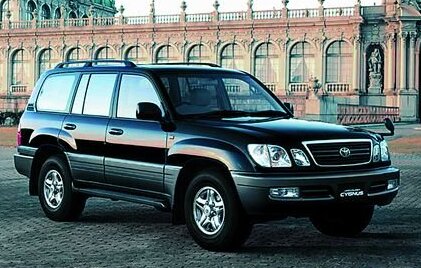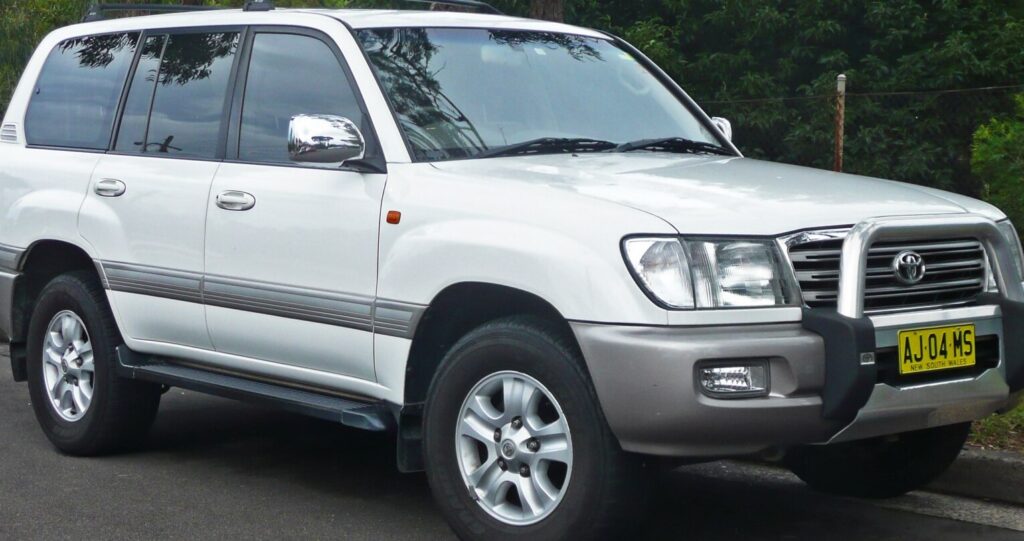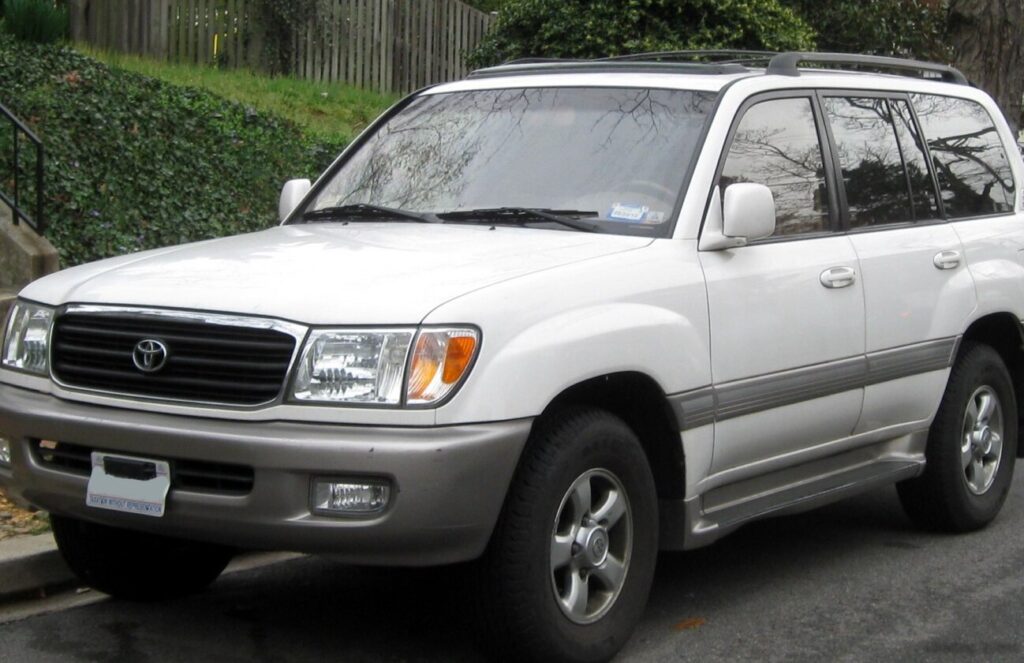
The Toyota Land Cruiser J100 4.2 TD, produced between 1998 and 2002, represented a significant evolution in Toyota’s legendary off-road vehicle lineage. Positioned as a premium, full-size SUV, the J100 series aimed to blend robust off-road capability with increased on-road refinement and luxury. The 4.2 TD variant, powered by the 1HD-FTE diesel engine, was a key offering, particularly in markets outside of North America where diesel engines were favored for their fuel efficiency and torque. This model sat within the J100 range as a workhorse option, offering a balance between capability and cost, falling below the more luxurious petrol-powered trims.
Technical Specifications
| Brand | Toyota |
| Model | Land Cruiser |
| Generation | Land Cruiser (J100) |
| Type (Engine) | 4.2 TD (204 Hp) |
| Start of production | 1998 |
| End of production | 2002 |
| Powertrain Architecture | Internal Combustion engine |
| Body type | SUV |
| Seats | 8 |
| Doors | 5 |
| Fuel consumption (economy) – urban | 16.1 l/100 km (14.6 US mpg, 17.5 UK mpg, 6.2 km/l) |
| Fuel consumption (economy) – combined | 11.1 l/100 km (21.2 US mpg, 25.4 UK mpg, 9 km/l) |
| Fuel Type | Diesel |
| Acceleration 0 – 100 km/h | 13.6 sec |
| Acceleration 0 – 62 mph | 13.6 sec |
| Acceleration 0 – 60 mph | 12.9 sec |
| Maximum speed | 170 km/h (105.63 mph) |
| Weight-to-power ratio | 12.2 kg/Hp, 81.8 Hp/tonne |
| Weight-to-torque ratio | 5.8 kg/Nm, 172.3 Nm/tonne |
| Power | 204 Hp @ 3400 rpm |
| Power per litre | 49 Hp/l |
| Torque | 430 Nm @ 1400 rpm (317.15 lb.-ft. @ 1400 rpm) |
| Engine layout | Front, Longitudinal |
| Engine Model/Code | 1HD-FTE |
| Engine displacement | 4164 cm3 (254.1 cu. in.) |
| Number of cylinders | 6 |
| Engine configuration | Inline |
| Cylinder Bore | 94 mm (3.7 in.) |
| Piston Stroke | 100 mm (3.94 in.) |
| Compression ratio | 18.8:1 |
| Number of valves per cylinder | 4 |
| Fuel injection system | Direct injection |
| Engine aspiration | Turbocharger, Intercooler |
| Valvetrain | SOHC |
| Engine oil capacity | 11.4 l (12.05 US qt, 10.03 UK qt) |
| Coolant | 13.7 l (14.48 US qt, 12.05 UK qt) |
| Kerb Weight | 2495 kg (5500.53 lbs.) |
| Max. weight | 3260 kg (7187.07 lbs.) |
| Max load | 765 kg (1686.54 lbs.) |
| Trunk (boot) space – minimum | 589 l (20.8 cu. ft.) |
| Trunk (boot) space – maximum | 2571 l (90.79 cu. ft.) |
| Fuel tank capacity | 96 l (25.36 US gal, 21.12 UK gal) |
| Length | 4890 mm (192.52 in.) |
| Width | 1940 mm (76.38 in.) |
| Height | 1860 mm (73.23 in.) |
| Wheelbase | 2850 mm (112.2 in.) |
| Front track | 1620 mm (63.78 in.) |
| Rear (Back) track | 1615 mm (63.58 in.) |
| Minimum turning circle | 12.1 m (39.7 ft.) |
| Drivetrain Architecture | All wheel drive (4×4) |
| Number of gears | 5 |
| Type of gearbox | Manual transmission |
| Front suspension | Double wishbone, Trailing arm |
| Rear suspension | Rigid axle suspension, Coil spring |
| Front brakes | Ventilated discs |
| Rear brakes | Ventilated discs |
| Assisting systems | ABS (Anti-lock braking system) |
| Steering type | Steering rack and pinion |
| Power steering | Hydraulic Steering |
| Tires size | 275/65 R17 |
Powertrain & Engine Architecture
The heart of the J100 4.2 TD is the 1HD-FTE engine, a 4.2-liter inline-six cylinder diesel. This engine is renowned for its durability and high torque output. The ‘FTE’ designation indicates a factory-turbocharged and intercooled version, significantly boosting power and efficiency compared to naturally aspirated versions. The 1HD-FTE utilizes a direct injection system, injecting fuel directly into the combustion chamber under extremely high pressure. This, combined with the turbocharger and intercooler, allows for a robust 204 horsepower at 3400 rpm and a substantial 430 Nm (317 lb-ft) of torque at a low 1400 rpm. The engine features a single overhead camshaft (SOHC) valvetrain, a design choice prioritizing simplicity and reliability. The J100 4.2 TD was typically paired with a robust 5-speed manual transmission, although a 4-speed automatic transmission was also available, albeit less common. The automatic transmission was designed to handle the engine’s significant torque, but often resulted in slightly reduced fuel economy and a less engaging driving experience.
Driving Characteristics
The Land Cruiser J100 4.2 TD with the manual transmission offered a surprisingly capable and refined driving experience. The engine’s abundant low-end torque meant that strong acceleration was available from very low speeds, making it ideal for off-road driving and towing. While not a sports car, the 4.2 TD provided adequate power for highway cruising and overtaking. The 5-speed manual transmission allowed for precise control over the engine’s powerband. The automatic transmission, while convenient, felt somewhat sluggish in comparison, with noticeable gear hunting in certain situations. The gear ratios were optimized for torque delivery rather than outright speed. The J100’s substantial weight (approximately 2495 kg or 5500 lbs) was noticeable, but the robust suspension and powerful engine mitigated much of this.
Equipment & Trim Levels
The J100 4.2 TD typically came with a respectable level of standard equipment, reflecting its positioning as a premium SUV. Standard features often included air conditioning, power windows and locks, central locking, and an AM/FM radio with a cassette player. Higher trim levels added features such as leather upholstery, woodgrain interior trim, a sunroof, and upgraded audio systems. Optional extras included a navigation system (rare for the time), heated seats, and a rear air conditioning system. The interior design was functional and durable, prioritizing practicality over outright luxury, although the build quality was generally very good.
Chassis & Braking
The J100’s chassis was a body-on-frame construction, providing exceptional strength and durability, essential for off-road use. The front suspension utilized a double wishbone and trailing arm setup, while the rear featured a rigid axle suspension with coil springs. This combination provided a comfortable ride on paved roads while maintaining excellent articulation for off-road terrain. Braking duties were handled by ventilated disc brakes on all four wheels, providing adequate stopping power for the vehicle’s weight. An Anti-lock Braking System (ABS) was standard, enhancing safety. The steering system was a hydraulic power steering rack and pinion, offering precise and responsive steering feel.
Market Reception & Comparison
The Land Cruiser J100 4.2 TD was generally well-received by automotive critics, praised for its robust build quality, off-road capability, and fuel efficiency (for a vehicle of its size). Compared to the petrol-powered J100 variants, the 4.2 TD offered significantly better fuel economy and a more relaxed driving experience, particularly on long journeys. However, it was slightly slower in acceleration. Compared to other large SUVs of the era, such as the Range Rover and the Mercedes-Benz M-Class, the Land Cruiser offered a more utilitarian and rugged appeal, prioritizing durability and off-road performance over outright luxury.
Legacy
The Toyota Land Cruiser J100 4.2 TD has earned a reputation for exceptional reliability and longevity. The 1HD-FTE engine is known to be capable of exceeding 300,000 miles with proper maintenance. Today, the J100 4.2 TD remains a popular choice in the used car market, particularly among those seeking a durable and capable off-road vehicle. Parts availability is generally good, and the relatively simple mechanical design makes it easier to maintain and repair compared to more modern SUVs. While fuel economy is not exceptional by today’s standards, the J100 4.2 TD continues to be a highly regarded and sought-after vehicle, representing a golden age of Toyota’s off-road engineering.