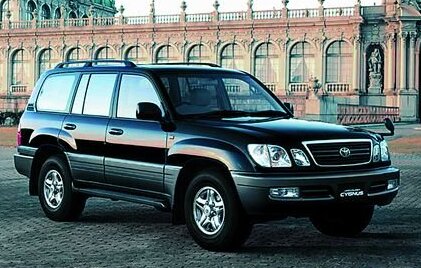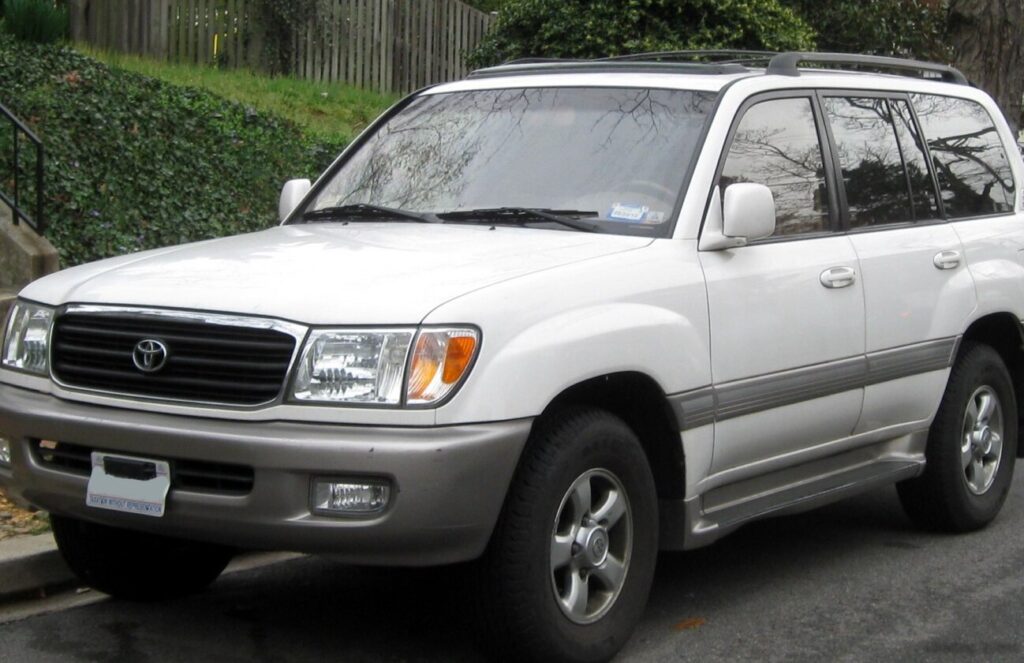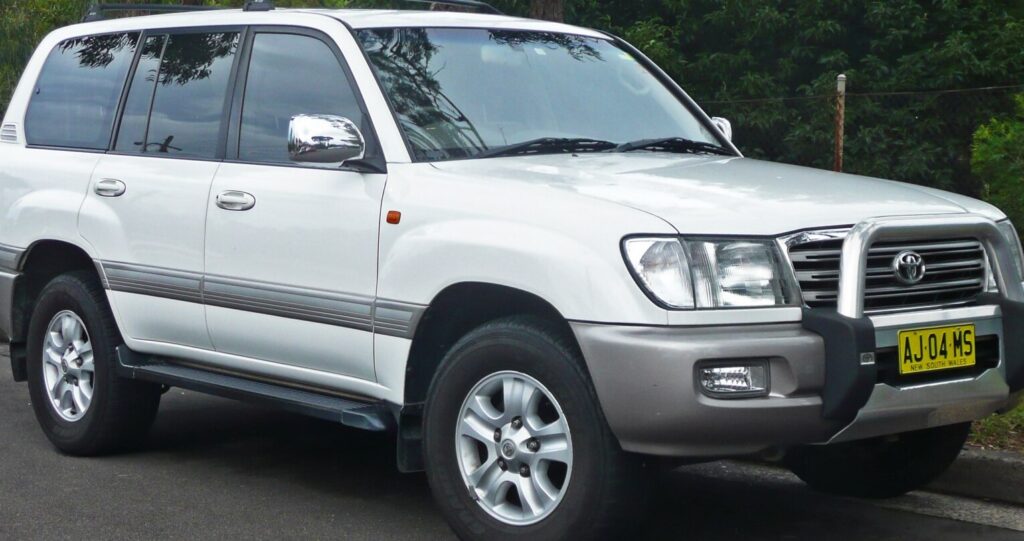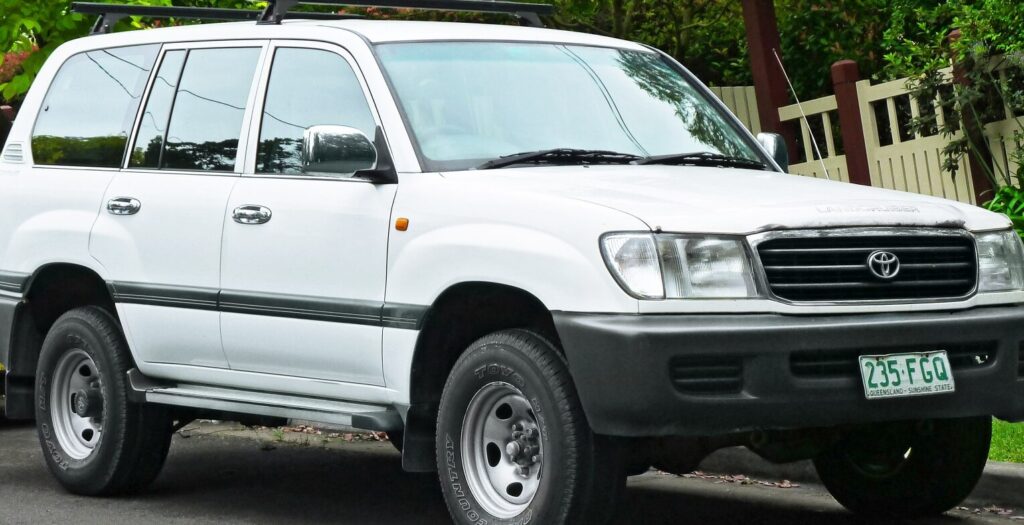
The Toyota Land Cruiser J105 series, produced from 1998 to 2005, represented a significant evolution of Toyota’s legendary off-road vehicle. Positioned as a robust and reliable SUV, the J105 aimed to balance off-road capability with improved on-road comfort and refinement compared to its predecessors. Within the J105 range, the 4.2 D variant, powered by the 1HZ diesel engine producing 131 horsepower, occupied a crucial role, particularly in markets outside of North America where diesel engines were favored for their fuel efficiency and torque. This model served as a workhorse option, appealing to those prioritizing durability and practicality over outright performance. It was offered with both manual and automatic transmissions, with the automatic being a popular choice for ease of use in challenging terrain and everyday driving.
Technical Specifications
| Brand | Toyota |
| Model | Land Cruiser |
| Generation | Land Cruiser (J105) |
| Type (Engine) | 4.2 D (131 Hp) |
| Start of production | 1998 |
| End of production | 2005 |
| Powertrain Architecture | Internal Combustion engine |
| Body type | SUV |
| Seats | 8 |
| Doors | 5 |
| Fuel Type | Diesel |
| Maximum speed | 155 km/h (96.31 mph) |
| Weight-to-power ratio | 18 kg/Hp, 55.5 Hp/tonne |
| Weight-to-torque ratio | 8.4 kg/Nm, 118.6 Nm/tonne |
| Power | 131 Hp @ 4000 rpm |
| Power per litre | 31.5 Hp/l |
| Torque | 280 Nm @ 2000 rpm (206.52 lb.-ft. @ 2000 rpm) |
| Engine layout | Front, Longitudinal |
| Engine Model/Code | 1HZ |
| Engine displacement | 4164 cm3 (254.1 cu. in.) |
| Number of cylinders | 6 |
| Engine configuration | Inline |
| Cylinder Bore | 94 mm (3.7 in.) |
| Piston Stroke | 100 mm (3.94 in.) |
| Compression ratio | 22.7:1 |
| Number of valves per cylinder | 2 |
| Fuel injection system | Precombustion chamber injection |
| Engine aspiration | Naturally aspirated engine |
| Valvetrain | OHC |
| Engine oil capacity | 9.3 l (9.83 US qt | 8.18 UK qt) |
| Coolant | 14 l (14.79 US qt | 12.32 UK qt) |
| Kerb Weight | 2360 kg (5202.91 lbs) |
| Max. weight | 3180 kg (7010.7 lbs) |
| Max load | 820 kg (1807.79 lbs) |
| Fuel tank capacity | 95 l (25.1 US gal | 20.9 UK gal) |
| Length | 4890 mm (192.52 in) |
| Width | 1920 mm (75.59 in) |
| Height | 1850 mm (72.83 in) |
| Wheelbase | 2850 mm (112.2 in) |
| Front track | 1605 mm (63.19 in) |
| Rear (Back) track | 1600 mm (62.99 in) |
| Front overhang | 895 mm (35.24 in) |
| Rear overhang | 1145 mm (45.08 in) |
| Minimum turning circle | 12.8 m (41.99 ft) |
| Drivetrain Architecture | All wheel drive (4×4) |
| Number of gears | 5 gears, manual transmission |
| Front suspension | Dependent spring suspension with anti-roll bar |
| Rear suspension | dependent spring suspension, Transverse stabilizer |
| Front brakes | Ventilated discs |
| Rear brakes | Drum |
| Assisting systems | ABS (Anti-lock braking system) |
| Steering type | Cone worm with recirculation balls |
| Power steering | Hydraulic Steering |
| Tires size | 235/85 R16LT |
Powertrain & Engine Architecture
The heart of the Land Cruiser J105 4.2 D is the 1HZ inline-six diesel engine. This engine is renowned for its exceptional durability and longevity, a hallmark of Toyota’s diesel engineering. The 1HZ utilizes a precombustion chamber injection system, a design common in diesel engines of this era. This system involves injecting fuel into a precombustion chamber, which then ignites the main combustion chamber, promoting more complete combustion and reducing noise. The engine’s 22.7:1 compression ratio contributes to its efficiency and torque output. The 131 horsepower and 280 Nm (206.52 lb-ft) of torque are delivered at relatively low engine speeds, making it well-suited for off-road driving and towing. The automatic transmission, typically a four-speed unit, was chosen to provide ease of operation, particularly for drivers unfamiliar with manual transmissions or those frequently navigating difficult terrain. The transmission’s gear ratios were optimized for low-speed torque and climbing ability, rather than outright acceleration.
Driving Characteristics
The 131 hp 4.2 D automatic Land Cruiser J105 delivers a driving experience focused on capability and dependability rather than speed. Acceleration is modest, and the vehicle feels its weight, especially when fully loaded. However, the engine’s strong low-end torque makes it capable of tackling steep inclines and navigating challenging off-road conditions with relative ease. The automatic transmission shifts smoothly, but can feel somewhat sluggish compared to more modern transmissions. Compared to the more powerful gasoline-powered Land Cruisers or even later diesel variants, the 4.2 D automatic prioritizes fuel efficiency and robustness over performance. Manual transmission versions of the same engine offered slightly improved responsiveness and fuel economy, but at the cost of convenience.
Equipment & Trim Levels
The 4.2 D variant of the J105 Land Cruiser typically came with a fairly basic level of equipment, reflecting its positioning as a practical, work-oriented vehicle. Standard features generally included air conditioning, power windows, and a basic audio system. Interior upholstery was typically vinyl or a durable cloth material. Optional extras could include power seats, a sunroof, and upgraded audio systems. Trim levels varied depending on the market, but generally focused on adding convenience features rather than significantly altering the vehicle’s core capabilities. The emphasis was on providing a functional and reliable vehicle rather than a luxurious one.
Chassis & Braking
The Land Cruiser J105 features a robust body-on-frame construction, providing excellent durability and off-road capability. The suspension utilizes a dependent spring setup with anti-roll bars on both the front and rear axles. This configuration provides a comfortable ride on paved roads while maintaining excellent articulation for off-road use. The front brakes are ventilated discs, providing adequate stopping power, while the rear brakes are drums, a cost-saving measure common in this class of vehicle. The steering system is a recirculating ball type, offering a direct feel but lacking the precision of more modern steering systems.
Market Reception & Comparison
The Land Cruiser J105 4.2 D was well-received in markets where diesel engines were popular, particularly in Europe, Australia, and parts of Asia. Critics praised its reliability, durability, and off-road capability. However, the engine’s relatively low power output and the somewhat dated automatic transmission were points of criticism. Compared to the gasoline-powered Land Cruisers, the 4.2 D offered significantly better fuel economy and lower running costs, making it a popular choice for those covering long distances or using the vehicle for work. Compared to other diesel-powered SUVs of the time, the Land Cruiser stood out for its exceptional reliability and build quality.
Legacy
The Toyota Land Cruiser J105 4.2 D has earned a reputation as one of the most reliable and durable SUVs ever built. The 1HZ engine is known to withstand extremely high mileage with proper maintenance. Today, these vehicles are highly sought after in the used car market, particularly those that have been well-maintained. The 4.2 D automatic variant remains a popular choice for those seeking a capable and dependable off-road vehicle that is also relatively affordable to operate. Its simplicity and robust construction make it a relatively easy vehicle to maintain and repair, even in remote locations. The J105 4.2 D continues to be a testament to Toyota’s commitment to building vehicles that stand the test of time.