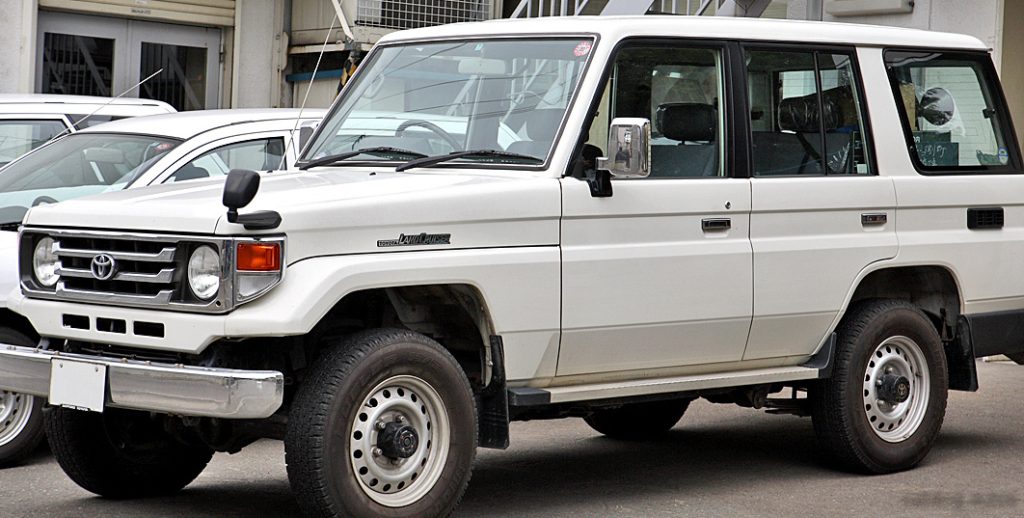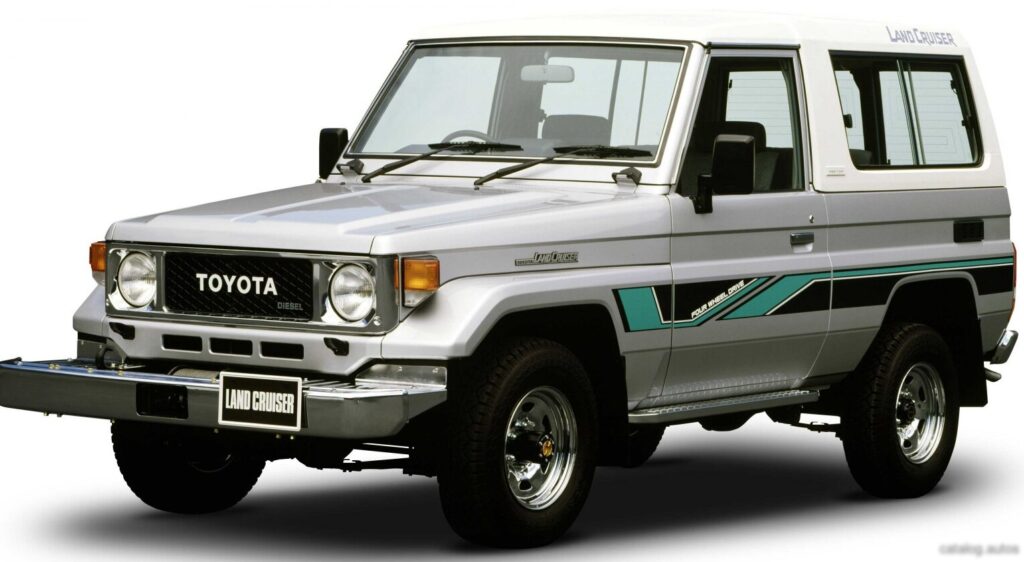
The Toyota Land Cruiser J70 series, produced from 1984 to 1998, represented a significant evolution in Toyota’s legendary off-road vehicle lineage. Within this generation, the LJ70 variant, equipped with the 2.4 TD (86 Hp) 4WD powertrain, occupied a crucial position as a workhorse option, particularly in markets outside of North America. This model, often recognized by its shorter wheelbase and three-door configuration, was designed for rugged utility and dependable performance. The LJ70’s production spanned from 1984 to 1990, serving as a bridge between the more basic, earlier J70 models and the later, more refined versions.
Technical Specifications
| Brand | Toyota |
| Model | Land Cruiser |
| Generation | Land Cruiser (J70, J73) |
| Type (Engine) | 2.4 TD (LJ70) (86 Hp) 4WD |
| Start of production | 1984 |
| End of production | 1990 |
| Powertrain Architecture | Internal Combustion engine |
| Body type | Off-road vehicle |
| Seats | 5 |
| Doors | 3 |
| Fuel Type | Diesel |
| Power | 86 Hp @ 4000 rpm |
| Power per litre | 35.2 Hp/l |
| Torque | 188 Nm @ 2400 rpm (138.66 lb.-ft. @ 2400 rpm) |
| Maximum engine speed | 4700-4900 rpm |
| Engine layout | Front, Longitudinal |
| Engine Model/Code | 2L-T |
| Engine displacement | 2446 cm3 (149.26 cu. in.) |
| Number of cylinders | 4 |
| Engine configuration | Inline |
| Cylinder Bore | 92 mm (3.62 in.) |
| Piston Stroke | 92 mm (3.62 in.) |
| Compression ratio | 20:1 |
| Number of valves per cylinder | 2 |
| Fuel injection system | Precombustion chamber injection |
| Engine aspiration | Turbocharger |
| Valvetrain | SOHC |
| Engine oil capacity | 6.7 l (7.08 US qt | 5.9 UK qt) |
| Coolant | 8.2 l (8.66 US qt | 7.21 UK qt) |
| Fuel tank capacity | 90 l (23.78 US gal | 19.8 UK gal) |
| Length | 3975 mm (156.5 in.) |
| Width | 1690 mm (66.54 in.) |
| Height | 1870 mm (73.62 in.) |
| Wheelbase | 2310 mm (90.94 in.) |
| Minimum turning circle | 11 m (36.09 ft.) |
| Drivetrain Architecture | The Internal combustion engine (ICE) drives the rear wheels permanently, and the front wheels are driven through an electrically or mechanically operated clutch if necessary. |
| Drive wheel | All wheel drive (4×4) |
| Number of gears | 5 |
| Type of gearbox | Manual transmission |
| Front suspension | Leaf spring |
| Rear suspension | Leaf spring |
| Front brakes | Ventilated discs |
| Rear brakes | Drum |
| Assisting systems | ABS (Anti-lock braking system) |
| Steering type | Cone worm with recirculation balls |
Powertrain & Engine Architecture
The heart of the LJ70 was the 2L-T 2.4-liter inline-four diesel engine. This engine, a staple in Toyota’s commercial vehicle lineup, was known for its durability and relatively simple design. The 2L-T featured precombustion chamber injection, a system common in diesel engines of the era, which improved combustion efficiency and reduced noise. A turbocharger was added to boost power output to 86 horsepower, a significant improvement over naturally aspirated versions. The engine’s single overhead camshaft (SOHC) valvetrain kept the design relatively uncomplicated, contributing to its reliability. The five-speed manual transmission was the standard offering, providing a good balance between fuel economy and usability. The transmission was chosen for its robustness and ability to handle the engine’s torque in demanding off-road conditions.
Driving Characteristics
The LJ70 2.4 TD, with its 86 horsepower and 188 Nm (138.66 lb-ft) of torque, wasn’t about outright speed. Instead, it prioritized low-end grunt and the ability to crawl over challenging terrain. The turbocharger provided a noticeable boost in power, but the engine still required careful gear selection, especially when climbing steep hills or carrying a load. Compared to later, more powerful Land Cruiser variants, the LJ70 felt comparatively underpowered, but this was offset by its simplicity and fuel efficiency. The manual transmission allowed for precise control, essential for off-road driving, and the gear ratios were well-suited to maintaining momentum in difficult conditions. The vehicle’s relatively short wheelbase contributed to its maneuverability in tight spaces.
Equipment & Trim Levels
The LJ70 2.4 TD was typically equipped with basic, utilitarian features. Standard equipment included steel wheels, vinyl or cloth upholstery, and a simple dashboard layout. Air conditioning and power steering were often optional extras, depending on the market. The interior was designed for practicality rather than luxury, with durable materials and easy-to-clean surfaces. The focus was on providing a functional and reliable vehicle for work or adventure. Trim levels were generally limited, with most LJ70s falling into a single, relatively basic specification.
Chassis & Braking
The LJ70’s chassis was a body-on-frame construction, providing exceptional strength and durability. The suspension utilized leaf springs at both the front and rear, a design choice that prioritized load-carrying capacity and off-road performance over ride comfort. Front brakes were ventilated discs, offering adequate stopping power, while the rear brakes were drums. This combination was typical for vehicles of this class and price point during the 1980s. An anti-lock braking system (ABS) was sometimes offered as an option, enhancing safety in slippery conditions. The steering system employed a cone worm and recirculation balls mechanism, providing a robust and reliable steering feel.
Market Reception & Comparison
The LJ70 2.4 TD was well-received in markets where a rugged, dependable, and affordable 4×4 was in demand. It was particularly popular in Australia, Africa, and parts of Asia. Critics praised its durability, off-road capability, and fuel efficiency. Compared to other Land Cruiser variants, such as those equipped with gasoline engines, the 2.4 TD offered superior fuel economy and lower maintenance costs. However, it lacked the refinement and performance of its more powerful siblings. Against competitors like the Nissan Patrol and Isuzu Trooper, the LJ70 offered a compelling combination of reliability, capability, and value.
Legacy
The Toyota Land Cruiser J70 series, and the LJ70 2.4 TD variant in particular, has earned a reputation for exceptional longevity and reliability. Many examples are still in use today, often having accumulated hundreds of thousands of kilometers. The 2L-T engine is known for its ability to withstand abuse and continue running with minimal maintenance. In the used car market, LJ70s are sought after by enthusiasts and those seeking a dependable off-road vehicle. While parts availability can be a concern in some regions, the Land Cruiser’s widespread popularity ensures that many components remain readily accessible. The LJ70 stands as a testament to Toyota’s commitment to building durable and capable vehicles that can withstand the test of time.