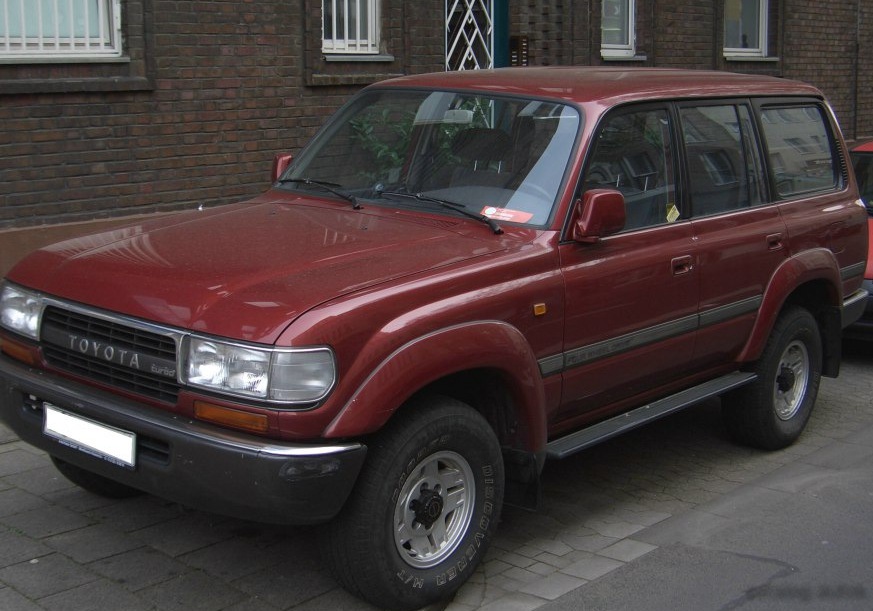
The Toyota Land Cruiser J80, manufactured between 1989 and 1997, marked a substantial advancement in both refinement and off-road capability for Toyota’s iconic SUV. The 4.0-liter (3F-E) variant, available from 1990-1992 in select markets, positioned itself as a middle-ground option within the J80 range, balancing performance, fuel efficiency, and cost. This version, producing 155 horsepower, proved particularly popular in regions with higher taxation on larger engines or where a more economical choice was preferred. It continued the Land Cruiser’s legacy of robustness and reliability while introducing a new level of comfort to the model line.
Technical Specifications
| Brand | Toyota |
| Model | Land Cruiser |
| Generation | Land Cruiser (J80) |
| Engine Type | 4.0 (155 Hp) 4WD |
| Start of production | 1990 |
| End of production | 1992 |
| Powertrain Architecture | Internal Combustion engine |
| Body type | SUV |
| Seats | 8 |
| Doors | 5 |
| Fuel consumption (urban) | 20 l/100 km (11.8 US mpg) |
| Fuel consumption (extra urban) | 13 l/100 km (18.1 US mpg) |
| Fuel Type | Petrol (Gasoline) |
| Maximum speed | 155 km/h (96.31 mph) |
| Weight-to-power ratio | 14.4 kg/Hp |
| Weight-to-torque ratio | 7.7 kg/Nm |
| Power | 155 Hp @ 4200 rpm |
| Power per litre | 39.2 Hp/l |
| Torque | 289 Nm @ 2600 rpm (213.16 lb.-ft. @ 2600 rpm) |
| Engine layout | Front, Longitudinal |
| Engine Model/Code | 3F-E |
| Engine displacement | 3955 cm3 (241.35 cu. in.) |
| Number of cylinders | 6 |
| Engine configuration | Inline |
| Cylinder Bore | 94 mm (3.7 in.) |
| Piston Stroke | 95 mm (3.74 in.) |
| Compression ratio | 8.1:1 |
| Number of valves per cylinder | 2 |
| Fuel injection system | Multi-port manifold injection |
| Engine aspiration | Naturally aspirated engine |
| Valvetrain | OHV |
| Engine oil capacity | 7.8 l (8.24 US qt | 6.86 UK qt) |
| Coolant capacity | 19.5 l (20.61 US qt | 17.16 UK qt) |
| Kerb Weight | 2230 kg (4916.31 lbs.) |
| Max. weight | 2670 kg (5886.34 lbs.) |
| Max load | 440 kg (970.03 lbs.) |
| Fuel tank capacity | 95 l (25.1 US gal | 20.9 UK gal) |
| Length | 4820 mm (189.76 in.) |
| Width | 1900 mm (74.8 in.) |
| Height | 1900 mm (74.8 in.) |
| Wheelbase | 2850 mm (112.2 in.) |
| Front track | 1575 mm (62.01 in.) |
| Rear track | 1580 mm (62.2 in.) |
| Ride height (ground clearance) | 210 mm (8.27 in.) |
| Minimum turning circle | 12 m (39.37 ft.) |
| Drivetrain Architecture | All wheel drive (4×4) |
| Number of gears | 5 |
| Gearbox type | Manual transmission |
| Front suspension | Dependent spring suspension with anti-roll bar |
| Rear suspension | Dependent spring suspension, Transverse stabilizer |
| Front brakes | Ventilated discs |
| Rear brakes | Ventilated discs |
| Steering type | Steering rack and pinion |
| Power steering | Hydraulic Steering |
| Tires size | 265/75 R15 |
Powertrain & Engine Architecture
The 3F-E inline-six engine powers this Land Cruiser variant. Displacing 4.0 liters, this naturally aspirated gasoline engine features a cast iron block and an aluminum cylinder head. The 3F-E utilizes a single overhead valve (OHV) valvetrain, a design choice prioritizing reliability and ease of maintenance. A multi-port fuel injection system delivers fuel, a significant improvement over the carburetors in earlier Land Cruiser models. The engine’s 8.1:1 compression ratio balances power output with the ability to run on lower octane fuel, crucial in many of its target markets. The 155 horsepower and 289 Nm (213 lb-ft) of torque are channeled to all four wheels through a durable five-speed manual transmission, selected for its robustness and ability to handle the engine’s torque in challenging off-road conditions.
Driving Characteristics
The 4.0-liter, 155 hp Land Cruiser J80 with a manual transmission delivers a driving experience focused on capability and dependability rather than rapid acceleration. While not particularly fast, the engine provides ample low and mid-range torque, making it well-suited for off-road driving and towing. The manual gearbox allows for precise control, especially when navigating difficult terrain. Compared to the later 4.5-liter engine or the diesel versions, this 4.0-liter feels less powerful, particularly when heavily loaded or climbing steep inclines. However, the lower power output also contributes to slightly better fuel economy, a benefit for owners undertaking long journeys. The gear ratios are optimized for low-speed torque, facilitating easy crawling over obstacles, but highway cruising requires more frequent gear changes.
Equipment & Trim Levels
The 4.0-liter Land Cruiser J80 typically came with a relatively basic equipment level, reflecting its position as a practical and utilitarian vehicle. Standard features generally included power steering, air conditioning, and a basic audio system. Interior upholstery was usually cloth, and the dashboard featured a functional, straightforward design. Optional extras, depending on the market, could include power windows, power locks, a sunroof, and upgraded audio systems. The J80 offers seating for up to eight passengers, with a split-folding rear seat providing flexibility for cargo and passenger arrangements. The emphasis is on durability and functionality rather than luxury.
Chassis & Braking
The J80 Land Cruiser employs a body-on-frame construction, providing exceptional strength and rigidity. The suspension consists of a dependent spring setup with anti-roll bars front and rear, prioritizing off-road articulation and load-carrying capacity over on-road handling. Ventilated disc brakes on all four wheels provide adequate stopping power for the vehicle’s weight. The steering system utilizes a hydraulic power steering rack and pinion, offering a good balance of assistance and feel. The J80’s robust chassis and suspension enable it to confidently tackle a wide range of terrains.
Market Reception & Comparison
The 4.0-liter Land Cruiser J80 received generally positive reviews from critics and consumers. It was praised for its reliability, durability, and off-road capability. Compared to the larger 4.5-liter engine, the 4.0-liter offered a more affordable entry point into the Land Cruiser lineup while still providing sufficient power for most tasks. The diesel variants, while offering better fuel economy, were often criticized for their slower acceleration and potentially higher maintenance costs. The 4.0-liter struck a good balance between these extremes, making it a popular choice for those seeking a capable and reliable SUV without a substantial price tag. Fuel economy, while not exceptional, was reasonable for a vehicle of its size and weight.
Legacy
The Toyota Land Cruiser J80, including the 4.0-liter variant, has earned a reputation as one of the most reliable and long-lasting SUVs ever produced. These vehicles are still commonly seen on the road today, often with high mileage and minimal maintenance. The 3F-E engine is known for its robustness and ability to withstand years of use. In the used car market, well-maintained J80s command a premium price, reflecting their enduring popularity and reputation for dependability. The 4.0-liter version, while not the most powerful, remains a desirable option for those seeking a classic Land Cruiser that is both capable and relatively affordable to maintain.