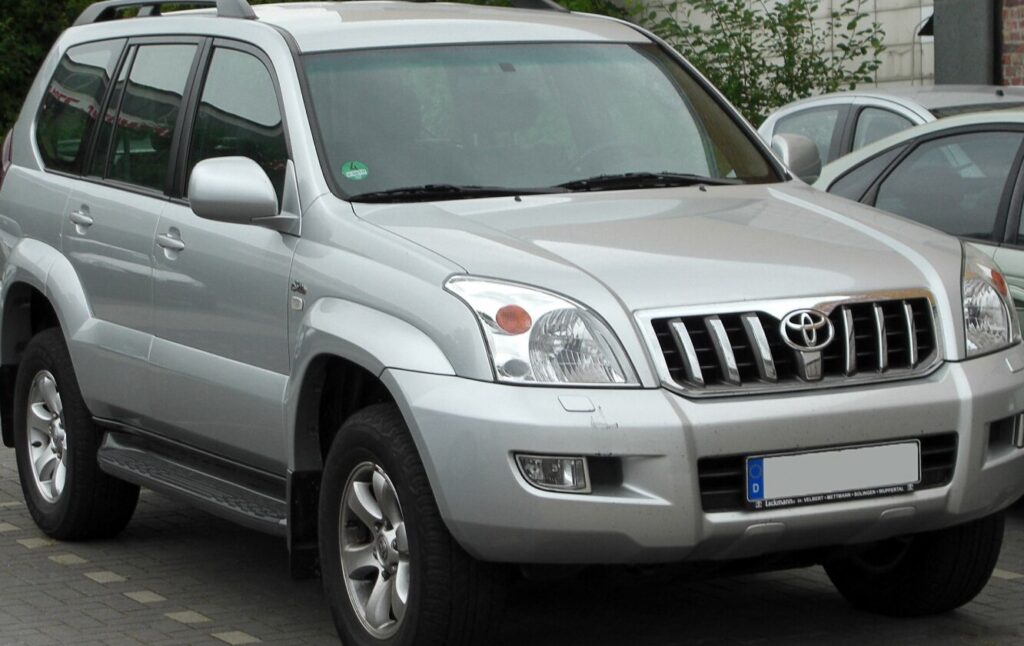
The Toyota Land Cruiser Prado J120, produced from 2002 to 2009, represented a significant evolution in Toyota’s long-standing tradition of robust, capable off-road vehicles. The 2.7i 16V (150 hp) 4WD ECT-E variant, manufactured between 2002 and 2004, served as an entry-level option within the J120 range, primarily aimed at buyers seeking a comfortable and reliable SUV with genuine four-wheel-drive capability, rather than outright performance. It was positioned below the more powerful 4.0-liter V6 models and, in some markets, the diesel-powered variants. This model was particularly popular in markets where gasoline engines were preferred and where lower running costs were a priority.
Technical Specifications
| Brand | Toyota |
| Model | Land Cruiser Prado |
| Generation | Land Cruiser Prado (J120) |
| Type (Engine) | 2.7 i 16V (150 Hp) 4WD ECT-E |
| Start of production | 2002 |
| End of production | 2004 |
| Powertrain Architecture | Internal Combustion engine |
| Body type | SUV |
| Seats | 5-8 |
| Doors | 5 |
| Fuel Type | Petrol (Gasoline) |
| Weight-to-power ratio | 12.5 kg/Hp, 79.8 Hp/tonne |
| Weight-to-torque ratio | 8 kg/Nm, 125 Nm/tonne |
| Power | 150 Hp @ 4800 rpm |
| Power per litre | 55.7 Hp/l |
| Torque | 235 Nm @ 4000 rpm (173.33 lb.-ft. @ 4000 rpm) |
| Engine layout | Front, Longitudinal |
| Engine Model/Code | 3RZ-FE |
| Engine displacement | 2693 cm3 (164.34 cu. in.) |
| Number of cylinders | 4 |
| Engine configuration | Inline |
| Cylinder Bore | 95 mm (3.74 in.) |
| Piston Stroke | 95 mm (3.74 in.) |
| Compression ratio | 9.5:1 |
| Number of valves per cylinder | 4 |
| Fuel injection system | Multi-port manifold injection |
| Engine aspiration | Naturally aspirated engine |
| Valvetrain | DOHC |
| Engine oil capacity | 5.8 l (6.13 US qt | 5.1 UK qt) |
| Coolant capacity | 7.1 l (7.5 US qt | 6.25 UK qt) |
| Kerb Weight | 1880-1920 kg (4144.69 – 4232.88 lbs.) |
| Max. weight | 2360 kg (5202.91 lbs.) |
| Max load | 440-480 kg (970.03 – 1058.22 lbs.) |
| Trunk (boot) space – minimum | 620 l (21.9 cu. ft.) |
| Trunk (boot) space – maximum | 1850 l (65.33 cu. ft.) |
| Fuel tank capacity | 87 l (22.98 US gal | 19.14 UK gal) |
| Length | 4715 mm (185.63 in.) |
| Width | 1875 mm (73.82 in.) |
| Height | 1870 mm (73.62 in.) |
| Wheelbase | 2790 mm (109.84 in.) |
| Front track | 1575 mm (62.01 in.) |
| Rear (Back) track | 1575 mm (62.01 in.) |
| Ride height (ground clearance) | 220 mm (8.66 in.) |
| Minimum turning circle (turning diameter) | 11.4 m (37.4 ft.) |
| Drivetrain Architecture | All wheel drive (4×4). Internal Combustion engine. |
| Number of gears and type of gearbox | 4 gears, automatic transmission ECT-E |
| Front suspension | Double wishbone |
| Rear suspension | Rigid axle suspension, Coil spring |
| Front brakes | Ventilated discs |
| Rear brakes | Ventilated discs |
| Assisting systems | ABS (Anti-lock braking system) |
| Steering type | Steering rack and pinion |
| Tires size | 265/65 R17 |
| Wheel rims size | 7.5J x 17 |
INTRODUCTION
The Toyota Land Cruiser Prado J120 2.7i 16V 4WD ECT-E, launched in 2002, was a key component of Toyota’s strategy to offer a more accessible and fuel-efficient Land Cruiser Prado. Building upon the success of the J100 series, the J120 shifted towards a more car-like driving experience while retaining the Prado’s renowned off-road prowess. The “ECT-E” designation refers to the electronically controlled transmission, a four-speed automatic designed to balance performance and fuel economy. This variant was particularly popular in regions where larger engines were subject to higher taxes or where fuel costs were a significant concern.
Powertrain & Engine Architecture
At the heart of the 2.7i Prado lies the 3RZ-FE engine, a 2.7-liter inline-four cylinder gasoline engine. This engine is a naturally aspirated unit, utilizing multi-port fuel injection and a double overhead camshaft (DOHC) valvetrain. The 3RZ-FE is known for its durability and relative simplicity, making it a reliable choice for long-term ownership. The engine produces 150 horsepower at 4800 rpm and 235 Nm (173 lb-ft) of torque at 4000 rpm. The four-speed automatic transmission (ECT-E) was specifically tuned to work with the engine’s characteristics, providing smooth shifts and adequate acceleration. While not a performance-oriented transmission, it offered a good balance between usability and efficiency. The transmission’s gear ratios were optimized for both on-road cruising and low-speed off-road maneuvering.
Driving Characteristics
The 2.7-liter engine and automatic transmission combination delivered a comfortable, if not exhilarating, driving experience. Acceleration was adequate for everyday driving, but the Prado 2.7i wasn’t designed for rapid overtaking or spirited driving. The automatic transmission, while smooth, could feel somewhat sluggish compared to the manual transmission options available in other Prado variants. The ECT-E transmission featured overdrive, contributing to improved fuel economy on highway journeys. Off-road, the Prado 2.7i proved surprisingly capable, thanks to its full-time four-wheel-drive system and adequate ground clearance. However, the lower torque output compared to the V6 models meant that more careful throttle control was required in challenging terrain.
Equipment & Trim Levels
The 2.7i Prado typically came equipped with a respectable level of standard features, including air conditioning, power windows and locks, and an AM/FM radio with CD player. Higher trim levels offered upgrades such as leather upholstery, sunroof, and a more advanced audio system. Safety features included ABS (Anti-lock Braking System) and dual front airbags. Optional extras often included a rear differential lock, a towing package, and upgraded alloy wheels. Interior appointments were generally functional and durable, reflecting the Prado’s focus on practicality and reliability.
Chassis & Braking
The J120 Prado utilized a body-on-frame construction, providing a robust and durable platform for both on-road and off-road driving. The front suspension featured a double wishbone design, while the rear suspension employed a rigid axle with coil springs. This setup provided a good balance between ride comfort and off-road articulation. Braking duties were handled by ventilated disc brakes on all four wheels, providing adequate stopping power for the vehicle’s weight. The ABS system helped to maintain steering control during emergency braking situations.
Market Reception & Comparison
The 2.7i Prado was generally well-received by critics as a practical and reliable SUV. However, it was often criticized for its lack of outright performance compared to the more powerful V6 models. Fuel economy was a strong point, particularly compared to the larger-engined Prados. In terms of reliability, the 3RZ-FE engine proved to be exceptionally durable, with many examples exceeding 200,000 miles with proper maintenance. Compared to the 4.0-liter V6, the 2.7i offered a more affordable entry point into Land Cruiser Prado ownership, but at the expense of performance and towing capacity. The diesel variants, where available, offered superior fuel economy and torque, but often came with a higher purchase price.
Legacy
The Toyota Land Cruiser Prado J120 2.7i 16V 4WD ECT-E remains a popular choice in the used car market today, particularly in regions where reliability and durability are highly valued. The 3RZ-FE engine is known for its longevity and relatively low maintenance costs. While not the fastest or most luxurious Prado variant, it offers a compelling combination of practicality, capability, and affordability. Well-maintained examples continue to command reasonable prices, reflecting the Prado’s enduring reputation as a dependable and capable SUV. Its simplicity and robust construction make it a relatively easy vehicle to maintain and repair, even in areas with limited access to specialized Toyota service centers.