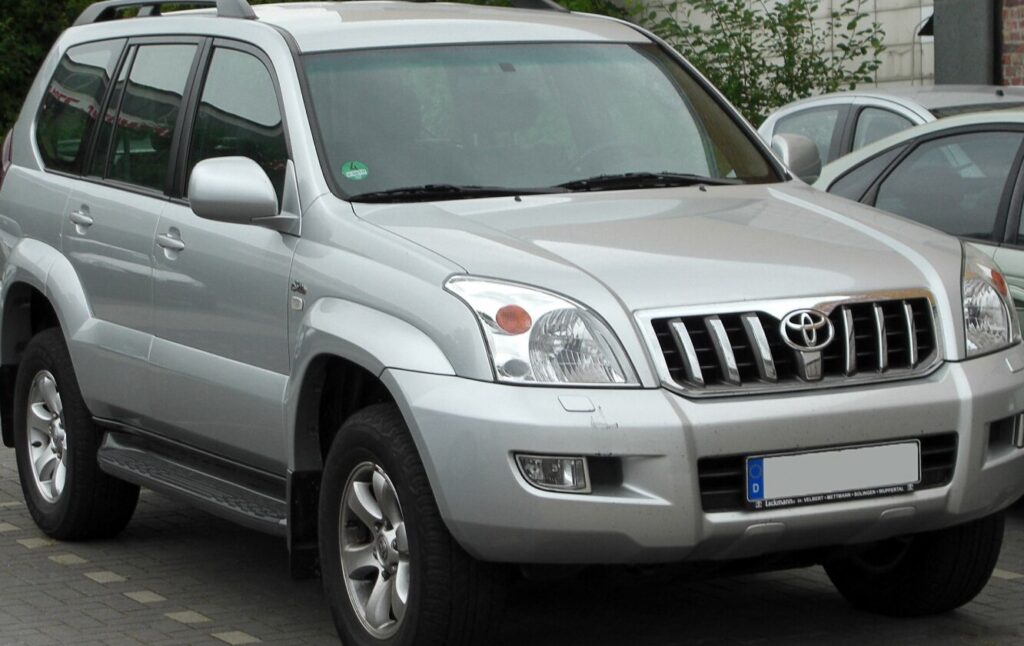
The Toyota Land Cruiser Prado J120, produced from 2002 to 2009, represented a significant evolution in Toyota’s long-standing tradition of robust, capable off-road vehicles. The 3.0 D-4D variant, specifically those manufactured between 2004 and 2006, was a popular choice in many international markets, particularly in Europe and Australia, where diesel engines were favored for their fuel efficiency and torque. This version, delivering 166 horsepower, occupied a middle ground in the J120 lineup, offering a balance between performance, economy, and price. It was positioned below the more powerful gasoline engines and the higher-output diesel variants, targeting buyers who prioritized practicality and reliability over outright speed.
Technical Specifications
| Brand | Toyota |
| Model | Land Cruiser Prado |
| Generation | Land Cruiser Prado (J120) |
| Type (Engine) | 3.0 D-4D (166 Hp) 4WD |
| Start of production | 2004 |
| End of production | 2006 |
| Powertrain Architecture | Internal Combustion engine |
| Body type | SUV |
| Seats | 8 |
| Doors | 5 |
| Fuel consumption (urban) | 11.1 l/100 km (21.2 US mpg) |
| Fuel consumption (extra urban) | 7.9 l/100 km (29.8 US mpg) |
| Fuel consumption (combined) | 9.1 l/100 km (25.8 US mpg) |
| CO2 emissions | 244 g/km |
| Fuel Type | Diesel |
| Acceleration 0 – 100 km/h | 11.5 sec |
| Acceleration 0 – 62 mph | 11.5 sec |
| Acceleration 0 – 60 mph | 10.9 sec |
| Maximum speed | 175 km/h (108.74 mph) |
| Emission standard | Euro 3 |
| Weight-to-power ratio | 11.7 kg/Hp |
| Weight-to-torque ratio | 4.7 kg/Nm |
| Power | 166 Hp @ 3400 rpm |
| Torque | 410 Nm @ 1800-2600 rpm (302.4 lb.-ft. @ 1800-2600 rpm) |
| Engine layout | Front, Longitudinal |
| Engine Model/Code | 1KD-FTV |
| Engine displacement | 2982 cm3 (181.97 cu. in.) |
| Number of cylinders | 4 |
| Engine configuration | Inline |
| Cylinder Bore | 96 mm (3.78 in.) |
| Piston Stroke | 103 mm (4.06 in.) |
| Compression ratio | 18.4:1 |
| Number of valves per cylinder | 4 |
| Fuel injection system | Diesel Commonrail |
| Engine aspiration | Turbocharger, Intercooler |
| Valvetrain | DOHC |
| Engine oil capacity | 7.4 l (7.82 US qt | 6.51 UK qt) |
| Coolant | 10.8 l (11.41 US qt | 9.5 UK qt) |
| Kerb Weight | 1940-2170 kg (4276.97 – 4784.03 lbs.) |
| Max. weight | 2850 kg (6283.17 lbs.) |
| Max load | 680-910 kg (1499.14 – 2006.21 lbs.) |
| Trunk (boot) space – minimum | 620 l (21.9 cu. ft.) |
| Trunk (boot) space – maximum | 1850 l (65.33 cu. ft.) |
| Fuel tank capacity | 87 l (22.98 US gal | 19.14 UK gal) |
| Max. roof load | 80 kg (176.37 lbs.) |
| Permitted trailer load with brakes (12%) | 2800 kg (6172.94 lbs.) |
| Permitted trailer load without brakes | 750 kg (1653.47 lbs.) |
| Permitted towbar download | 130 kg (286.6 lbs.) |
| Length | 4715 mm (185.63 in.) |
| Width | 1875 mm (73.82 in.) |
| Height | 1850 mm (72.83 in.) |
| Wheelbase | 2790 mm (109.84 in.) |
| Front track | 1575 mm (62.01 in.) |
| Rear (Back) track | 1575 mm (62.01 in.) |
| Minimum turning circle | 11.4 m (37.4 ft.) |
| Approach angle | 31° |
| Departure angle | 26° |
| Ramp-over angle | 20° |
| Climb angle | 42° |
| Wading depth | 700 mm (27.56 in.) |
| Drivetrain Architecture | All wheel drive (4×4) |
| Number of gears | 6 gears, manual transmission |
| Front suspension | Double wishbone |
| Rear suspension | Rigid axle suspension, Coil spring |
| Front brakes | Ventilated discs |
| Rear brakes | Ventilated discs |
| Assisting systems | ABS (Anti-lock braking system) |
| Steering type | Steering rack and pinion |
| Tires size | 225/70 R17 |
| Wheel rims size | 6J x 17 |
INTRODUCTION
The 3.0 D-4D Prado, introduced in 2004 as part of the J120 series, quickly became a mainstay for families and adventurers alike. Built on the 120 platform, it offered a significant upgrade in refinement and on-road comfort compared to its predecessors, while retaining the Land Cruiser’s legendary off-road capability. The J120 Prado was designed to appeal to a broader audience, moving away from the purely utilitarian image of earlier Land Cruisers. This particular engine and transmission combination was widely available in markets outside of North America, where the Prado was not officially sold during this generation.
Powertrain & Engine Architecture
The heart of the 3.0 D-4D Prado is the 1KD-FTV engine, a 2.982-liter inline-four diesel. This engine utilizes a common rail direct injection system, delivering fuel at extremely high pressure for improved combustion efficiency and reduced emissions. A turbocharger with an intercooler further enhances performance, boosting power and torque. The 1KD-FTV is known for its durability and relatively simple design, contributing to its long-term reliability. The engine features a double overhead camshaft (DOHC) valvetrain with four valves per cylinder, optimizing airflow for increased power output. The 166 horsepower and 302 lb-ft of torque are delivered across a broad RPM range, making it well-suited for both on-road cruising and off-road challenges. The transmission is a 6-speed manual, providing precise control and efficient power delivery.
Driving Characteristics
The 3.0 D-4D Prado with a manual transmission offers a comfortable and capable driving experience. While not a sports car, the engine provides ample torque for effortless acceleration and confident overtaking. The manual gearbox allows for greater driver control, particularly when navigating challenging terrain. Compared to the gasoline-powered Prados, the 3.0 D-4D offers significantly better fuel economy. Against the higher-output diesel variants, it trades some outright performance for improved efficiency and a lower price point. The gear ratios are well-chosen, providing a balance between low-end grunt for off-roading and comfortable cruising at highway speeds. The Prado’s suspension absorbs bumps and irregularities effectively, providing a smooth ride even on rough surfaces.
Equipment & Trim Levels
The 3.0 D-4D Prado typically came equipped with a range of standard features, including air conditioning, power windows, power locks, and a basic audio system. Higher trim levels offered upgrades such as leather upholstery, sunroof, navigation system, and upgraded audio systems. Safety features included ABS brakes, airbags, and a robust chassis designed to protect occupants in the event of a collision. Optional extras often included a rear differential lock, a winch, and upgraded suspension components for more serious off-road enthusiasts.
Chassis & Braking
The J120 Prado features a body-on-frame construction, providing exceptional strength and durability. The front suspension utilizes a double wishbone setup, while the rear employs a rigid axle with coil springs. This combination delivers a comfortable ride and excellent off-road capability. Braking duties are handled by ventilated disc brakes on all four wheels, providing ample stopping power. The ABS system helps to maintain control during emergency braking situations. The Prado’s robust chassis and suspension system allow it to handle a variety of terrains with ease.
Market Reception & Comparison
The 3.0 D-4D Prado was generally well-received by automotive critics, who praised its fuel efficiency, reliability, and off-road capability. It was often compared favorably to other mid-size SUVs, such as the Mitsubishi Pajero and the Nissan Patrol. While some critics noted that the engine lacked the outright power of the gasoline variants, they acknowledged that the 3.0 D-4D offered a compelling combination of performance, economy, and practicality. Fuel economy figures consistently ranked among the best in its class, making it an attractive option for buyers who frequently travel long distances.
Legacy
The 1KD-FTV engine has proven to be remarkably durable and reliable, with many examples exceeding 200,000 miles with proper maintenance. The J120 Prado 3.0 D-4D remains a popular choice in the used car market, particularly in regions where diesel engines are common. Its reputation for reliability, combined with its off-road capability and comfortable ride, ensures that it continues to be a sought-after vehicle for those seeking a rugged and dependable SUV. Regular maintenance, including oil changes and filter replacements, is crucial for ensuring the long-term health of the engine and transmission.