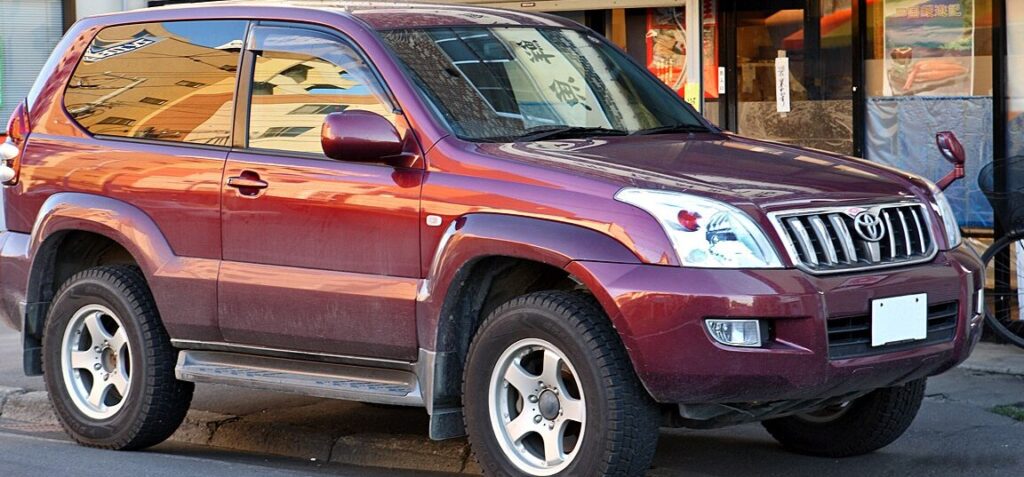
The Toyota Land Cruiser Prado J125, produced from 2002 to 2009, represented a significant evolution in Toyota’s long-standing tradition of robust, capable off-road vehicles. The 3.0 D-4D variant, specifically the one equipped with the ECT (Electronically Controlled Transmission) automatic, was offered from 2004 to 2006 in many markets outside of North America. This model aimed to balance fuel efficiency with the Prado’s renowned off-road prowess, targeting buyers who desired a comfortable and capable SUV for both daily driving and adventurous excursions. It occupied a mid-range position within the J125 lineup, slotting between the base 2.4-liter petrol engine and the more powerful 3.4-liter V6 options.
Technical Specifications
| Brand | Toyota |
| Model | Land Cruiser Prado |
| Generation | Land Cruiser Prado (J125) |
| Type (Engine) | 3.0 D-4D (166 Hp) ECT |
| Start of production | 2004 |
| End of production | 2006 |
| Powertrain Architecture | Internal Combustion engine |
| Body type | SUV |
| Seats | 5 |
| Doors | 3 |
| Fuel consumption (urban) | 11.4 l/100 km (20.6 US mpg, 24.8 UK mpg, 8.8 km/l) |
| Fuel consumption (extra urban) | 7.5 l/100 km (31.4 US mpg, 37.7 UK mpg, 13.3 km/l) |
| Fuel consumption (combined) | 8.9 l/100 km (26.4 US mpg, 31.7 UK mpg, 11.2 km/l) |
| CO2 emissions | 240 g/km |
| Fuel Type | Diesel |
| Acceleration 0 – 100 km/h | 11.2 sec |
| Acceleration 0 – 62 mph | 11.2 sec |
| Acceleration 0 – 60 mph | 10.6 sec |
| Maximum speed | 175 km/h (108.74 mph) |
| Emission standard | Euro 3 |
| Weight-to-power ratio | 11.1 kg/Hp, 89.7 Hp/tonne |
| Weight-to-torque ratio | 5.4 kg/Nm, 185.4 Nm/tonne |
| Power | 166 Hp @ 3400 rpm |
| Power per litre | 55.7 Hp/l |
| Torque | 343 Nm @ 1800-2600 rpm (252.98 lb.-ft. @ 1800-2600 rpm) |
| Engine layout | Front, Longitudinal |
| Engine Model/Code | 1KD-FTV |
| Engine displacement | 2982 cm3 (181.97 cu. in.) |
| Number of cylinders | 4 |
| Engine configuration | Inline |
| Cylinder Bore | 96 mm (3.78 in.) |
| Piston Stroke | 103 mm (4.06 in.) |
| Compression ratio | 18.4:1 |
| Number of valves per cylinder | 4 |
| Fuel injection system | Diesel Commonrail |
| Engine aspiration | Turbocharger, Intercooler |
| Valvetrain | DOHC |
| Engine oil capacity | 7.4 l (7.82 US qt | 6.51 UK qt) |
| Coolant | 10.8 l (11.41 US qt | 9.5 UK qt) |
| Kerb Weight | 1850-2020 kg (4078.55 – 4453.34 lbs.) |
| Max. weight | 2600 kg (5732.02 lbs.) |
| Max load | 580-750 kg (1278.68 – 1653.47 lbs.) |
| Trunk (boot) space – minimum | 403 l (14.23 cu. ft.) |
| Trunk (boot) space – maximum | 1350 l (47.67 cu. ft.) |
| Fuel tank capacity | 87 l (22.98 US gal | 19.14 UK gal) |
| Max. roof load | 80 kg (176.37 lbs.) |
| Permitted trailer load with brakes (12%) | 2800 kg (6172.94 lbs.) |
| Permitted trailer load without brakes | 750 kg (1653.47 lbs.) |
| Permitted towbar download | 130 kg (286.6 lbs.) |
| Length | 4365 mm (171.85 in.) |
| Width | 1875 mm (73.82 in.) |
| Height | 1865 mm (73.43 in.) |
| Wheelbase | 2455 mm (96.65 in.) |
| Front track | 1575 mm (62.01 in.) |
| Rear (Back) track | 1575 mm (62.01 in.) |
| Ride height (ground clearance) | 220 mm (8.66 in.) |
| Minimum turning circle (turning diameter) | 11.2 m (36.75 ft.) |
| Approach angle | 31° |
| Departure angle | 29° |
| Ramp-over (brakeover) angle | 20° |
| Climb angle | 42° |
| Wading depth | 700 mm (27.56 in.) |
| Drivetrain Architecture | The Internal combustion engine (ICE) drives permanently the four wheels of the vehicle. |
| Drive wheel | All wheel drive (4×4) |
| Number of gears and type of gearbox | 5 gears, automatic transmission ECT |
| Front suspension | Double wishbone |
| Rear suspension | Rigid axle suspension, Coil spring |
| Front brakes | Ventilated discs |
| Rear brakes | Ventilated discs |
| Assisting systems | ABS (Anti-lock braking system) |
| Steering type | Steering rack and pinion |
| Tires size | 225/70 R17 |
| Wheel rims size | 6J x 17 |
Powertrain & Engine Architecture
The heart of the Prado 3.0 D-4D ECT is the 1KD-FTV engine, a 2.982-liter inline-four diesel. This engine utilizes a common rail direct injection system, delivering fuel at extremely high pressure for improved combustion efficiency and reduced emissions. The 1KD-FTV is equipped with a turbocharger and intercooler, boosting power output to 166 horsepower at 3400 rpm and 343 Nm (253 lb-ft) of torque between 1800 and 2600 rpm. The engine features a double overhead camshaft (DOHC) valvetrain with four valves per cylinder. The ‘ECT’ designation refers to the electronically controlled automatic transmission, a four-speed unit designed to provide smooth shifting and optimized gear selection for various driving conditions. This transmission was chosen for its ease of use and suitability for drivers who preferred a more relaxed driving experience.
Driving Characteristics
The 3.0 D-4D with the automatic transmission offered a comfortable and capable driving experience. While not as quick as the petrol-powered Prados or those equipped with a manual transmission, the 1KD-FTV provided ample torque for everyday driving and off-road situations. The automatic transmission, while smooth, did result in some power loss compared to the manual version. The gear ratios were tuned for fuel efficiency and relaxed cruising, rather than outright acceleration. In real-world conditions, the Prado 3.0 D-4D ECT could achieve 0-60 mph in around 10.6 seconds and reach a top speed of 175 km/h (109 mph). The engine’s strong low-end torque made it particularly well-suited for tackling challenging terrain, providing good control and traction.
Equipment & Trim Levels
The 3.0 D-4D ECT trim typically included features such as air conditioning, power windows, power door locks, and a basic audio system. Higher trim levels added features like leather upholstery, sunroof, and upgraded audio systems. Standard safety equipment included ABS brakes and airbags. Interior upholstery was often cloth, with optional leather available. Dashboard configurations were relatively straightforward, prioritizing functionality over elaborate design. Optional extras included a rear differential lock, a winch, and various off-road accessories.
Chassis & Braking
The Prado J125 featured a robust body-on-frame construction, providing excellent durability and off-road capability. The front suspension utilized a double wishbone setup, while the rear employed a rigid axle with coil springs. This configuration offered a good balance between ride comfort and off-road performance. Braking duties were handled by ventilated disc brakes on all four wheels, providing adequate stopping power for the vehicle’s weight. The Prado’s relatively high ground clearance (220mm) and approach/departure angles contributed to its off-road prowess.
Market Reception & Comparison
The Prado 3.0 D-4D ECT was generally well-received by automotive critics as a practical and capable SUV. It was praised for its fuel efficiency, comfortable ride, and off-road ability. However, some critics noted that the automatic transmission could feel sluggish at times, and the engine lacked the outright performance of the larger petrol engines. Compared to the 2.4-liter petrol version, the 3.0 D-4D offered significantly more torque and better fuel economy. Compared to the 3.4-liter V6, it provided a more economical option, albeit with less power. The 3.0 D-4D was often favored by buyers who prioritized fuel efficiency and off-road capability over outright speed.
Legacy
The 1KD-FTV engine, in general, has proven to be a reliable and durable powerplant, and the Prado 3.0 D-4D ECT is no exception. With proper maintenance, these engines can easily exceed 200,000 miles. Common issues include turbocharger wear and potential problems with the fuel injection system, but these are typically addressed with regular servicing. On the used car market, the Prado 3.0 D-4D ECT remains a popular choice for those seeking a dependable and capable SUV. Its reputation for reliability, combined with its off-road credentials, ensures continued demand and relatively strong resale values.