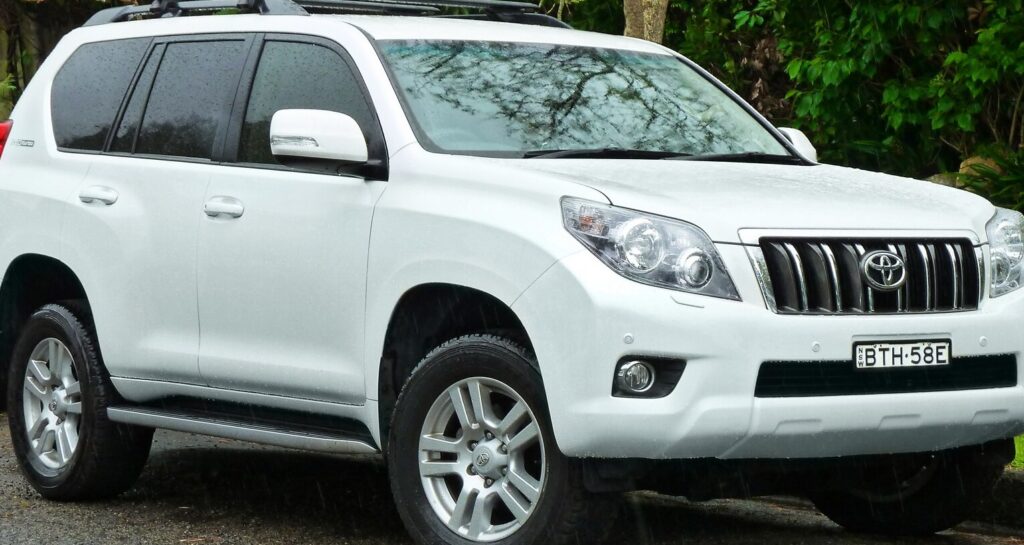
The Toyota Land Cruiser Prado J150, specifically the 5-door 2.7i (163 hp) 4WD variant with the ECT-E automatic transmission, was produced from 2009 to 2013. This model represents a significant iteration of Toyota’s long-running Land Cruiser family, positioned as a more approachable and family-oriented SUV compared to the larger, more luxurious Land Cruiser 200 series. The J150 Prado aimed to balance off-road capability with on-road comfort and practicality, serving as a popular choice in markets outside of North America where the full-size Land Cruiser wasn’t as prevalent. This particular 2.7-liter engine and automatic transmission combination served as the entry point into the Prado lineup in many regions, offering a blend of affordability and Toyota’s renowned reliability.
Technical Specifications
| Brand | Toyota |
| Model | Land Cruiser Prado |
| Generation | Land Cruiser Prado (J150) 5-door |
| Type | 2.7 i (163 Hp) 4WD ECT-E |
| Start of production | 2009 |
| End of production | 2013 |
| Powertrain Architecture | Internal Combustion engine |
| Body type | SUV |
| Seats | 7 |
| Doors | 5 |
| Fuel Type | Petrol (Gasoline) |
| Weight-to-power ratio | 12.8 kg/Hp, 78.4 Hp/tonne |
| Weight-to-torque ratio | 8.5 kg/Nm, 118.3 Nm/tonne |
| Power | 163 Hp @ 5200 rpm |
| Power per litre | 60.5 Hp/l |
| Torque | 246 Nm @ 3800 rpm (181.44 lb.-ft. @ 3800 rpm) |
| Engine layout | Front, Longitudinal |
| Engine Model/Code | 2TR-FE |
| Engine displacement | 2693 cm3 (164.34 cu. in.) |
| Number of cylinders | 4 |
| Engine configuration | Inline |
| Cylinder Bore | 95 mm (3.74 in.) |
| Piston Stroke | 95 mm (3.74 in.) |
| Compression ratio | 9.6:1 |
| Number of valves per cylinder | 4 |
| Fuel injection system | Multi-port manifold injection |
| Engine aspiration | Naturally aspirated engine |
| Valvetrain | DOHC |
| Engine oil capacity | 5.6 l (5.92 US qt | 4.93 UK qt) |
| Coolant | 8.3 l (8.77 US qt | 7.3 UK qt) |
| Kerb Weight | 2080-2090 kg (4585.62 – 4607.66 lbs.) |
| Max. weight | 2475 kg (5456.44 lbs.) |
| Max load | 385-395 kg (848.78 – 870.83 lbs.) |
| Trunk (boot) space – minimum | 104 l (3.67 cu. ft.) |
| Trunk (boot) space – maximum | 1934 l (68.3 cu. ft.) |
| Fuel tank capacity | 87 l (22.98 US gal | 19.14 UK gal) |
| Length | 4760 mm (187.4 in.) |
| Width | 1885 mm (74.21 in.) |
| Width including mirrors | 2185 mm (86.02 in.) |
| Height | 1850 mm (72.83 in.) |
| Wheelbase | 2790 mm (109.84 in.) |
| Front track | 1585 mm (62.4 in.) |
| Rear (Back) track | 1585 mm (62.4 in.) |
| Ride height (ground clearance) | 220 mm (8.66 in.) |
| Minimum turning circle (turning diameter) | 11.6 m (38.06 ft.) |
| Drivetrain Architecture | All wheel drive (4×4). Internal Combustion engine. |
| Number of gears and type of gearbox | 4 gears, automatic transmission ECT-E |
| Front suspension | Coil spring, Double wishbone, Transverse stabilizer |
| Rear suspension | Rigid axle suspension, Coil spring |
| Front brakes | Ventilated discs |
| Rear brakes | Ventilated discs |
| Assisting systems | ABS (Anti-lock braking system) |
| Steering type | Steering rack and pinion |
| Tires size | 265/65 R17 |
| Wheel rims size | 7.5J x 17 |
Powertrain & Engine Architecture
The heart of this Prado variant is the 2TR-FE engine, a 2.7-liter inline-four cylinder gasoline engine. This engine is a member of Toyota’s TR family, known for its durability and relatively simple design. The 2TR-FE utilizes a cast iron block and an aluminum cylinder head, contributing to its robustness. Fuel delivery is managed by a multi-port fuel injection system, providing adequate, though not exceptional, fuel atomization. The engine features a double overhead camshaft (DOHC) valvetrain with four valves per cylinder, optimizing breathing for improved power output. The ECT-E automatic transmission is a four-speed unit, designed for smooth operation and reliability. While not the most modern transmission in terms of gear count, it was well-suited to the engine’s torque characteristics and the Prado’s intended use case.
Driving Characteristics
The 163 hp output and 246 Nm of torque, coupled with the four-speed automatic, resulted in a driving experience focused on usability rather than outright performance. Acceleration was adequate for everyday driving and highway cruising, but not particularly brisk. The automatic transmission’s gear ratios were tuned for fuel efficiency and smooth shifts, prioritizing comfort over sporty responsiveness. Compared to the more powerful 4.0-liter V6 versions of the Prado, this 2.7-liter model felt noticeably less potent, especially when fully loaded or tackling steep inclines. However, the lower engine weight contributed to better handling and a slightly more nimble feel. The 4WD system provided confident traction in various conditions, making it suitable for light to moderate off-road excursions.
Equipment & Trim Levels
The 2.7i 4WD ECT-E typically represented a mid-range trim level in many markets. Standard features generally included air conditioning, power windows and locks, a basic audio system, and alloy wheels. Interior upholstery was usually cloth, with options for leather upgrades. Safety features such as ABS and multiple airbags were standard. Optional extras could include a sunroof, upgraded audio systems, navigation, and parking sensors. The dashboard layout was functional and straightforward, prioritizing ease of use over stylistic flair.
Chassis & Braking
The Prado J150 utilized a body-on-frame construction, providing a robust and durable platform for off-road driving. The front suspension consisted of a double wishbone setup with coil springs and a transverse stabilizer bar, offering a comfortable ride and decent handling. The rear suspension employed a rigid axle configuration with coil springs, prioritizing durability and load-carrying capacity. Braking duties were handled by ventilated discs on all four wheels, providing adequate stopping power for the vehicle’s weight. The chassis was designed to accommodate the Prado’s 4WD system and provide sufficient ground clearance for off-road obstacles.
Market Reception & Comparison
The 2.7-liter Prado was generally well-received as a practical and reliable SUV, particularly in markets where fuel economy and affordability were key considerations. Critics often praised its off-road capability and comfortable ride, but noted its relatively modest performance compared to higher-powered variants. Compared to the 4.0-liter V6 models, the 2.7i offered better fuel economy, but at the expense of acceleration and towing capacity. The 2.7i also provided a more affordable entry point into the Prado lineup, making it accessible to a wider range of buyers. Against competitors like the Mitsubishi Pajero and Nissan Patrol, the Prado 2.7i offered a compelling combination of reliability, comfort, and off-road prowess.
Legacy
The 2TR-FE engine, in general, has proven to be exceptionally durable and reliable, with many examples exceeding 200,000 miles with proper maintenance. The Prado J150, including the 2.7i variant, enjoys a strong reputation for longevity and dependability. In the used car market, these models remain popular due to their affordability and Toyota’s reputation for quality. While the four-speed automatic transmission may seem dated by modern standards, it has proven to be robust and relatively trouble-free. The Prado J150 2.7i continues to be a viable option for buyers seeking a capable, reliable, and relatively fuel-efficient SUV, particularly those who prioritize durability and off-road capability over outright performance.