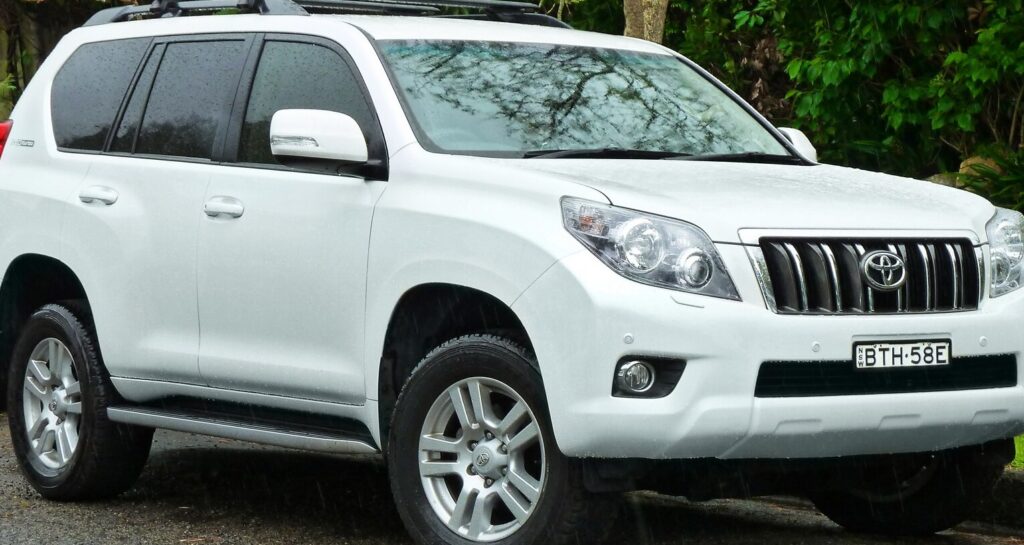
The Toyota Land Cruiser Prado J150, specifically the 5-door model equipped with the 3.0 D-4D diesel engine producing 190 horsepower, was a key offering in Toyota’s globally successful Land Cruiser lineup from 2011 to 2013. Positioned as a mid-range option within the J150 series, it bridged the gap between more basic trims and the higher-specification models. This variant was particularly popular in markets outside of North America, where the Prado was sold alongside the larger, more luxurious Land Cruiser 200 series. The J150 Prado represented a significant step forward in refinement and on-road comfort compared to its predecessors, while retaining the Land Cruiser’s legendary off-road capability.
Technical Specifications
| Brand | Toyota |
| Model | Land Cruiser Prado |
| Generation | Land Cruiser Prado (J150) 5-door |
| Type (Engine) | 3.0 D-4D (190 Hp) 4WD |
| Start of production | 2011 |
| End of production | 2013 |
| Powertrain Architecture | Internal Combustion engine |
| Body type | SUV |
| Seats | 5-7 |
| Doors | 5 |
| Fuel consumption (economy) – urban (NEDC) | 9.7-9.8 l/100 km (24.2 – 24 US mpg, 29.1 – 28.8 UK mpg, 10.3 – 10.2 km/l) |
| Fuel consumption (economy) – extra urban (NEDC) | 7.1-7.3 l/100 km (33.1 – 32.2 US mpg, 39.8 – 38.7 UK mpg, 14.1 – 13.7 km/l) |
| Fuel consumption (economy) – combined (NEDC) | 8.1-8.2 l/100 km (29 – 28.7 US mpg, 34.9 – 34.4 UK mpg, 12.3 – 12.2 km/l) |
| CO2 emissions (NEDC) | 214-217 g/km |
| Fuel Type | Diesel |
| Acceleration 0 – 100 km/h | 10.6 sec |
| Acceleration 0 – 62 mph | 10.6 sec |
| Acceleration 0 – 60 mph | 10.1 sec |
| Maximum speed | 175 km/h (108.74 mph) |
| Emission standard | Euro 5 |
| Weight-to-power ratio | 10.4 kg/Hp, 95.7 Hp/tonne |
| Weight-to-torque ratio | 4.7 kg/Nm, 211.6 Nm/tonne |
| Power | 190 Hp @ 3400 rpm |
| Torque | 420 Nm @ 1600-3000 rpm (309.78 lb.-ft. @ 1600-3000 rpm) |
| Engine layout | Front, Longitudinal |
| Engine Model/Code | 1KD-FTV |
| Engine displacement | 2982 cm3 (181.97 cu. in.) |
| Number of cylinders | 4 |
| Engine configuration | Inline |
| Cylinder Bore | 96 mm (3.78 in.) |
| Piston Stroke | 103 mm (4.06 in.) |
| Number of valves per cylinder | 4 |
| Fuel injection system | Diesel Commonrail |
| Engine aspiration | Turbocharger, Intercooler |
| Valvetrain | DOHC |
| Engine oil capacity | 7 l (7.4 US qt | 6.16 UK qt) |
| Coolant | 13.2 l (13.95 US qt | 11.61 UK qt) |
| Kerb Weight | 1985-2325 kg (4376.18 – 5125.75 lbs.) |
| Max. weight | 2900 kg (6393.41 lbs.) |
| Max load | 575-915 kg (1267.66 – 2017.23 lbs.) |
| Trunk (boot) space – minimum | 104 l (3.67 cu. ft.) |
| Trunk (boot) space – maximum | 1934 l (68.3 cu. ft.) |
| Fuel tank capacity | 87 l (22.98 US gal | 19.14 UK gal) |
| Max. roof load | 80 kg (176.37 lbs.) |
| Permitted trailer load with brakes (12%) | 3000 kg (6613.87 lbs.) |
| Permitted trailer load without brakes | 750 kg (1653.47 lbs.) |
| Permitted towbar download | 120 kg (264.55 lbs.) |
| Length | 4760 mm (187.4 in.) |
| Width | 1885 mm (74.21 in.) |
| Width including mirrors | 2185 mm (86.02 in.) |
| Height | 1845 mm (72.64 in.) |
| Wheelbase | 2790 mm (109.84 in.) |
| Front track | 1585-1605 mm (62.4 – 63.19 in.) |
| Rear (Back) track | 1585-1605 mm (62.4 – 63.19 in.) |
| Ride height (ground clearance) | 215 mm (8.46 in.) |
| Minimum turning circle (turning diameter) | 11.8 m (38.71 ft.) |
| Approach angle | 32° |
| Departure angle | 25° |
| Ramp-over (brakeover) angle | 22° |
| Climb angle | 42° |
| Wading depth | 700 mm (27.56 in.) |
| Drivetrain Architecture | The Internal combustion engine (ICE) drives permanently the four wheels of the vehicle. |
| Drive wheel | All wheel drive (4×4) |
| Number of gears and type of gearbox | 6 gears, manual transmission |
| Front suspension | Coil spring, Double wishbone, Transverse stabilizer |
| Rear suspension | Rigid axle suspension, Coil spring |
| Front brakes | Ventilated discs |
| Rear brakes | Ventilated discs |
| Assisting systems | ABS (Anti-lock braking system) |
| Steering type | Steering rack and pinion |
| Tires size | 245/70 R17; 265/60 R18 |
| Wheel rims size | 6.5J x 17; 7.5J x 18 |
INTRODUCTION
The Toyota Land Cruiser Prado J150 3.0 D-4D 4WD, produced from 2011 to 2013, represents a significant evolution of Toyota’s renowned off-road SUV. Built on the J150 platform, this fifth-generation Prado aimed to deliver a more comfortable and refined driving experience without sacrificing the ruggedness and reliability expected of the Land Cruiser nameplate. The 3.0 D-4D engine, a four-cylinder diesel, was a popular choice in many markets due to its balance of power, fuel efficiency, and relatively low emissions. This particular variant typically sat in the middle of the Prado lineup, offering a good level of equipment and capability for families and adventurers alike.
Powertrain & Engine Architecture
The heart of this Prado variant is the 1KD-FTV 3.0-liter inline-four diesel engine. This engine utilizes a common rail direct injection system, delivering fuel at extremely high pressure for improved combustion efficiency and reduced emissions. A turbocharger with an intercooler further enhances performance, boosting power output to 190 horsepower at 3400 rpm and 420 Nm (309.78 lb-ft) of torque between 1600 and 3000 rpm. The engine features a double overhead camshaft (DOHC) valvetrain with four valves per cylinder. The 6-speed manual transmission was standard, offering precise gear changes and contributing to the Prado’s fuel efficiency. The engine is longitudinally mounted, directing power to all four wheels via a robust four-wheel-drive system.
Driving Characteristics
The 190 hp 3.0 D-4D Prado offers a respectable, if not exhilarating, driving experience. The engine provides ample torque for everyday driving and tackling off-road obstacles. While not as quick as the gasoline-powered variants, the diesel engine’s low-end grunt makes it well-suited for towing and navigating challenging terrain. The 6-speed manual transmission allows for good control over the engine’s power band. Compared to higher-output Prado models, this variant feels less stressed during prolonged highway cruising, potentially contributing to long-term reliability. The Prado’s suspension provides a comfortable ride, absorbing bumps and irregularities in the road surface effectively. However, the vehicle’s considerable weight is noticeable, particularly during spirited driving.
Equipment & Trim Levels
The 3.0 D-4D Prado typically came equipped with a range of standard features, including air conditioning, power windows and locks, a basic audio system, and alloy wheels. Higher trim levels offered upgrades such as leather upholstery, a sunroof, a more advanced audio system with navigation, and automatic climate control. Safety features included ABS brakes, airbags, and a stability control system. Optional extras often included a rear differential lock, a winch, and upgraded off-road tires.
Chassis & Braking
The Prado J150 features a body-on-frame construction, providing excellent durability and off-road capability. The front suspension utilizes a double wishbone setup with coil springs and a transverse stabilizer bar, while the rear suspension employs a rigid axle with coil springs. This configuration provides a good balance of ride comfort and off-road articulation. Braking duties are handled by ventilated disc brakes on all four wheels, providing ample stopping power. The Prado’s robust chassis and braking system contribute to its overall safety and reliability.
Market Reception & Comparison
The 3.0 D-4D Prado was generally well-received by automotive critics, who praised its comfortable ride, spacious interior, and off-road capability. However, some reviewers noted that the engine could feel underpowered when fully loaded or tackling steep inclines. Compared to the 4.0-liter V6 gasoline engine offered in some markets, the 3.0 D-4D provided better fuel economy but less outright performance. The 3.0 D-4D was often seen as a more practical and economical choice for buyers who prioritized fuel efficiency and long-distance cruising over outright speed. Compared to the 2.8L diesel, the 3.0L offered a bit more refinement and power.
Legacy
The Toyota Land Cruiser Prado J150 3.0 D-4D has proven to be a remarkably reliable and durable vehicle. The 1KD-FTV engine is known for its longevity, and with proper maintenance, it can easily exceed 200,000 miles. In the used car market, these Prados are highly sought after due to their reputation for reliability and off-road capability. They continue to be popular choices for adventurers, families, and anyone seeking a rugged and dependable SUV. While modern SUVs offer more advanced technology and features, the J150 Prado remains a testament to Toyota’s commitment to building vehicles that stand the test of time.