Technical Specifications
| Brand | Toyota |
| Model | Land Cruiser Prado |
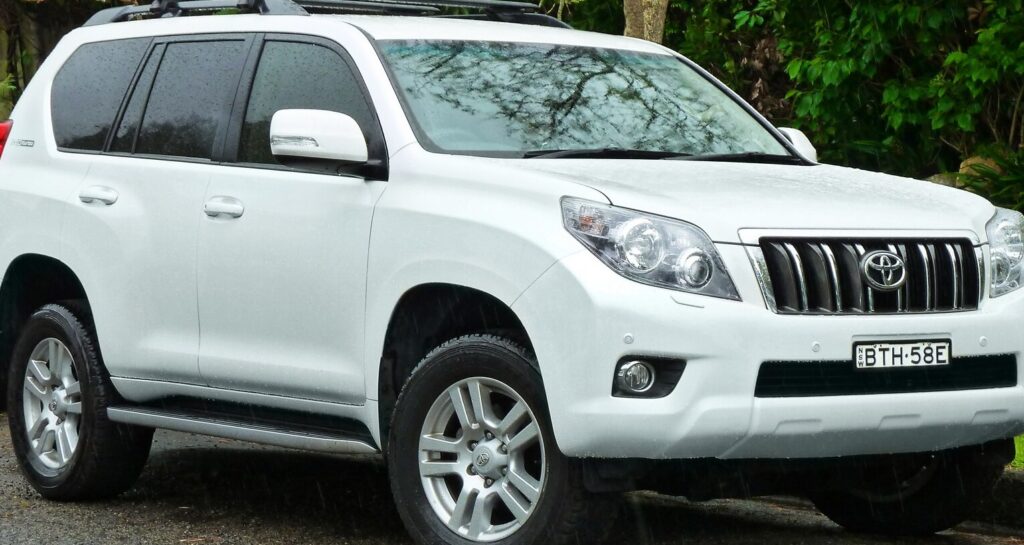
| Generation | Land Cruiser Prado (J150) 5-door |
| Type (Engine) | 3.0 D-4D (190 Hp) 4WD Automatic |
| Start of production | 2011 |
| End of production | 2013 |
| Powertrain Architecture | Internal Combustion engine |
| Body type | SUV |
| Seats | 5-7 |
| Doors | 5 |
| Fuel consumption (urban) | 9.6-9.7 l/100 km (24.5 – 24.2 US mpg) |
| Fuel consumption (extra urban) | 7-7.1 l/100 km (33.6 – 33.1 US mpg) |
| Fuel consumption (combined) | 7.9-8.1 l/100 km (29.8 – 29 US mpg) |
| CO2 emissions | 209-213 g/km |
| Fuel Type | Diesel |
| Maximum speed | 175 km/h (108.74 mph) |
| Emission standard | Euro 5 |
| Weight-to-power ratio | 10.5 kg/Hp |
| Weight-to-torque ratio | 4.8 kg/Nm |
| Power | 190 Hp @ 3400 rpm |
| Torque | 420 Nm @ 1600-3000 rpm (309.78 lb.-ft. @ 1600-3000 rpm) |
| Engine layout | Front, Longitudinal |
| Engine Model/Code | 1KD-FTV |
| Engine displacement | 2982 cm3 (181.97 cu. in.) |
| Number of cylinders | 4 |
| Engine configuration | Inline |
| Cylinder Bore | 96 mm (3.78 in.) |
| Piston Stroke | 103 mm (4.06 in.) |
| Number of valves per cylinder | 4 |
| Fuel injection system | Diesel Commonrail |
| Engine aspiration | Turbocharger, Intercooler |
| Valvetrain | DOHC |
| Engine oil capacity | 7 l (7.4 US qt | 6.16 UK qt) |
| Coolant capacity | 13.2 l (13.95 US qt | 11.61 UK qt) |
| Kerb Weight | 1995-2355 kg (4398.22 – 5191.89 lbs.) |
| Max. weight | 2900 kg (6393.41 lbs.) |
| Max load | 545-905 kg (1201.52 – 1995.18 lbs.) |
| Trunk (boot) space (min) | 104 l (3.67 cu. ft.) |
| Trunk (boot) space (max) | 1934 l (68.3 cu. ft.) |
| Fuel tank capacity | 87 l (22.98 US gal | 19.14 UK gal) |
| Max. roof load | 80 kg (176.37 lbs.) |
| Permitted trailer load (braked) | 3000 kg (6613.87 lbs.) |
| Permitted trailer load (unbraked) | 750 kg (1653.47 lbs.) |
| Permitted towbar download | 120 kg (264.55 lbs.) |
| Length | 4760 mm (187.4 in.) |
| Width | 1885 mm (74.21 in.) |
| Width including mirrors | 2185 mm (86.02 in.) |
| Height | 1845 mm (72.64 in.) |
| Wheelbase | 2790 mm (109.84 in.) |
| Front track | 1585-1605 mm (62.4 – 63.19 in.) |
| Rear track | 1585-1605 mm (62.4 – 63.19 in.) |
| Ride height (ground clearance) | 215 mm (8.46 in.) |
| Minimum turning circle | 11.8 m (38.71 ft.) |
| Approach angle | 32° |
| Departure angle | 25° |
| Ramp-over angle | 22° |
| Climb angle | 42° |
| Wading depth | 700 mm (27.56 in.) |
| Drivetrain | All wheel drive (4×4) |
| Number of gears | 5 |
| Gearbox type | Automatic transmission |
| Front suspension | Coil spring, Double wishbone, Transverse stabilizer |
| Rear suspension | Rigid axle suspension, Coil spring |
| Front brakes | Ventilated discs |
| Rear brakes | Ventilated discs |
| Assisting systems | ABS (Anti-lock braking system) |
| Steering type | Steering rack and pinion |
| Tires size | 245/70 R17; 265/60 R18 |
| Wheel rims size | 6.5J x 17; 7.5J x 18 |
The Toyota Land Cruiser Prado J150 3.0 D-4D Automatic, produced between 2011 and 2013, represents a compelling blend of off-road prowess and on-road refinement. Positioned within the J150 Prado range, this variant offered a balance between the more economical base models and the higher-performance, larger-displacement options. Built on the robust J150 platform, it catered to buyers seeking a versatile SUV capable of handling diverse terrains and demanding conditions. The Prado’s reputation for reliability and durability made it a popular choice in markets worldwide, particularly in regions where challenging road conditions are prevalent.
Powertrain & Engine Architecture
At the heart of this Prado variant lies the 1KD-FTV 3.0-liter inline-four turbodiesel engine. This engine is a workhorse, known for its longevity and relatively straightforward maintenance. The 1KD-FTV utilizes a common rail direct injection system, delivering fuel directly into the cylinders at extremely high pressure for improved combustion efficiency and reduced emissions. A variable geometry turbocharger (VGT) and intercooler further enhance performance by increasing air intake and reducing intake air temperature. The engine produces 190 horsepower at 3400 rpm and a substantial 420 Nm (309.78 lb.-ft.) of torque between 1600 and 3000 rpm. This torque band provides ample pulling power for both on-road overtaking and off-road crawling. The engine is paired with a 5-speed automatic transmission, designed for smooth shifting and ease of use. While not the most modern transmission by today’s standards, it proved to be reliable and well-suited to the engine’s characteristics.
Driving Characteristics
The 190 hp 3.0 D-4D Automatic Prado delivers a comfortable and capable driving experience. Acceleration is adequate, though not particularly brisk, with the focus being on providing strong low-end and mid-range torque. The automatic transmission contributes to a relaxed driving style, particularly in urban environments. Compared to the manual transmission versions, the automatic offers greater convenience, but at the expense of some driver engagement and potentially slightly reduced fuel economy. Compared to the more powerful 4.0-liter V6 models, the 3.0 D-4D feels less potent, especially when fully loaded or tackling steep inclines. However, the diesel engine’s superior fuel efficiency and lower running costs make it an attractive alternative for many buyers. The Prado’s full-time four-wheel-drive system provides excellent traction in various conditions, and the vehicle’s robust suspension absorbs bumps and irregularities with ease.
Equipment & Trim Levels
The 3.0 D-4D Automatic Prado typically came equipped with a respectable level of standard features. These generally included air conditioning, power windows and locks, a basic audio system, and alloy wheels. Higher trim levels offered additional features such as leather upholstery, a sunroof, navigation system, and upgraded audio systems. Safety features such as ABS, multiple airbags, and stability control were standard across the range. The interior design was functional and durable, prioritizing practicality over luxury. The Prado’s spacious cabin comfortably accommodates five to seven passengers, depending on the seating configuration.
Chassis & Braking
The J150 Prado utilizes a body-on-frame construction, providing exceptional strength and durability. The suspension system consists of coil springs and double wishbones at the front, and a rigid axle with coil springs at the rear. This setup provides a good balance between ride comfort and off-road capability. Braking duties are handled by ventilated disc brakes on all four wheels, providing ample stopping power. The Prado’s robust chassis and capable braking system contribute to its overall safety and stability.
Market Reception & Comparison
The Toyota Land Cruiser Prado J150 3.0 D-4D Automatic was generally well-received by automotive critics and consumers alike. It was praised for its reliability, durability, and off-road capability. The diesel engine’s fuel efficiency was also a major selling point, particularly in regions with high fuel prices. Compared to other trims in the Prado lineup, the 3.0 D-4D Automatic offered a compelling value proposition, providing a good balance of performance, economy, and features. Some critics noted that the automatic transmission could feel slightly sluggish at times, and that the interior design was somewhat dated compared to some competitors. However, these criticisms were generally outweighed by the Prado’s overall strengths.
Legacy
The 1KD-FTV engine, found in this Prado variant, has earned a reputation for exceptional reliability and longevity. With proper maintenance, these engines can easily exceed 200,000 miles (320,000 kilometers). The J150 Prado, in general, remains a highly sought-after SUV in the used car market, particularly in regions where durability and off-road capability are highly valued. The 3.0 D-4D Automatic variant continues to be a popular choice for buyers seeking a reliable and versatile SUV that can handle a wide range of tasks. Its combination of fuel efficiency, capability, and Toyota’s renowned build quality ensures its continued relevance for years to come.