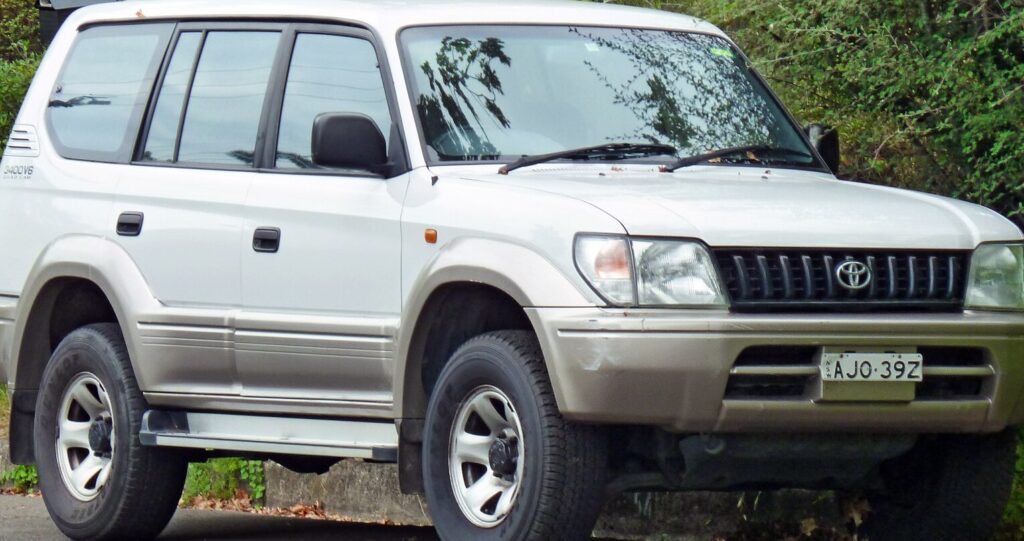
The Toyota Land Cruiser Prado J90, produced between 1996 and 1999, represented a significant evolution in Toyota’s long-running Land Cruiser lineage. This generation, internally designated J90, aimed to blend the rugged off-road capability expected of a Land Cruiser with increased on-road comfort and refinement. The 5-door configuration became increasingly popular, offering a balance between passenger capacity and maneuverability. Among the engine options available, the 3.0 TD (125 hp) 4WD variant occupied a specific niche, positioned as a capable and relatively economical choice for buyers prioritizing durability and all-terrain performance over outright speed. It was built on the 1HX0 platform, shared with the Lexus RX300, marking a shift towards more car-like underpinnings.
Toyota Land Cruiser Prado J90 3.0 TD (125 hp) 4WD: Overview
The 3.0 TD variant of the J90 Prado was primarily marketed in regions where diesel fuel was readily available and preferred for its fuel efficiency and torque characteristics. It served as a middle-ground option, slotting below the more powerful gasoline engines and above base-model configurations. This model appealed to families and individuals needing a robust vehicle for both daily commuting and occasional off-road excursions. The 125 horsepower output, coupled with a robust four-wheel-drive system, made it a practical choice for a wide range of driving conditions. It was often favored by those who needed a reliable vehicle for work or travel in areas with challenging terrain.
Powertrain & Engine Architecture
The heart of the 3.0 TD Prado is the 1KZ-TE engine, a 2.982-liter (181.97 cubic inches) inline-four cylinder diesel engine. This engine is renowned for its durability and relatively simple design. It utilizes a precombustion chamber injection system, a common feature in Toyota diesel engines of the era, which contributes to quieter operation and improved combustion efficiency compared to direct injection systems. The 1KZ-TE boasts a compression ratio of 21.2:1 and is equipped with an overhead camshaft (OHC) valvetrain with two valves per cylinder. A turbocharger is integral to the engine’s design, boosting power output to 125 hp at 3600 rpm and generating 295 Nm (217.58 lb-ft) of torque at 2000 rpm.
While a five-speed manual transmission was standard, the 3.0 TD Prado was also offered with a four-speed automatic transmission. This automatic, while providing convenience, was not known for its particularly quick shifts or fuel efficiency compared to the manual counterpart. The automatic transmission was geared towards providing smooth operation and ease of use, prioritizing comfort over performance. The engine oil capacity is 7 liters (7.4 US quarts / 6.16 UK quarts), and the coolant capacity is 10 liters (10.57 US quarts / 8.8 UK quarts).
Driving Characteristics
The 3.0 TD Prado with the automatic transmission delivers a driving experience focused on usability and dependability rather than outright performance. Acceleration from 0-100 km/h (0-62 mph) takes approximately 14 seconds, and 0-60 mph is achieved in around 13.3 seconds. The top speed is limited to 160 km/h (99.42 mph). The engine’s torque peak at 2000 rpm provides adequate pulling power for everyday driving and moderate off-road conditions. However, the automatic transmission can feel somewhat sluggish, especially when attempting quick overtaking maneuvers. The gear ratios are optimized for fuel economy and low-speed crawling, rather than rapid acceleration. Compared to the gasoline-powered Prados, the 3.0 TD offers significantly better fuel economy, but at the expense of overall speed and responsiveness. The manual transmission version offered a more engaging driving experience and slightly improved performance.
Equipment & Trim Levels
The 3.0 TD Prado typically came equipped with a reasonable level of standard features, though the exact specifications varied depending on the market. Standard equipment generally included power windows, power door locks, air conditioning, and a basic audio system. Interior upholstery was typically cloth, though leather options were available as upgrades. The dashboard layout was functional and straightforward, prioritizing ease of use over aesthetic flair. Optional extras included a sunroof, upgraded audio systems, and alloy wheels. Higher trim levels often featured woodgrain interior trim and additional comfort features. The Prado J90 offered seating for up to eight passengers, with a flexible seating configuration allowing for increased cargo space when needed.
Chassis & Braking
The J90 Prado’s chassis features a robust body-on-frame construction, providing excellent durability and off-road capability. The front suspension utilizes a coil spring, double wishbone setup with a transverse stabilizer bar, while the rear suspension employs a rigid axle with coil springs. This configuration provides a comfortable ride on paved roads while maintaining excellent articulation for off-road use. Braking duties are handled by ventilated discs on all four wheels, providing adequate stopping power for the vehicle’s weight. An Anti-lock Braking System (ABS) was standard, enhancing safety and control during emergency braking situations. The steering system is a rack and pinion setup with hydraulic power steering, offering precise and responsive handling. Tire size was typically 215/80 R16.
Market Reception & Comparison
The 3.0 TD Prado was generally well-received by automotive critics as a practical and reliable SUV. Its fuel efficiency was a major selling point, particularly in regions with high fuel costs. However, some critics noted the engine’s relatively modest power output and the automatic transmission’s lack of responsiveness. Compared to the gasoline-powered Prados, the 3.0 TD offered better fuel economy (approximately 13.2 l/100 km urban, 9.6 l/100 km extra-urban) but slower acceleration. It also compared favorably to other diesel-powered SUVs of the era in terms of reliability and off-road capability. The Prado’s reputation for durability and longevity contributed to its strong resale value.
Technical Specifications
| Brand | Toyota |
| Model | Land Cruiser Prado |
| Generation | Land Cruiser Prado (J90) 5-door |
| Type | 3.0 TD (125 Hp) 4WD |
| Start of production | 1996 |
| End of production | 1999 |
| Engine Model/Code | 1KZ-TE |
| Engine displacement | 2982 cm3 (181.97 cu. in.) |
| Number of cylinders | 4 |
| Power | 125 Hp @ 3600 rpm |
| Torque | 295 Nm @ 2000 rpm (217.58 lb.-ft. @ 2000 rpm) |
| Fuel Type | Diesel |
| Acceleration 0 – 100 km/h | 14 sec |
| Acceleration 0 – 60 mph | 13.3 sec |
| Maximum speed | 160 km/h (99.42 mph) |
| Kerb Weight | 1885 kg (4155.71 lbs.) |
| Max. weight | 2680 kg (5908.39 lbs.) |
| Fuel tank capacity | 90 l (23.78 US gal | 19.8 UK gal) |
| Length | 4675 mm (184.06 in.) |
| Width | 1820 mm (71.65 in.) |
| Height | 1880 mm (74.02 in.) |
| Wheelbase | 2675 mm (105.31 in.) |
Legacy
The 3.0 TD Prado J90 has earned a reputation as a remarkably reliable and durable vehicle. The 1KZ-TE engine is known for its longevity, and with proper maintenance, can easily exceed 300,000 kilometers (186,000 miles). In the used car market, these Prados continue to command reasonable prices, reflecting their enduring appeal and reputation for dependability. While the automatic transmission may not be the most desirable option for performance enthusiasts, it remains a popular choice for buyers seeking a comfortable and easy-to-drive SUV. The J90 Prado, particularly the 3.0 TD variant, remains a testament to Toyota’s commitment to building robust and long-lasting vehicles.