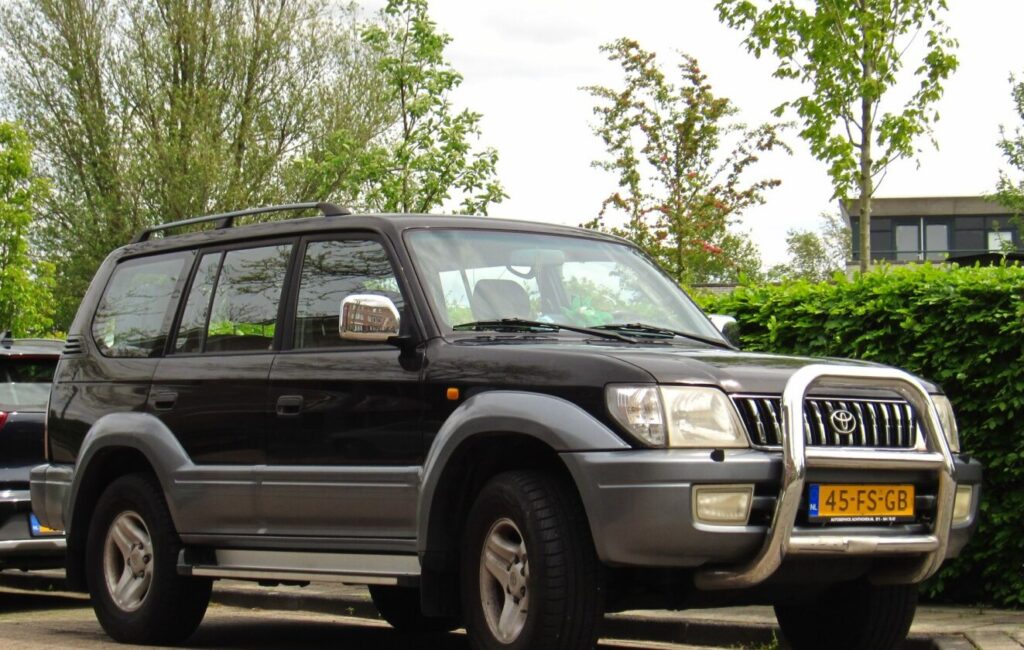
The Toyota Land Cruiser Prado J90 series, particularly the facelifted version introduced in 2000, represented a significant evolution of Toyota’s renowned off-road capability combined with increasing on-road refinement. This five-door variant, powered by the 3.0-liter turbocharged diesel engine producing 145 horsepower, occupied a middle ground within the J90 lineup, offering a balance between fuel efficiency, torque for off-road excursions, and a more accessible price point compared to the gasoline-powered models. Production of this specific configuration ran from 2000 to 2002, serving markets where diesel engines were favored for their economy and durability. The Prado J90, built on the 120-series platform, aimed to bridge the gap between the rugged, utilitarian Land Cruiser 80 series and the more luxurious, car-like SUVs emerging at the time.
The 3.0 TD (145 Hp) Prado: Positioning and Market Role
The 3.0 TD variant with the 145 hp engine and ECT (Electronically Controlled Transmission) automatic gearbox was positioned as a practical and versatile choice within the J90 Prado range. It wasn’t the entry-level model – that distinction belonged to the naturally aspirated diesel versions available in some markets – but it wasn’t the premium offering either. The gasoline-powered 3.4-liter V6 was generally considered the higher-tier option, appealing to buyers prioritizing smoother power delivery and refinement. The 3.0 TD aimed at buyers who needed the Prado’s off-road prowess and spaciousness but also valued fuel economy and sufficient torque for towing or navigating challenging terrain. It was a popular choice for families and those living in rural areas where robust reliability was paramount.
Powertrain & Engine Architecture
The heart of this Prado variant is the 1KZ-TE 3.0-liter inline-four cylinder diesel engine. This engine is a stalwart of the Toyota diesel lineup, known for its durability and relatively simple mechanical design. It features a cast iron block and aluminum cylinder head, contributing to its robustness. The 1KZ-TE utilizes a precombustion chamber injection system, a common design for diesel engines of this era. This system involves injecting fuel into a precombustion chamber connected to the main cylinder, promoting more complete combustion and reducing noise. The engine is turbocharged, boosting power output to 145 hp at 3600 rpm and 343 Nm (252.98 lb-ft) of torque at 2000 rpm. The overhead camshaft (OHC) valvetrain operates two valves per cylinder.
The engine is longitudinally mounted in the chassis. The automatic transmission is a four-speed ECT unit, designed to provide smooth and convenient gear changes. While not as sophisticated as modern automatic transmissions, the ECT unit was reliable and well-suited to the engine’s torque characteristics. The transmission’s gear ratios were optimized for both on-road cruising and off-road crawling, providing a balance between fuel efficiency and low-speed control.
Fuel Injection and Turbocharging
The precombustion chamber injection system, while effective, is less efficient than modern common-rail direct injection systems. However, it contributes to the engine’s inherent reliability. The turbocharger, a key component in boosting power, is a variable geometry turbo (VGT) in some markets, allowing for improved responsiveness across a wider range of engine speeds. The engine oil capacity is 7 liters (7.4 US qt / 6.16 UK qt), and the recommended oil specification is crucial for maintaining engine longevity.
Driving Characteristics
The 3.0 TD Prado with the automatic transmission delivers a driving experience focused on usability and torque. Acceleration is not particularly brisk, but the 343 Nm of torque provides ample pulling power for overtaking and climbing hills. The automatic transmission shifts smoothly, but it can feel somewhat sluggish compared to manual transmissions or more modern automatics. The gear ratios are spaced to prioritize fuel economy and low-end torque, making it well-suited for off-road driving and towing. Compared to the 3.4-liter V6, the diesel Prado feels less refined and has more noticeable engine noise, but it offers significantly better fuel economy. The diesel’s torque curve is also more favorable for off-road situations, providing greater control at low speeds.
Equipment & Trim Levels
The 3.0 TD Prado typically came equipped with a reasonable level of standard features, though specific equipment levels varied depending on the market. Standard features generally included air conditioning, power windows, power door locks, and a basic audio system. Interior upholstery was typically cloth, though leather seats were often available as an option. The dashboard layout was functional and straightforward, prioritizing usability over luxury. Optional extras included a sunroof, upgraded audio system, cruise control, and alloy wheels. The Prado J90 offered seating for up to eight passengers, with a third-row seat that could be folded flat to increase cargo space. Trunk space ranged from 742 liters (26.2 cu. ft) with the third-row seats up to 1150 liters (40.61 cu. ft) with them folded down.
Chassis & Braking
The Prado J90 features a robust body-on-frame construction, providing excellent durability and off-road capability. The front suspension utilizes a coil spring, double wishbone setup with a transverse stabilizer bar, while the rear suspension employs a rigid axle with coil springs. This suspension configuration provides a comfortable ride on paved roads while maintaining excellent articulation for off-road use. Braking duties are handled by ventilated discs on all four wheels, providing adequate stopping power. An Anti-lock Braking System (ABS) was standard equipment, enhancing safety. The steering system is a rack and pinion setup with hydraulic power steering, offering precise and responsive steering feel. The vehicle rides on 215/80 R16 tires, providing a good balance between on-road comfort and off-road traction.
Market Reception & Comparison
The 3.0 TD Prado was generally well-received by critics and buyers alike. It was praised for its reliability, fuel economy, and off-road capability. However, some critics noted its relatively slow acceleration and less refined engine compared to the gasoline-powered models. In terms of fuel economy, the 3.0 TD significantly outperformed the 3.4-liter V6, making it a more economical choice for long-distance driving. Reliability was a strong point, with the 1KZ-TE engine proving to be exceptionally durable. Compared to competitors like the Mitsubishi Pajero and Nissan Patrol, the Prado offered a good balance of refinement, capability, and reliability.
Technical Specifications
| Brand | Toyota |
| Model | Land Cruiser Prado |
| Generation | Land Cruiser Prado (J90, facelift 2000) 5-door |
| Type | 3.0 TD (145 Hp) 4WD ECT |
| Start of production | 2000 year |
| End of production | 2002 year |
| Engine Model/Code | 1KZ-TE |
| Engine displacement | 2982 cm3 (181.97 cu. in.) |
| Number of cylinders | 4 |
| Engine configuration | Inline |
| Cylinder Bore | 96 mm (3.78 in.) |
| Piston Stroke | 103 mm (4.06 in.) |
| Compression ratio | 21:1 |
| Number of valves per cylinder | 2 |
| Fuel injection system | Precombustion chamber injection |
| Engine aspiration | Turbocharger |
| Power | 145 Hp @ 3600 rpm |
| Torque | 343 Nm @ 2000 rpm (252.98 lb.-ft. @ 2000 rpm) |
| Kerb Weight | 1910-1950 kg (4210.83 – 4299.01 lbs.) |
| Max. weight | 2450 kg (5401.33 lbs.) |
| Fuel tank capacity | 90 l (23.78 US gal | 19.8 UK gal) |
| Length | 4690 mm (184.65 in.) |
| Width | 1820 mm (71.65 in.) |
| Height | 1880 mm (74.02 in.) |
| Wheelbase | 2675 mm (105.31 in.) |
| Gears/Transmission | 4 gears, automatic transmission ECT |
Legacy
The 3.0 TD Prado J90, particularly with the 1KZ-TE engine, has earned a reputation for exceptional long-term reliability. Many examples are still on the road today, testament to the engine’s durability and Toyota’s build quality. In the used car market, these Prados are sought after for their robustness and off-road capability. While they may not offer the latest technology or refinement, they represent a dependable and capable SUV that can handle a wide range of tasks. Maintenance is relatively straightforward, and parts availability remains good, making them a practical choice for those seeking a rugged and reliable vehicle. The 1KZ-TE engine is known to be capable of high mileage with proper maintenance, further enhancing its appeal in the used car market.