
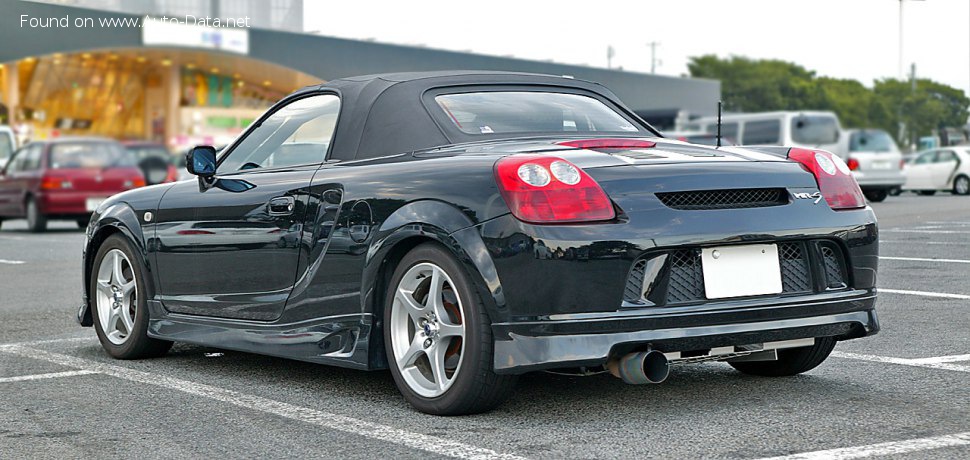
The Toyota MR-S, known in North America as the MR2 Spyder and in the UK and Australia as the MR2 Roadster, represents the third and final generation of Toyota’s iconic mid-engine, rear-wheel-drive sports car. Produced from October 1999 to July 2007, the MR-S marked a significant departure from its predecessors, embracing a philosophy of lightweight purity and unadulterated driving engagement. Unlike the more powerful and technologically complex second-generation MR2, the MR-S focused on agility, balance, and the direct connection between driver and road, making it a spiritual successor to classic British roadsters but with Toyota’s renowned reliability.
The Toyota MR-S 1.8 16V VT-i (140 Hp): Engineering for Engagement
Powertrain & Engine Architecture
At the heart of the Toyota MR-S 1.8 16V VT-i (140 Hp) lies Toyota’s well-regarded 1ZZ-FE engine, a 1.8-liter (1794 cm3 or 109.48 cu. in.) inline four-cylinder unit. This powerplant is distinguished by its 16-valve DOHC (Dual Overhead Camshaft) design and Toyota’s Variable Valve Timing with intelligence (VVT-i) system. The VVT-i technology continuously adjusts the timing of the intake valves, optimizing valve overlap for improved torque delivery across the rev range and enhanced fuel efficiency. This naturally aspirated engine delivers a respectable 140 horsepower at 6400 rpm, which translates to a power-to-liter ratio of 78 Hp/l, showcasing its efficient design for its displacement.
Peak torque is rated at 172 Nm (126.86 lb.-ft.) at 4400 rpm, providing ample mid-range grunt for spirited driving. The engine’s rear-transverse layout is central to the MR-S’s dynamic character, contributing to its balanced weight distribution and nimble handling. Power is sent to the rear wheels via a precise 5-speed manual transmission, offering a direct and engaging driving experience that enthusiasts crave. The 1ZZ-FE engine utilizes multi-port fuel injection, a common system for its time, providing precise fuel delivery for optimal combustion. The engine’s valvetrain is a key component of its performance, with the DOHC configuration allowing for efficient cylinder filling and exhaust scavenging.
Driving Characteristics
The 140 hp output of the MR-S 1.8 VT-i, coupled with its lightweight construction, resulted in a driving experience focused on agility rather than outright acceleration. Compared to the turbocharged MR2 variants of the past, or even the higher-output Honda S2000, the 1.8L engine provided a more linear power delivery. This made the car very approachable for drivers of all skill levels. The 5-speed manual transmission was well-matched to the engine’s characteristics, offering precise shifts and allowing the driver to keep the engine in its sweet spot. The gear ratios were tuned for acceleration in the lower gears and comfortable cruising at highway speeds. While not exceptionally quick in a straight line (0-60 mph in 7.5 seconds), the MR-S truly shined on winding roads, where its mid-engine layout and balanced chassis allowed for confident cornering and precise handling. Compared to the Mazda MX-5 Miata, the MR-S offered a more exotic feel due to its mid-engine configuration, though the Miata generally provided a more forgiving and accessible driving experience.
Equipment & Trim Levels
The MR-S 1.8 16V VT-i was generally offered with a relatively standard equipment list, reflecting its focus on driving purity. Standard features typically included power windows, power locks, and a basic audio system. Air conditioning was often included, though it could sometimes be an optional extra depending on the market. Interior upholstery was typically cloth, with leather options available as upgrades. The dashboard layout was driver-focused, with clear and concise instrumentation. Optional extras included alloy wheels, a premium audio system, and a limited-slip differential, which further enhanced the car’s handling capabilities. The MR-S was positioned as a mid-range offering within the MR2 lineup, offering a balance between affordability and performance. It sat below any potential turbocharged or higher-performance variants that were not widely available in all markets.
Chassis & Braking
The MR-S is built for handling. It features a wishbone front suspension and a coil spring rear suspension, a setup chosen for its ability to provide precise control and a compliant ride. Braking is handled by ventilated discs on both the front and rear wheels, ensuring strong stopping power. An Anti-lock Braking System (ABS) was standard, enhancing safety under hard braking conditions. The steering system utilizes a hydraulic rack and pinion setup, offering excellent feedback and direct response to driver inputs, a hallmark of engaging sports cars of its era. The car comes equipped with staggered tire sizes: 185/55 R15 on the front and 205/50 R15 on the rear, optimizing grip and handling balance. The chassis was designed to be lightweight and rigid, contributing to the car’s overall agility. The rear suspension geometry was carefully tuned to minimize body roll and maximize grip during cornering.
Market Reception & Comparison
Critics generally praised the Toyota MR-S 1.8 16V VT-i for its engaging driving dynamics, precise handling, and Toyota’s renowned reliability. However, some reviewers noted its relatively modest power output and limited practicality. Compared to the Mazda MX-5 Miata, the MR-S offered a more unique driving experience due to its mid-engine layout, but the Miata was often seen as more affordable and accessible. Fuel economy was considered good for a sports car, with urban consumption around 22.4 US mpg and extra-urban driving yielding 34.1 US mpg. Reliability was a strong point, with the 1ZZ-FE engine proving to be durable and relatively maintenance-free. The MR-S generally required less frequent and less expensive maintenance compared to some of its European competitors. The car’s resale value has remained relatively stable over the years, reflecting its growing popularity among enthusiasts.
Technical Specifications: Toyota MR-S 1.8 16V VT-i (140 Hp)
| Category | Specification |
| Brand | Toyota |
| Model | MR-S |
| Generation | MR-S |
| Type (Engine) | 1.8 16V VT-i (140 Hp) |
| Start of Production | October, 1999 |
| End of Production | July, 2007 |
| Powertrain Architecture | Internal Combustion Engine |
| Body type | Cabriolet |
| Seats | 2 |
| Doors | 2 |
| Fuel Type | Petrol (Gasoline) |
| Fuel Consumption (Urban) | 22.4 US mpg (10.5 l/100 km) |
| Fuel Consumption (Extra Urban) | 34.1 US mpg (6.9 l/100 km) |
| Acceleration 0 – 60 mph | 7.5 sec |
| Acceleration 0 – 62 mph (0-100 km/h) | 7.9 sec |
| Maximum Speed | 130.49 mph (210 km/h) |
| Power | 140 Hp @ 6400 rpm |
| Power per liter | 78 Hp/l |
| Torque | 126.86 lb.-ft. @ 4400 rpm (172 Nm) |
| Engine Layout | Rear, Transverse |
| Engine Displacement | 1.8 liters (1794 cm3 / 109.48 cu. in.) |
| Number of Cylinders | 4 |
| Engine Configuration | Inline |
| Cylinder Bore | 3.11 in. (79 mm) |
| Piston Stroke | 3.6 in. (91.5 mm) |
| Compression Ratio | 10:1 |
| Valves per Cylinder | 4 |
| Fuel Injection System | Multi-port manifold injection |
| Engine Aspiration | Naturally aspirated engine |
| Valvetrain | DOHC |
| Kerb Weight | 2314.85 lbs (1050 kg) |
| Max. Weight | 2700.66 lbs (1225 kg) |
| Max Load | 385.81 lbs (175 kg) |
| Trunk (boot) Space – Minimum | 3.18 cu. ft. (90 l) |
| Fuel Tank Capacity | 12.68 US gal (48 l) |
| Length | 152.95 in. (3885 mm) |
| Width | 66.73 in. (1695 mm) |
| Height | 48.82 in. (1240 mm) |
| Wheelbase | 96.46 in. (2450 mm) |
| Front Track | 58.07 in. (1475 mm) |
| Rear (Back) Track | 57.48 in. (1460 mm) |
| Minimum Turning Circle | 32.15 ft. (9.8 m) |
| Drivetrain Architecture | Internal combustion engine drives the rear wheels |
| Drive Wheel | Rear wheel drive |
| Gearbox Type | 5-speed manual transmission |
| Front Suspension | Wishbone |
| Rear Suspension | Coil spring |
| Front Brakes | Ventilated discs |
| Rear Brakes | Ventilated discs |
| Assisting Systems | ABS (Anti-lock braking system) |
| Steering Type | Steering rack and pinion |
| Power Steering | Hydraulic Steering |
| Tires Size | Front: 185/55 R15; Rear: 205/50 R15 |
Legacy
The Toyota MR-S, or MR2 Spyder as it was predominantly known in the US, holds a significant place in Toyota’s history and the broader sports car landscape. It represented Toyota’s commitment to the pure, lightweight roadster concept, a genre that prioritizes driver involvement and handling prowess over brute force. Its mid-engine, rear-wheel-drive layout distinguished it from its primary competitor, the Mazda MX-5 Miata, which featured a more conventional front-engine, rear-wheel-drive architecture. While the Miata was celebrated for its balance and affordability, the MR-S offered a different flavor of engagement, with a more exotic mid-engine feel that evoked comparisons to more expensive European sports cars like the Porsche Boxster, albeit on a smaller, more accessible scale.
During its production run, the MR-S appealed to enthusiasts seeking a reliable, fun-to-drive convertible with excellent handling characteristics. Its light weight and responsive engine made it a joy on twisty roads, and its open-top design added to the sensory experience. The car’s reputation was built on its agility, precise steering, and predictable handling at the limit, making it an excellent platform for track days and weekend drives.
The discontinuation of the MR-S in 2007 marked the end of the MR2 lineage, leaving a void in Toyota’s sports car lineup that wouldn’t be filled until the introduction of the 86/BRZ platform years later. Today, the Toyota MR-S (MR2 Spyder) is considered a modern classic, valued by collectors and enthusiasts for its distinctive mid-engine layout, engaging driving dynamics, and the inherent reliability of a Toyota. It stands as a testament to an era when purity of design and driving pleasure were paramount, offering a unique and rewarding experience that continues to captivate automotive aficionados. Its legacy is one of a focused, uncompromised sports car that delivered on its promise of accessible, open-top driving excitement.
