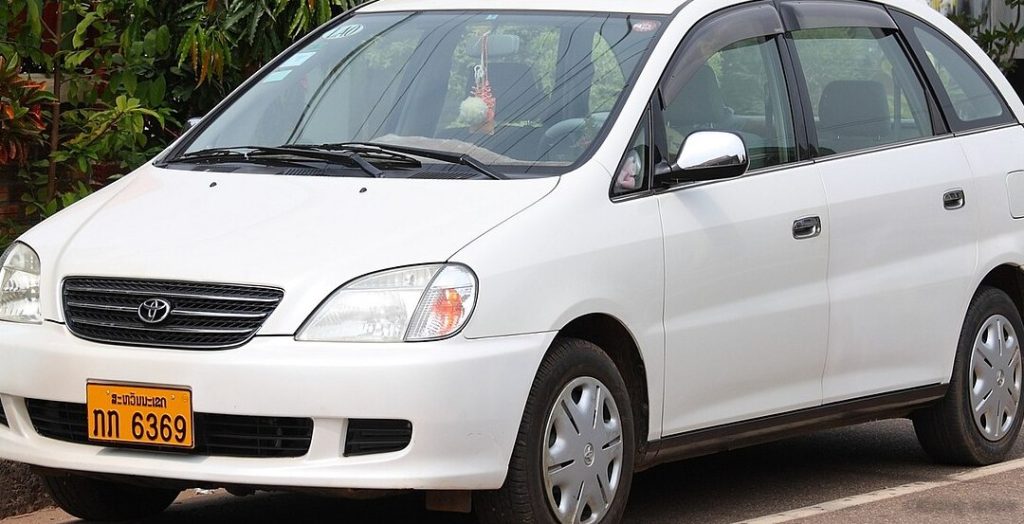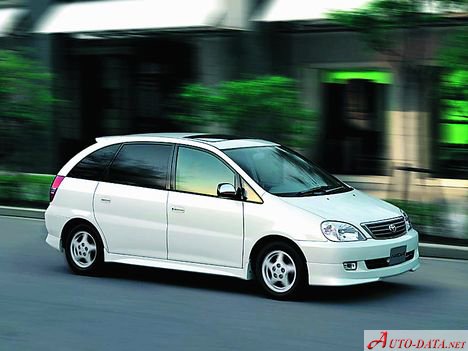
The Toyota Nadia (SXN10) represents a unique and innovative approach to the compact minivan segment, primarily developed for the Japanese domestic market (JDM). Launched in 1998, the Nadia aimed to blend the practicality of a minivan with the driving dynamics and styling closer to a conventional sedan, distinguishing itself from more boxy competitors. The specific variant under review, the 2.0 i 16V D-4 (152 Hp), produced between 2001 and 2003, showcases Toyota’s commitment to advanced engine technology and versatile vehicle packaging during that era. This iteration of the Nadia, part of its first and only generation (SXN10), offered a compelling blend of performance, fuel efficiency, and interior flexibility, tailored to the demands of Japanese families seeking a capable and compact daily driver. While never officially sold in the United States, the Nadia exemplifies a particular design philosophy prevalent in the Japanese automotive landscape, focusing on maximizing interior space within compact exterior dimensions, a concept often referred to as “packaging efficiency.”
Powertrain & Engine Architecture
At the heart of the 2001-2003 Toyota Nadia (SXN10) 2.0 i 16V D-4 lies the sophisticated 1AZ-FSE engine, a 2.0-liter (1998 cm³ or 121.93 cu. in.) inline four-cylinder unit. This powerplant was notable for its use of Toyota’s D-4 direct injection system, an advanced technology for its time that optimized fuel delivery directly into the combustion chamber. This system allowed for precise control over the air-fuel mixture, leading to improved fuel economy and reduced emissions, while simultaneously enhancing power output. The naturally aspirated engine produced a healthy 152 horsepower at 6000 rpm, which was quite competitive for a compact minivan, providing ample power for both city driving and highway cruising.
Torque figures further underscore the engine’s capability, delivering 200 Nm (approximately 147.51 lb.-ft.) at 4000 rpm. This broad torque band ensured responsive acceleration and confident overtaking, even when the vehicle was fully loaded. The engine’s layout was front-transverse, driving the front wheels through a 4-speed automatic transmission. This transmission, a common choice for Toyota during this period, prioritized smooth operation and ease of use over outright performance. It featured electronically controlled torque converter lock-up for improved fuel efficiency at highway speeds. The gear ratios were tuned for a balance between acceleration and cruising comfort, with a relatively conservative first gear and a taller fourth gear for efficient highway driving. The DOHC (Double Overhead Camshaft) valvetrain with four valves per cylinder further contributed to the engine’s efficiency and smooth operation. The 1AZ-FSE engine, with its 9.8:1 compression ratio and 86 mm bore and stroke, demonstrated Toyota’s engineering prowess in balancing performance with real-world usability and efficiency, making the Nadia a capable and economical family vehicle.
Driving Characteristics
The 2.0L 152 hp / Automatic combination in the Toyota Nadia offered a comfortable and predictable driving experience. Compared to the manual transmission versions, the automatic naturally sacrificed some responsiveness, particularly during quick acceleration. However, the 4-speed automatic provided smooth gear changes and made the Nadia exceptionally easy to drive in urban environments. The power delivery was linear, with a usable amount of torque available from relatively low engine speeds thanks to the D-4 direct injection system. While not a sporty vehicle, the Nadia felt adequately powered for most driving situations, including highway merging and overtaking. Compared to higher-output versions available in other Toyota models, such as those with the 1AZ-FE engine, the 1AZ-FSE prioritized fuel efficiency and refinement over outright performance. The automatic transmission’s shift points were programmed to favor fuel economy, resulting in a slightly less engaging driving experience than a manual transmission would offer. The weight-to-power ratio of 8.7 kg/Hp meant that the Nadia wasn’t particularly quick, but it felt stable and composed during normal driving conditions.
Equipment & Trim Levels
The 2.0 i 16V D-4 variant of the Toyota Nadia typically represented a mid-range trim level within the SXN10 lineup. Standard features included power windows, power door locks, air conditioning, and a basic audio system. Interior upholstery was typically cloth, available in a range of colors. The dashboard featured a straightforward design with easy-to-read gauges and logically placed controls. Optional extras available for this trim included alloy wheels, a sunroof, upgraded audio systems with CD changers, and woodgrain interior trim. Some models also featured optional rear parking sensors, a valuable addition given the Nadia’s compact dimensions and limited rear visibility. The seating configuration was typically a five-seater with a 60/40 split folding rear bench, allowing for flexible cargo space. Safety features, beyond the standard ABS, were relatively basic for the time, typically including dual front airbags.
Chassis & Braking
The Toyota Nadia (SXN10) utilized a front-wheel-drive chassis with a MacPherson strut suspension at the front and a coil spring suspension at the rear. This setup aimed to provide a comfortable ride while maintaining reasonable handling characteristics. The suspension was tuned for softness, prioritizing ride comfort over sporty handling. The front suspension featured a stabilizer bar to reduce body roll during cornering. Braking was handled by ventilated discs at the front and drum brakes at the rear, a common configuration for vehicles in this class during the early 2000s. While adequate for normal driving conditions, the rear drum brakes offered less stopping power and fade resistance compared to rear disc brakes. The hydraulic power steering provided light and easy steering effort, making the Nadia easy to maneuver in tight spaces. The 195/60 R15 H tires provided a good balance between grip and ride comfort.
Market Reception & Comparison
Critics generally viewed the Toyota Nadia (SXN10) 2.0 i 16V D-4 as a practical and well-engineered compact minivan. The D-4 direct injection engine was praised for its fuel efficiency and smooth operation. However, some reviewers noted that the 4-speed automatic transmission felt somewhat dated compared to newer transmissions with more gears. Compared to other trims in the Nadia lineup, the 2.0L automatic offered a good balance between performance and fuel economy. It was more affordable than the higher-output versions, making it an attractive option for budget-conscious buyers. Fuel economy was a strong point, with the 1AZ-FSE engine achieving respectable figures for its class. Reliability was also a key strength, as Toyota is known for its durable and dependable vehicles. Compared to competitors like the Honda Stream and Nissan Tino, the Nadia offered a slightly more refined driving experience and a more spacious interior, but it lacked the sporty image of the Stream.
Technical Specifications
| Category | Specification |
| General Information | |
| Brand | Toyota |
| Model | Nadia |
| Generation | Nadia (SXN10) |
| Type (Engine) | 2.0 i 16V D-4 (152 Hp) |
| Start of production | 2001 year |
| End of production | 2003 year |
| Powertrain Architecture | Internal Combustion engine |
| Body type | Minivan |
| Seats | 5 |
| Doors | 5 |
| Performance Specs | |
| Fuel Type | Petrol (Gasoline) |
| Weight-to-power ratio | 8.7 kg/Hp (115.2 Hp/tonne) |
| Weight-to-torque ratio | 6.6 kg/Nm (151.5 Nm/tonne) |
| Engine Specs | |
| Power | 152 Hp @ 6000 rpm |
| Power per liter | 76.1 Hp/l |
| Torque | 200 Nm @ 4000 rpm (147.51 lb.-ft. @ 4000 rpm) |
| Engine layout | Front, Transverse |
| Engine Model/Code | 1AZ-FSE |
| Engine displacement | 1998 cm³ (2.0 l / 121.93 cu. in.) |
| Number of cylinders | 4 |
| Engine configuration | Inline |
| Cylinder Bore | 86 mm (3.39 in.) |
| Piston Stroke | 86 mm (3.39 in.) |
| Compression ratio | 9.8:1 |
| Number of valves per cylinder | 4 |
| Fuel injection system | Direct injection |
| Engine aspiration | Naturally aspirated engine |
| Valvetrain | DOHC |
| Engine oil capacity | 4.2 l (4.44 US qt) |
| Coolant | 5.9 l (6.23 US qt) |
| Space, Volume and Weights | |
| Curb Weight | 1320 kg (2910.1 lbs.) |
| Max. weight | 1595 kg (3516.37 lbs.) |
| Max load | 275 kg (606.27 lbs.) |
| Trunk (boot) space – minimum | 810 l (28.6 cu. ft.) |
| Fuel tank capacity | 60 l (15.85 US gal) |
| Dimensions | |
| Length | 4435 mm (174.61 in.) |
| Width | 1695 mm (66.73 in.) |
| Height | 1625 mm (63.98 in.) |
| Wheelbase | 2735 mm (107.68 in.) |
| Front track | 1470 mm (57.87 in.) |
| Rear (Back) track | 1450 mm (57.09 in.) |
| Drivetrain, Brakes and Suspension Specs | |
| Drivetrain Architecture | The Internal combustion engine (ICE) drives the front wheels of the vehicle. |
| Drive wheel | Front wheel drive |
| Number of gears and type of gearbox | 4 gears, automatic transmission |
| Front suspension | Wishbone |
| Rear suspension | Coil spring |
| Front brakes | Ventilated discs |
| Rear brakes | Drum |
| Assisting systems | ABS (Anti-lock braking system) |
| Steering type | Steering rack and pinion |
| Power steering | Hydraulic Steering |
| Tires size | 195/60 R15 H |
Legacy
The Toyota Nadia (SXN10) carved out a distinctive niche in the highly competitive Japanese domestic market during its production run from 1998 to 2003. Positioned as a “crossover” between a traditional minivan and a station wagon, it appealed to families who desired the practicality of extra space without the often-bulky appearance and driving dynamics of larger minivans. Its compact dimensions made it ideal for Japan’s urban environments, where parking and maneuverability are paramount, while its spacious interior and flexible seating offered genuine utility. In terms of long-term reliability, the 1AZ-FSE engine, when properly maintained, has proven to be a durable and dependable unit. Common issues are relatively minor, often related to age and wear, such as oil leaks and sensor failures. The automatic transmission is also generally reliable, although regular fluid changes are crucial for preventing problems. Today, the Nadia is remembered as a testament to Toyota’s diverse product portfolio and its continuous innovation, even for models exclusively tailored to specific regional markets. Its robust engineering and practical design have ensured that many examples continue to serve their owners reliably, a testament to its enduring quality. In the used car market, the Nadia remains an affordable and practical option for those seeking a spacious and reliable family vehicle.