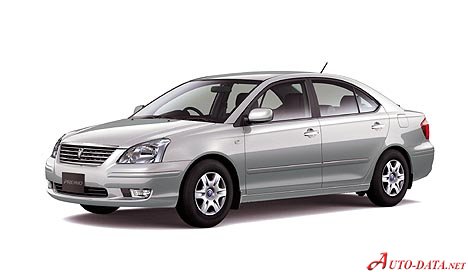
The Toyota Premio is a compact sedan that was primarily marketed in Japan and parts of Asia from 2001 to 2007. Positioned as a more upscale alternative to the Corolla, the Premio offered a blend of comfort, practicality, and Toyota’s renowned reliability. While never officially sold in the United States, understanding the Premio provides insight into Toyota’s global strategy and the features valued by consumers in those markets. The 1.5 16V model, producing 109 horsepower, represented a key trim level within the Premio lineup, appealing to buyers seeking a balance between fuel efficiency and adequate performance.
Toyota Premio 1.5 16V: An Overview
The first generation Toyota Premio (introduced in December 2001 and discontinued in June 2007) was designed to cater to a segment of the Japanese automotive market that desired a vehicle larger and more refined than the standard compact offerings. It shared a platform with the Allion, a similar model sold through a different Toyota dealership network in Japan – essentially offering two distinct showroom experiences for nearly identical vehicles. The Premio distinguished itself with a slightly more conservative styling approach, targeting a mature and family-oriented demographic. The 1.5 16V engine option was a popular choice, providing sufficient power for daily commuting and highway driving while maintaining reasonable fuel economy.
Engine & Performance
The Toyota Premio 1.5 16V is powered by the 1NZ-FE 1.5-liter inline-four cylinder gasoline engine. This naturally aspirated engine produces 109 horsepower at 6000 rpm and 141 Nm (104 lb.-ft.) of torque at 4200 rpm. The engine features a double overhead camshaft (DOHC) valvetrain with four valves per cylinder, contributing to its relatively efficient operation. Fuel is delivered via a multi-port manifold injection system. Acceleration from 0 to 100 km/h (0-62 mph) takes approximately 10.5 seconds, while 0 to 60 mph is achieved in around 10 seconds. The vehicle has a top speed of 180 km/h (111.85 mph). The engine’s power-to-weight ratio is 95.6 horsepower per tonne, and the torque-to-weight ratio is 123.7 Nm per tonne. Fuel economy is rated at 13 liters per 100 km (18.1 US mpg) in urban driving and 6 liters per 100 km (39.2 US mpg) in extra-urban conditions.
Design & Features
The Toyota Premio 1.5 16V is a four-door, five-seat sedan. Its design prioritizes practicality and a comfortable interior over sporty aesthetics. The exterior styling is characterized by clean lines and a relatively understated appearance, typical of Japanese automotive design of the early 2000s. Inside, the Premio offers a spacious cabin with a focus on ergonomics and ease of use. Features included hydraulic power steering, an anti-lock braking system (ABS), and a four-speed automatic transmission. Safety features, while standard for the time, were geared towards occupant protection in the event of a collision. The vehicle’s dimensions are 4550 mm (179.13 in) in length, 1695 mm (66.73 in) in width, and 1470 mm (57.87 in) in height, with a wheelbase of 2700 mm (106.3 in). The front and rear track widths are 1480 mm (58.27 in) and 1460 mm (57.48 in) respectively.
Technical Specifications
| Brand | Toyota |
| Model | Premio |
| Generation | Premio |
| Type (Engine) | 1.5 16V (109 Hp) |
| Start of production | December, 2001 |
| End of production | June, 2007 |
| Powertrain Architecture | Internal Combustion engine |
| Body type | Sedan |
| Seats | 5 |
| Doors | 4 |
| Fuel consumption (urban) | 13 l/100 km (18.1 US mpg, 21.7 UK mpg) |
| Fuel consumption (extra urban) | 6 l/100 km (39.2 US mpg, 47.1 UK mpg) |
| Fuel Type | Petrol (Gasoline) |
| Acceleration 0 – 100 km/h | 10.5 sec |
| Acceleration 0 – 62 mph | 10.5 sec |
| Acceleration 0 – 60 mph | 10 sec |
| Maximum speed | 180 km/h (111.85 mph) |
| Weight-to-power ratio | 10.5 kg/Hp |
| Weight-to-torque ratio | 8.1 kg/Nm |
| Power | 109 Hp @ 6000 rpm |
| Torque | 141 Nm @ 4200 rpm (104 lb.-ft. @ 4200 rpm) |
| Engine layout | Front, Transverse |
| Engine Model/Code | 1NZ-FE |
| Engine displacement | 1497 cm3 (91.35 cu. in.) |
| Number of cylinders | 4 |
| Engine configuration | Inline |
| Cylinder Bore | 75 mm (2.95 in.) |
| Piston Stroke | 84.7 mm (3.33 in.) |
| Compression ratio | 10.5:1 |
| Number of valves per cylinder | 4 |
| Fuel injection system | Multi-port manifold injection |
| Engine aspiration | Naturally aspirated |
| Valvetrain | DOHC |
| Engine oil capacity | 3.7 l (3.91 US qt | 3.26 UK qt) |
| Coolant capacity | 6.3 l (6.66 US qt | 5.54 UK qt) |
| Kerb Weight | 1140 kg (2513.27 lbs.) |
| Fuel tank capacity | 60 l (15.85 US gal | 13.2 UK gal) |
| Length | 4550 mm (179.13 in.) |
| Width | 1695 mm (66.73 in.) |
| Height | 1470 mm (57.87 in.) |
| Wheelbase | 2700 mm (106.3 in.) |
| Front track | 1480 mm (58.27 in.) |
| Rear track | 1460 mm (57.48 in.) |
| Drivetrain Architecture | Front wheel drive |
| Number of gears | 4 |
| Gearbox type | Automatic transmission |
| Front suspension | Spring Strut |
| Rear suspension | Trailing arm |
| Front brakes | Ventilated discs |
| Rear brakes | Drum |
| Assisting systems | ABS (Anti-lock braking system) |
| Steering type | Steering rack and pinion |
| Power steering | Hydraulic |
| Tires size | 185/70 R14 |
The Toyota Premio 1.5 16V, while not a performance vehicle, offered a compelling package of reliability, comfort, and fuel efficiency for buyers in its target market. Its success demonstrates Toyota’s ability to tailor vehicles to specific regional preferences and maintain a strong presence in diverse automotive landscapes.