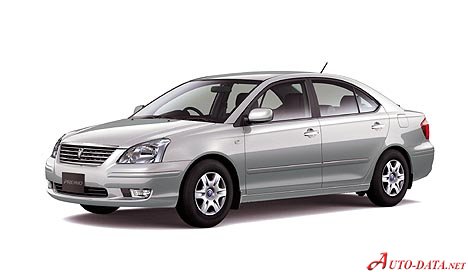
The Toyota Premio is a compact sedan produced by the Japanese automaker Toyota from 2001 to 2007. Primarily aimed at the Japanese domestic market (JDM), the Premio occupied a niche between the more mainstream Corolla and the larger, more luxurious Mark II/Chaser series. It was designed to appeal to buyers seeking a comfortable, well-equipped, and reliable sedan with a slightly more upscale feel than the Corolla, but at a more accessible price point than the Mark II. The 1.8 16V AWD variant, producing 125 horsepower, represents a popular configuration offering all-weather capability and a balance of performance and fuel efficiency. While not officially sold in the United States, understanding the Premio provides insight into Toyota’s product strategy for specific regional markets and its commitment to offering a diverse range of vehicles.
Toyota Premio 1.8 16V (125 Hp) AWD: An Overview
The Toyota Premio, particularly the 1.8 16V AWD model, was conceived as a competitor to other Japanese sedans like the Nissan Bluebird Sylphy and the Honda Integra. It distinguished itself through a focus on interior space, build quality, and a relatively sophisticated suspension setup for its class. The AWD system was a key selling point in regions prone to inclement weather, providing enhanced traction and stability. The vehicle’s design was conservative, reflecting the Japanese preference for understated elegance and practicality. The 2001-2007 generation represents the sole iteration of the Premio, making it a relatively short-lived but significant model in Toyota’s history.
Engine & Performance
The heart of the Toyota Premio 1.8 16V AWD is the 1ZZ-FE 1.8-liter inline-four cylinder engine. This naturally aspirated powerplant delivers 125 horsepower at 6000 rpm and 161 Nm (118.75 lb.-ft.) of torque at 4200 rpm. The engine utilizes a multi-port fuel injection system and a double overhead camshaft (DOHC) valvetrain, contributing to its relatively smooth operation and respectable power output for its displacement. The power-to-weight ratio of 9.4 kg/Hp (106.8 Hp/tonne) allows for a brisk, if not overtly sporty, driving experience. The engine’s 1.8-liter displacement (1794 cm3 or 109.48 cu. in.) and a compression ratio of 10:1 strike a balance between performance and fuel economy. Power delivery is linear, making it suitable for everyday driving conditions. The engine is paired with a four-speed automatic transmission, directing power to all four wheels via Toyota’s all-wheel-drive system. This drivetrain configuration provides enhanced grip and stability, particularly on slippery surfaces.
Design & Features
The Toyota Premio 1.8 16V AWD is a traditional four-door sedan with a comfortable and spacious interior designed to accommodate five passengers. Its exterior styling is characterized by clean lines and a relatively conservative aesthetic, typical of Japanese automotive design of the early 2000s. The vehicle’s dimensions – 4550 mm (179.13 in.) in length, 1695 mm (66.73 in.) in width, and 1470 mm (57.87 in.) in height – provide ample interior space without being overly bulky. Key features include a well-appointed interior with comfortable seating, a functional dashboard layout, and standard amenities such as air conditioning, power windows, and a sound system. Safety features, while not as advanced as those found in modern vehicles, include an Anti-lock Braking System (ABS) to enhance braking performance and stability. The suspension system, featuring spring struts at the front and a traction connecting lever setup at the rear, is tuned for a comfortable ride quality. The vehicle’s curb weight of 1170 kg (2579.41 lbs.) contributes to its manageable handling characteristics.
Technical Specifications
| General Information | |
| Brand | Toyota |
| Model | Premio |
| Generation | Premio |
| Type (Engine) | 1.8 16V (125 Hp) AWD |
| Start of production | December, 2001 |
| End of production | June, 2007 |
| Powertrain Architecture | Internal Combustion engine |
| Body type | Sedan |
| Seats | 5 |
| Doors | 4 |
| Performance Specs | |
| Fuel Type | Petrol (Gasoline) |
| Maximum speed | 200 km/h (124.27 mph) |
| Weight-to-power ratio | 9.4 kg/Hp, 106.8 Hp/tonne |
| Weight-to-torque ratio | 7.3 kg/Nm, 137.6 Nm/tonne |
| Engine Specs | |
| Power | 125 Hp @ 6000 rpm |
| Power per litre | 69.7 Hp/l |
| Torque | 161 Nm @ 4200 rpm (118.75 lb.-ft. @ 4200 rpm) |
| Engine layout | Front, Transverse |
| Engine Model/Code | 1ZZ-FE |
| Engine displacement | 1794 cm3 (109.48 cu. in.) |
| Number of cylinders | 4 |
| Engine configuration | Inline |
| Cylinder Bore | 79 mm (3.11 in.) |
| Piston Stroke | 91.5 mm (3.6 in.) |
| Compression ratio | 10:1 |
| Number of valves per cylinder | 4 |
| Fuel injection system | Multi-port manifold injection |
| Engine aspiration | Naturally aspirated engine |
| Valvetrain | DOHC |
| Engine oil capacity | 3.7 l (3.91 US qt | 3.26 UK qt) |
| Coolant | 6.5 l (6.87 US qt | 5.72 UK qt) |
| Space, Volume and Weights | |
| Kerb Weight | 1170 kg (2579.41 lbs.) |
| Fuel tank capacity | 60 l (15.85 US gal | 13.2 UK gal) |
| Dimensions | |
| Length | 4550 mm (179.13 in.) |
| Width | 1695 mm (66.73 in.) |
| Height | 1470 mm (57.87 in.) |
| Wheelbase | 2700 mm (106.3 in.) |
| Front track | 1480 mm (58.27 in.) |
| Rear (Back) track | 1460 mm (57.48 in.) |
| Drivetrain, Brakes and Suspension Specs | |
| Drive wheel | All wheel drive (4×4) |
| Number of gears and type of gearbox | 4 gears, automatic transmission |
| Front suspension | Spring Strut |
| Rear suspension | Suspension with traction connecting levers |
| Front brakes | Ventilated discs |
| Rear brakes | Drum |
| Assisting systems | ABS (Anti-lock braking system) |
| Steering type | Steering rack and pinion |
| Power steering | Hydraulic Steering |
| Tires size | 185/70 R14 |