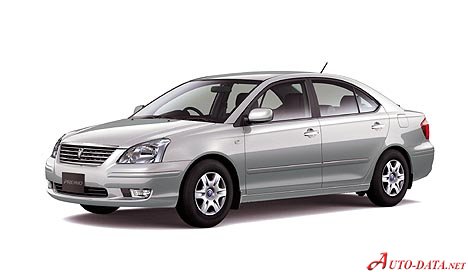
The Toyota Premio is a compact sedan that was primarily marketed in Japan and parts of Asia from 2001 to 2007. Positioned as a more upscale alternative to the Corolla, the Premio offered a blend of comfort, reliability, and a slightly more refined driving experience. While never officially sold in the United States, the Premio represents a significant vehicle in Toyota’s global lineup, particularly in markets where sedans remain highly popular. The first generation, produced between December 2001 and June 2007, is the focus of this article, specifically the 1.8 16V variant producing 132 horsepower.
Toyota Premio 1.8 16V: An Overview
The Toyota Premio was conceived to cater to a segment of buyers seeking a vehicle that offered more than the basic transportation provided by the Corolla, but without the higher price point of the Mark II or Chaser. It aimed to bridge the gap, providing a comfortable and well-equipped sedan for families and professionals. The 1.8 16V model, equipped with the 1ZZ-FE engine, was a popular choice, balancing performance with fuel efficiency. The vehicle’s design emphasized practicality and a conservative aesthetic, appealing to a broad demographic.
Engine & Performance
The heart of the Toyota Premio 1.8 16V is the 1ZZ-FE 1.8-liter inline-four cylinder engine. This naturally aspirated engine produces 132 horsepower at 6000 rpm and 171 Nm (126.12 lb.-ft.) of torque at 4200 rpm. The engine features a double overhead camshaft (DOHC) valvetrain with four valves per cylinder, contributing to its relatively high power output for its displacement – 73.6 horsepower per liter. Fuel is delivered via a multi-port manifold injection system. Power is sent to the front wheels through a four-speed automatic transmission. The Premio 1.8 16V achieves a maximum speed of 200 km/h (124.27 mph). The weight-to-power ratio is 8.9 kg/Hp, and the weight-to-torque ratio is 6.8 kg/Nm, indicating a reasonably efficient powertrain. Fuel economy is rated at 10.5 l/100 km (22.4 US mpg) in urban driving and 6.5 l/100 km (36.2 US mpg) in extra-urban conditions.
Design & Features
The Toyota Premio is a traditional four-door sedan with a conservative and understated design. Its styling prioritizes practicality and a sense of maturity over sporty aesthetics. The interior is designed for comfort and functionality, offering seating for five passengers. Key features included power steering (hydraulic), an anti-lock braking system (ABS), and ventilated disc brakes on the front wheels, with drum brakes on the rear. The vehicle’s suspension utilizes a spring strut setup at the front and a traction connecting lever suspension at the rear, aiming for a comfortable ride quality. The Premio’s dimensions are 4550 mm (179.13 in) in length, 1695 mm (66.73 in) in width, and 1470 mm (57.87 in) in height, with a wheelbase of 2700 mm (106.3 in). The vehicle’s kerb weight is 1170 kg (2579.41 lbs), and it boasts a fuel tank capacity of 60 liters (15.85 US gal).
Technical Specifications
| Brand | Toyota |
| Model | Premio |
| Generation | Premio |
| Type (Engine) | 1.8 16V (132 Hp) |
| Start of production | December, 2001 |
| End of production | June, 2007 |
| Powertrain Architecture | Internal Combustion engine |
| Body type | Sedan |
| Seats | 5 |
| Doors | 4 |
| Fuel consumption (urban) | 10.5 l/100 km (22.4 US mpg) |
| Fuel consumption (extra urban) | 6.5 l/100 km (36.2 US mpg) |
| Fuel Type | Petrol (Gasoline) |
| Maximum speed | 200 km/h (124.27 mph) |
| Weight-to-power ratio | 8.9 kg/Hp |
| Weight-to-torque ratio | 6.8 kg/Nm |
| Power | 132 Hp @ 6000 rpm |
| Power per litre | 73.6 Hp/l |
| Torque | 171 Nm @ 4200 rpm (126.12 lb.-ft. @ 4200 rpm) |
| Engine layout | Front, Transverse |
| Engine Model/Code | 1ZZ-FE |
| Engine displacement | 1794 cm3 (109.48 cu. in.) |
| Number of cylinders | 4 |
| Engine configuration | Inline |
| Cylinder Bore | 79 mm (3.11 in.) |
| Piston Stroke | 91.5 mm (3.6 in.) |
| Compression ratio | 10:1 |
| Number of valves per cylinder | 4 |
| Fuel injection system | Multi-port manifold injection |
| Engine aspiration | Naturally aspirated |
| Valvetrain | DOHC |
| Engine oil capacity | 3.7 l (3.91 US qt | 3.26 UK qt) |
| Coolant capacity | 6.9 l (7.29 US qt | 6.07 UK qt) |
| Kerb Weight | 1170 kg (2579.41 lbs.) |
| Fuel tank capacity | 60 l (15.85 US gal | 13.2 UK gal) |
| Length | 4550 mm (179.13 in.) |
| Width | 1695 mm (66.73 in.) |
| Height | 1470 mm (57.87 in.) |
| Wheelbase | 2700 mm (106.3 in.) |
| Front track | 1480 mm (58.27 in.) |
| Rear track | 1460 mm (57.48 in.) |
| Drivetrain Architecture | Front wheel drive |
| Number of gears | 4 |
| Gearbox type | Automatic transmission |
| Front suspension | Spring Strut |
| Rear suspension | Suspension with traction connecting levers |
| Front brakes | Ventilated discs |
| Rear brakes | Drum |
| Assisting systems | ABS (Anti-lock braking system) |
| Steering type | Steering rack and pinion |
| Power steering | Hydraulic |
| Tires size | 185/70 R14 |
The Toyota Premio 1.8 16V, while not a performance car, offered a reliable and comfortable transportation solution for buyers in its target markets. Its blend of practicality, efficiency, and a relatively refined driving experience made it a popular choice in a competitive segment. Although it remained largely unknown in North America, the Premio represents a significant part of Toyota’s global success story.