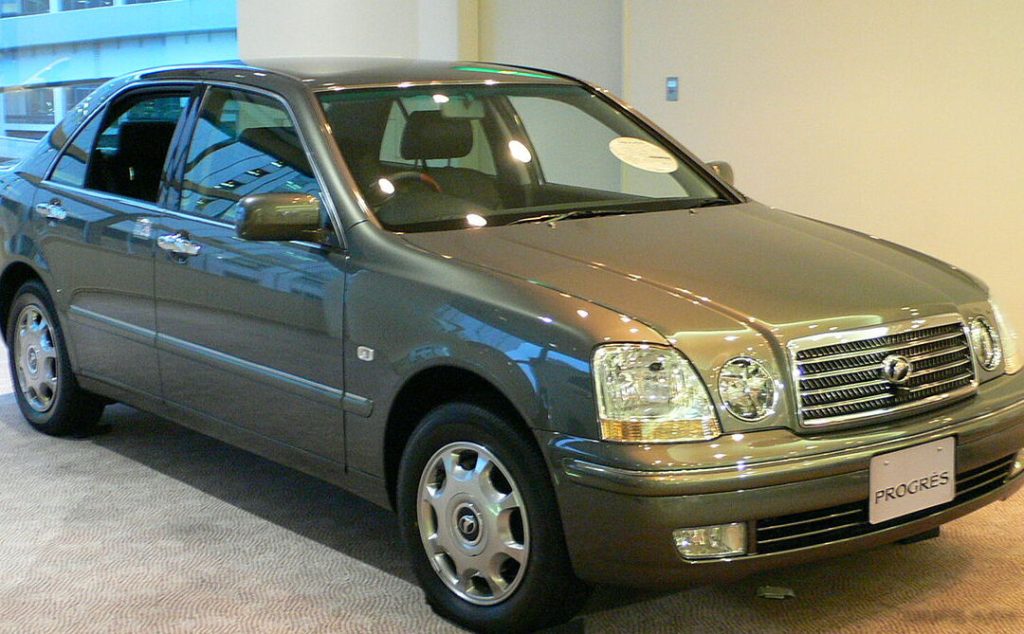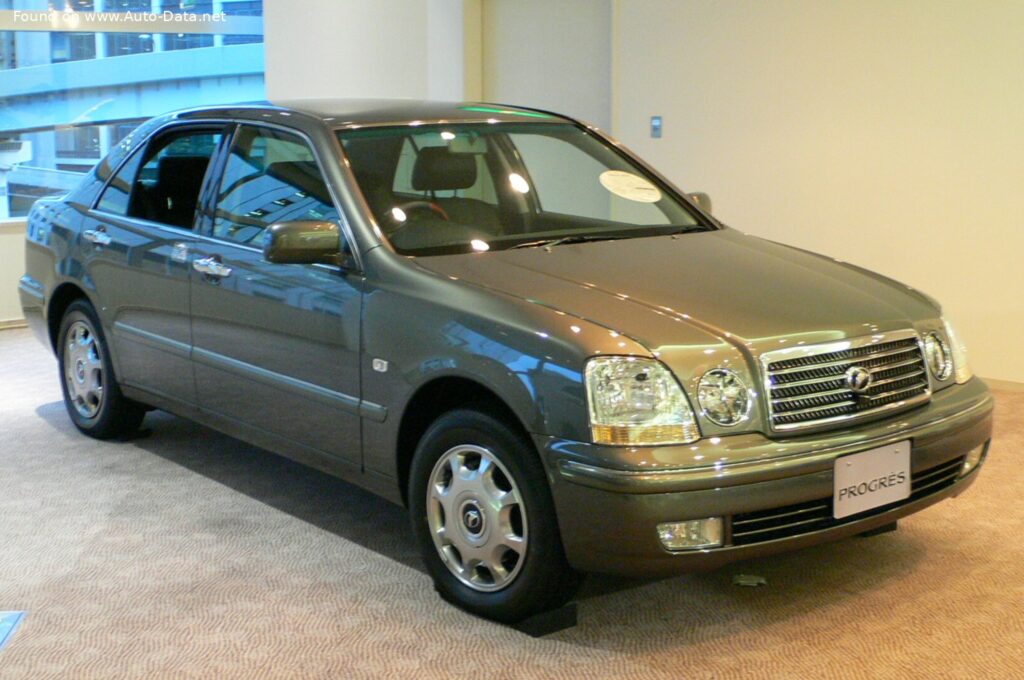
The Toyota Progres 2.5 i 24V (200 Hp) represents a significant, yet largely unknown outside of Japan, chapter in Toyota’s pursuit of compact luxury. Produced from 1998 to 2007, the Progres (derived from the French word for “progress”) was conceived as a premium compact sedan tailored specifically for the Japanese domestic market (JDM). It aimed to offer an elevated driving and ownership experience, embodying refinement, advanced technology, and exceptional build quality in a more manageable footprint than its larger stablemates like the Crown or Celsior (Lexus LS in the United States). Positioned as a sophisticated, rear-wheel-drive (RWD) vehicle, the Progres targeted affluent buyers who desired Lexus-level comfort and sophistication without the need for a full-size luxury sedan. This particular variant, powered by a 2.5-liter V6 engine, exemplified the blend of smooth performance and luxurious appointments that defined its generation.
Toyota Progres 2.5 i 24V: A JDM Luxury Sedan
The Toyota Progres occupied a unique position in the Japanese automotive landscape. It wasn’t intended for global export, and therefore remained largely unfamiliar to American consumers. However, within Japan, it served as a compelling alternative to larger, more conventional luxury cars. The Progres aimed to provide a similar level of comfort and features as Lexus models, but in a more compact and agile package, better suited to Japan’s urban environments and road conditions. Its focus on rear-wheel drive was also a deliberate choice, offering a more traditional and engaging driving experience favored by many Japanese motorists.
Engine & Performance
At the heart of the Toyota Progres 2.5 i 24V lies a 2.5-liter V6 gasoline engine. This powerplant, designated as the 4S-FE, is a naturally aspirated unit featuring a Double Overhead Camshaft (DOHC) valvetrain with four valves per cylinder. Displacing 2,492 cubic centimeters (152.07 cubic inches), the engine produces 200 horsepower at 6,000 rpm. Torque output is rated at 184.39 lb.-ft. (250 Nm) at 3,800 rpm, providing ample power for both city driving and highway cruising. The engine’s design prioritized smooth, linear power delivery over aggressive acceleration, aligning with the car’s luxury-oriented character.
Power is channeled to the rear wheels through a smooth-shifting 4-speed automatic transmission. This rear-wheel-drive configuration contributes to a balanced driving experience and enhances handling characteristics. The Progres achieves a top speed of approximately 111.85 mph (180 km/h), electronically limited in accordance with Japanese regulations. Fuel economy is respectable for its class and era, achieving approximately 18.1 US mpg (13 l/100 km) in urban settings and 29.4 US mpg (8 l/100 km) on the highway. The vehicle’s weight-to-power ratio of 7.6 kg/Hp (131.6 Hp/tonne) further emphasizes its focus on comfortable and composed performance.
Design & Features
The Toyota Progres boasts a classic four-door sedan body style, accommodating five passengers. Its exterior design is characterized by understated elegance, avoiding the ostentatious styling often associated with European luxury vehicles. The Progres measures 177.56 inches (4510 mm) in length, 66.93 inches (1700 mm) in width, and 56.5 inches (1435 mm) in height. Its 109.45-inch (2780 mm) wheelbase contributes to a stable ride and a surprisingly spacious cabin for its size.
The interior of the Progres is a testament to Japanese craftsmanship and attention to detail. High-quality materials, comfortable seating, and a quiet cabin environment are central to the driving experience. Features typically include automatic climate control, a premium audio system, and an advanced (for its time) navigation system. The trunk offers 14.83 cubic feet (420 liters) of cargo space, providing sufficient room for everyday needs and weekend trips. The suspension system, utilizing a double wishbone configuration at both the front and rear, prioritizes ride comfort and stability, effectively absorbing road imperfections. Ventilated front and solid rear disc brakes, coupled with an Anti-lock Braking System (ABS), ensure confident stopping power. Hydraulic power steering provides light and precise control.
Technical Specifications
| Category | Specification |
| Brand | Toyota |
| Model | Progres |
| Generation | Progres |
| Type (Engine) | 2.5 i 24V (200 Hp) |
| Production Start | 1998 year |
| Production End | 2007 year |
| Powertrain Architecture | Internal Combustion engine |
| Body Type | Sedan |
| Seats | 5 |
| Doors | 4 |
| Performance Specs | |
| Fuel Consumption (Urban) | 18.1 US mpg (13 l/100 km) |
| Fuel Consumption (Extra Urban) | 29.4 US mpg (8 l/100 km) |
| Fuel Type | Petrol (Gasoline) |
| Maximum Speed | 111.85 mph (180 km/h) |
| Weight-to-Power Ratio | 7.6 kg/Hp, 131.6 Hp/tonne |
| Weight-to-Torque Ratio | 6.1 kg/Nm, 164.5 Nm/tonne |
| Engine Specs | |
| Power | 200 Hp @ 6000 rpm |
| Power per Liter | 80.3 Hp/l |
| Torque | 184.39 lb.-ft. (250 Nm) @ 3800 rpm |
| Engine Layout | Front, Longitudinal |
| Engine Displacement | 2.5 liters (2492 cm3, 152.07 cu. in.) |
| Number of Cylinders | 6 |
| Engine Configuration | V-engine |
| Cylinder Bore | 3.39 in. (86 mm) |
| Piston Stroke | 2.81 in. (71.5 mm) |
| Compression Ratio | 11:1 |
| Number of Valves per Cylinder | 4 |
| Fuel Injection System | Multi-port manifold injection |
| Engine Aspiration | Naturally aspirated engine |
| Valvetrain | DOHC |
| Space, Volume and Weights | |
| Kerb Weight | 3351.03 lbs (1520 kg) |
| Max. Weight | 3957.3 lbs (1795 kg) |
| Max Load | 606.27 lbs (275 kg) |
| Trunk (Boot) Space – Minimum | 14.83 cu. ft. (420 l) |
| Fuel Tank Capacity | 18.49 US gal (70 l) |
| Dimensions | |
| Length | 177.56 in. (4510 mm) |
| Width | 66.93 in. (1700 mm) |
| Height | 56.5 in. (1435 mm) |
| Wheelbase | 109.45 in. (2780 mm) |
| Front Track | 58.07 in. (1475 mm) |
| Rear (Back) Track | 57.48 in. (1460 mm) |
| Drivetrain, Brakes and Suspension Specs | |
| Drivetrain Architecture | Internal combustion engine (ICE) drives the rear wheels. |
| Drive Wheel | Rear wheel drive |
| Number of Gears and Gearbox Type | 4 gears, automatic transmission |
| Front Suspension | Double wishbone |
| Rear Suspension | Double wishbone |
| Front Brakes | Ventilated discs |
| Rear Brakes | Disc |
| Assisting Systems | ABS (Anti-lock braking system) |
| Steering Type | Steering rack and pinion |
| Power Steering | Hydraulic Steering |
| Tires Size | 195/65 R15 H |
Legacy and Market Impact
The Toyota Progres established a unique position within the Japanese luxury car market. It appealed to buyers who desired the refinement of a larger luxury sedan but preferred a more compact and manageable vehicle. Serving as a “mini-Lexus” for the Japanese market, it offered interior quality, quietness, and advanced features comparable to its more expensive counterparts. While never officially sold in the United States, the Progres gained a following among JDM enthusiasts, recognized for its reliability, build quality, and comfortable driving experience. Its robust mechanicals and advanced features for its time have ensured that many examples remain on the road today, representing a compelling example of Japanese automotive engineering.
The Progres’ legacy lies in demonstrating Toyota’s ability to deliver a premium product in a smaller package. It proved that luxury wasn’t solely defined by size, but also by meticulous engineering, refined performance, and a commitment to occupant comfort. For those familiar with the JDM scene, the Progres remains a testament to Japanese automotive excellence and a unique offering within the luxury sedan segment.