
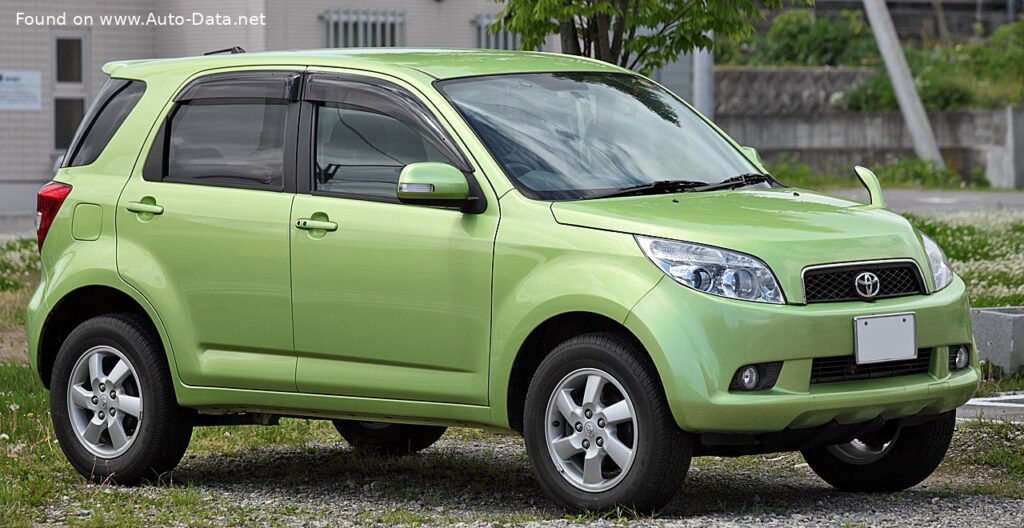
The Toyota Rush 1.5, a compact Sport Utility Vehicle (SUV), was produced from 2006 to 2008. Primarily aimed at the Asian market, particularly Indonesia and the Philippines, the Rush offered affordable four-wheel drive capability in a relatively small package. It filled a niche for families seeking a versatile vehicle capable of handling both urban commutes and occasional off-road excursions. While not officially sold in the United States, understanding the Rush provides insight into Toyota’s global strategy of offering regionally tailored vehicles. This article details the specifications and characteristics of the 2006-2008 Toyota Rush 1.5 4WD Automatic.
Toyota Rush 1.5: Overview and Market Positioning
The Toyota Rush was conceived as a budget-friendly SUV, leveraging the platform of the Toyota Terios. It was designed to appeal to buyers in developing markets where robust, practical vehicles were highly valued. The Rush distinguished itself with its body-on-frame construction, a relatively uncommon feature in this class, contributing to its durability and off-road potential. The 4WD system, combined with its compact size, made it a popular choice for navigating challenging road conditions. The vehicle’s success in Southeast Asia demonstrated Toyota’s ability to cater to specific regional demands.
Engine & Performance
The Toyota Rush 1.5 is powered by the 3SZ-VE 1.5-liter inline-four cylinder gasoline engine. This naturally aspirated engine produces 109 horsepower at 6000 rpm and 141 Nm (104 lb.-ft.) of torque at 4400 rpm. While not a powerhouse, the engine provides adequate performance for its intended purpose. The engine’s power-to-weight ratio is 10.9 kg/Hp, or 91.6 Hp/tonne, and the torque-to-weight ratio is 8.4 kg/Nm, or 118.5 Nm/tonne. The engine features a multi-port fuel injection system and a double overhead camshaft (DOHC) valvetrain. The engine is longitudinally mounted in the chassis. The Rush utilizes a four-speed automatic transmission, delivering power to all four wheels via a part-time four-wheel drive system. Fuel economy is rated at 7.14 liters per 100 kilometers (32.9 US mpg or 39.6 UK mpg) in extra-urban driving conditions. The engine has a displacement of 1495 cm3 (91.23 cu. in.) with a bore of 72 mm (2.83 in.) and a stroke of 91.8 mm (3.61 in.). It operates with a compression ratio of 10:1.
Design & Features
The Toyota Rush boasts a traditional SUV body style with five doors and seating for five passengers. Its boxy shape maximizes interior space and provides good visibility. The vehicle’s design prioritizes functionality over aesthetics, reflecting its target market. The Rush’s body-on-frame construction contributes to its robustness and ability to withstand rough terrain. Key features include an anti-lock braking system (ABS) for enhanced safety, and electric power steering for ease of maneuverability. The interior is basic but functional, with durable materials designed to withstand heavy use. The Rush’s compact dimensions – 3995 mm (157.28 in.) in length, 1695 mm (66.73 in.) in width, and 1705 mm (67.13 in.) in height – make it relatively easy to park and maneuver in urban environments. The wheelbase measures 2580 mm (101.57 in.), and the front and rear tracks are 1445 mm (56.89 in.) and 1460 mm (57.48 in.), respectively. The minimum turning circle is 9.8 meters (32.15 ft.).
Technical Specifications
| Brand | Toyota |
| Model | Rush |
| Generation | Rush |
| Type (Engine) | 1.5 (109 Hp) 4WD Automatic |
| Start of production | December, 2006 |
| End of production | 2008 |
| Powertrain Architecture | Internal Combustion engine |
| Body type | SUV |
| Seats | 5 |
| Doors | 5 |
| Fuel consumption (extra urban) | 7.14 l/100 km (32.9 US mpg, 39.6 UK mpg, 14 km/l) |
| Fuel Type | Petrol (Gasoline) |
| Emission standard | Euro 4 |
| Weight-to-power ratio | 10.9 kg/Hp |
| Power | 109 Hp @ 6000 rpm |
| Torque | 141 Nm @ 4400 rpm (104 lb.-ft. @ 4400 rpm) |
| Engine layout | Middle, Longitudinal |
| Engine Model/Code | 3SZ-VE |
| Engine displacement | 1495 cm3 (91.23 cu. in.) |
| Number of cylinders | 4 |
| Engine configuration | Inline |
| Cylinder Bore | 72 mm (2.83 in.) |
| Piston Stroke | 91.8 mm (3.61 in.) |
| Compression ratio | 10:1 |
| Number of valves per cylinder | 4 |
| Fuel injection system | Multi-port manifold injection |
| Engine aspiration | Naturally aspirated engine |
| Valvetrain | DOHC |
| Engine oil capacity | 3.2 l (3.38 US qt | 2.82 UK qt) |
| Coolant capacity | 5.8 l (6.13 US qt | 5.1 UK qt) |
| Kerb Weight | 1190 kg (2623.5 lbs.) |
| Fuel tank capacity | 50 l (13.21 US gal | 11 UK gal) |
| Length | 3995 mm (157.28 in.) |
| Width | 1695 mm (66.73 in.) |
| Height | 1705 mm (67.13 in.) |
| Wheelbase | 2580 mm (101.57 in.) |
| Front track | 1445 mm (56.89 in.) |
| Rear track | 1460 mm (57.48 in.) |
| Minimum turning circle | 9.8 m (32.15 ft.) |
| Drive wheel | All wheel drive (4×4) |
| Number of gears | 4 |
| Gearbox type | Automatic transmission |
| Front suspension | Independent type McPherson |
| Rear suspension | Torsion |
| Front brakes | Disc |
| Rear brakes | Drum |
| Assisting systems | ABS (Anti-lock braking system) |
| Steering type | Steering rack and pinion |
| Power steering | Electric Steering |
| Tires size | 215/65R16 |
In conclusion, the Toyota Rush 1.5 4WD Automatic represented a practical and affordable SUV option for markets prioritizing durability and off-road capability. While not sold in the US, it exemplifies Toyota’s commitment to providing vehicles tailored to diverse global needs. Its simple, robust design and four-wheel drive system made it a popular choice for families and individuals seeking a versatile vehicle capable of handling a variety of terrains.
