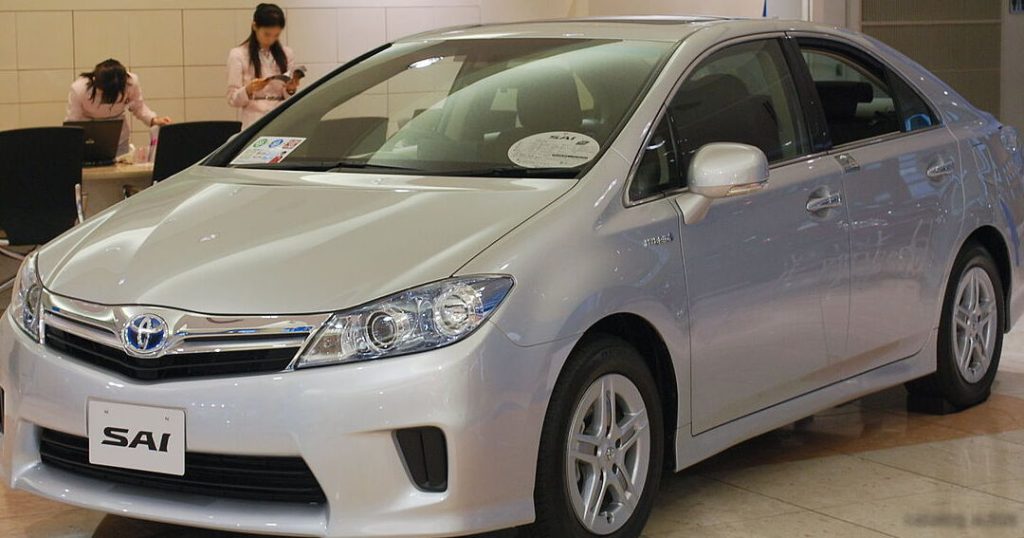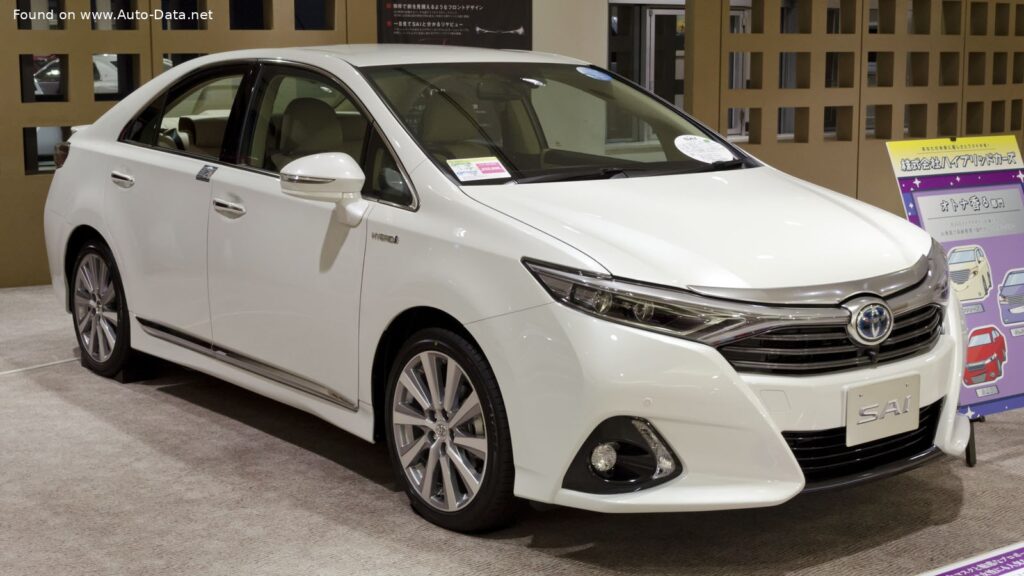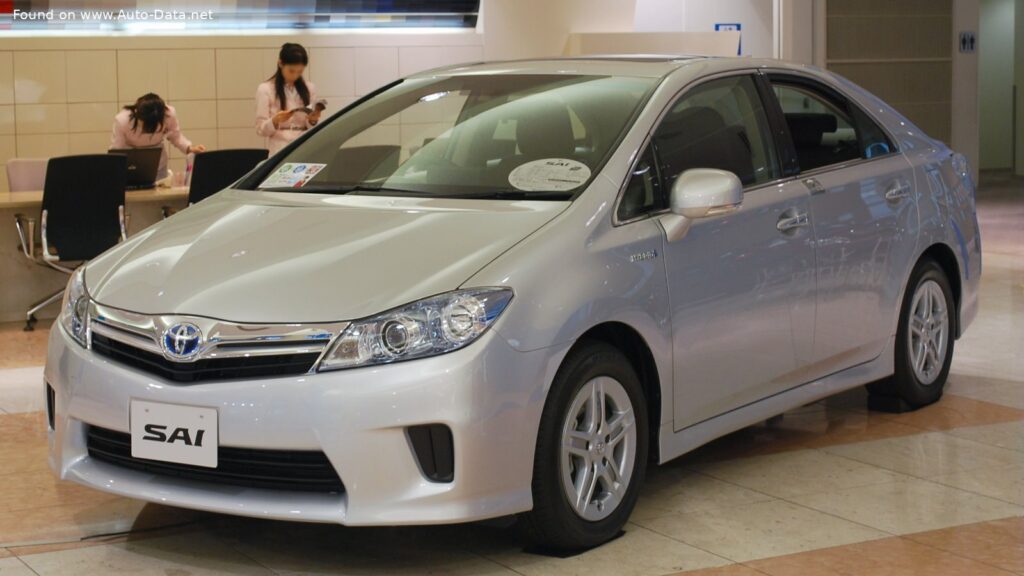
The Toyota Sai is a compact hybrid sedan that was produced by Toyota from 2009 to 2013. Primarily marketed in Japan, the Sai occupied a niche between the Prius and the Lexus HS 250h, offering a more conventional sedan appearance with Toyota’s Hybrid Synergy Drive technology. While not officially sold in the United States, understanding the Sai provides insight into Toyota’s broader hybrid strategy during this period and its application to a more traditionally styled vehicle. The 2.4-liter variant, producing a combined system output of 190 horsepower, represents the higher-performance option within the Sai lineup.
Toyota Sai 2.4: A Detailed Overview
The Toyota Sai was conceived as a more aesthetically conservative alternative to the Prius, appealing to buyers who desired the fuel efficiency of a hybrid powertrain but preferred a conventional sedan body style. It was positioned as a premium offering within Toyota’s Japanese domestic market, featuring a higher level of refinement and standard equipment compared to the Prius. The Sai’s design aimed for a sophisticated and understated elegance, differentiating it from the more polarizing styling of the Prius. The 2.4-liter model, equipped with the 2AZ-FXE engine, provided a noticeable performance upgrade over the base 1.8-liter version.
Engine & Performance
The Toyota Sai 2.4 utilizes Toyota’s Hybrid Synergy Drive (HSD) system, a full hybrid (FHEV) architecture. The powertrain centers around a 2.4-liter (2362 cm3) 2AZ-FXE inline-four cylinder gasoline engine, producing 150 horsepower at 6000 rpm and 187 Nm (137.92 lb.-ft.) of torque at 4400 rpm. This engine is paired with a powerful electric motor, designated 2JM, capable of generating 143 horsepower and 270 Nm (199.14 lb.-ft.) of torque. The combined system output is rated at 190 horsepower. Power is delivered to the front wheels via an electronically controlled continuously variable transmission (e-CVT). This configuration allows for seamless transitions between gasoline engine power, electric motor power, or a combination of both, optimizing fuel efficiency and performance. The weight-to-power ratio is 8.3 kg/Hp, and the weight-to-torque ratio is 8.4 kg/Nm. A Start & Stop System further enhances fuel economy by automatically shutting off the engine when the vehicle is stationary.
Design & Features
The Toyota Sai is a four-door, five-seat sedan with a conventional trunk. Its exterior design is characterized by clean lines, a relatively low profile, and a focus on understated elegance. The interior is well-appointed, featuring quality materials and a comfortable cabin layout. Key features included power windows, power locks, air conditioning, and an audio system. Safety features, typical for vehicles of this era, included Anti-lock Braking System (ABS). The Sai’s design prioritized a comfortable and refined driving experience, appealing to buyers seeking a premium hybrid sedan. The vehicle’s dimensions are 4620 mm (181.89 in.) in length, 1770 mm (69.69 in.) in width, and 1495 mm (58.86 in.) in height, with a wheelbase of 2700 mm (106.3 in.). Ride height (ground clearance) is 150 mm (5.91 in.).
Technical Specifications
| Brand | Toyota |
| Model | Sai |
| Generation | Sai |
| Type (Engine) | 2.4 (190 Hp) Hybrid e-CVT |
| Start of production | 2009 |
| End of production | 2013 |
| Powertrain Architecture | FHEV (Full Hybrid Electric Vehicle) |
| Body type | Sedan |
| Seats | 5 |
| Doors | 4 |
| Fuel consumption (combined) | 4.3-5 l/100 km (54.7 – 47 US mpg, 65.7 – 56.5 UK mpg, 23.3 – 20 km/l) |
| CO2 emissions | 101-117 g/km |
| Fuel Type | Petrol (Gasoline) |
| Weight-to-power ratio | 8.3 kg/Hp |
| Weight-to-torque ratio | 8.4 kg/Nm |
| Battery technology | Nickel-metal hydride (NiMH) |
| Electric motor power | 143 Hp |
| Electric motor Torque | 270 Nm (199.14 lb.-ft.) |
| Electric motor model/code | 2JM |
| Electric motor location | Integrated into the transmission |
| Electric motor type | Synchronous |
| System power | 190 Hp |
| Engine Power | 150 Hp @ 6000 rpm |
| Engine Torque | 187 Nm @ 4400 rpm (137.92 lb.-ft. @ 4400 rpm) |
| Engine layout | Front, Transverse |
| Engine Model/Code | 2AZ-FXE |
| Engine displacement | 2362 cm3 (144.14 cu. in.) |
| Number of cylinders | 4 |
| Engine configuration | Inline |
| Cylinder Bore | 88.5 mm (3.48 in.) |
| Piston Stroke | 96 mm (3.78 in.) |
| Compression ratio | 12.5:1 |
| Number of valves per cylinder | 4 |
| Fuel injection system | Multi-port manifold injection |
| Engine aspiration | Naturally aspirated engine |
| Valvetrain | DOHC, VVT |
| Engine oil capacity | 4.3 l (4.54 US qt | 3.78 UK qt) |
| Coolant capacity | 7.3 l (7.71 US qt | 6.42 UK qt) |
| Kerb Weight | 1570-1590 kg (3461.26 – 3505.35 lbs.) |
| Max. weight | 1845-1865 kg (4067.53 – 4111.62 lbs.) |
| Max load | 275 kg (606.27 lbs.) |
| Fuel tank capacity | 55 l (14.53 US gal | 12.1 UK gal) |
| Length | 4620 mm (181.89 in.) |
| Width | 1770 mm (69.69 in.) |
| Height | 1495 mm (58.86 in.) |
| Wheelbase | 2700 mm (106.3 in.) |
| Front track | 1535 mm (60.43 in.) |
| Rear track | 1530 mm (60.24 in.) |
| Ride height (ground clearance) | 150 mm (5.91 in.) |
| Minimum turning circle | 10.4-11.2 m (34.12 – 36.75 ft.) |
| Drivetrain Architecture | Front wheel drive. FHEV. ICE and electric motor drive front wheels. |
| Drive wheel | Front wheel drive |
| Number of gears and type of gearbox | automatic transmission e-CVT |
| Front suspension | Independent, type McPherson with coil spring and anti-roll bar |
| Rear suspension | Double wishbone, Transverse stabilizer, Coil spring |
| Front brakes | Ventilated discs |
| Rear brakes | Disc |
| Assisting systems | ABS (Anti-lock braking system) |
| Steering type | Steering rack and pinion |
| Power steering | Electric Steering |
| Tires size | 205/60 R16; 215/45 R18 |
| Wheel rims size | 6.5J x 16; 7J x 18 |
The Toyota Sai 2.4 represented a compelling option for buyers seeking a fuel-efficient and refined hybrid sedan. While not available in the US market, it showcased Toyota’s commitment to hybrid technology and its ability to integrate it into a variety of vehicle styles.