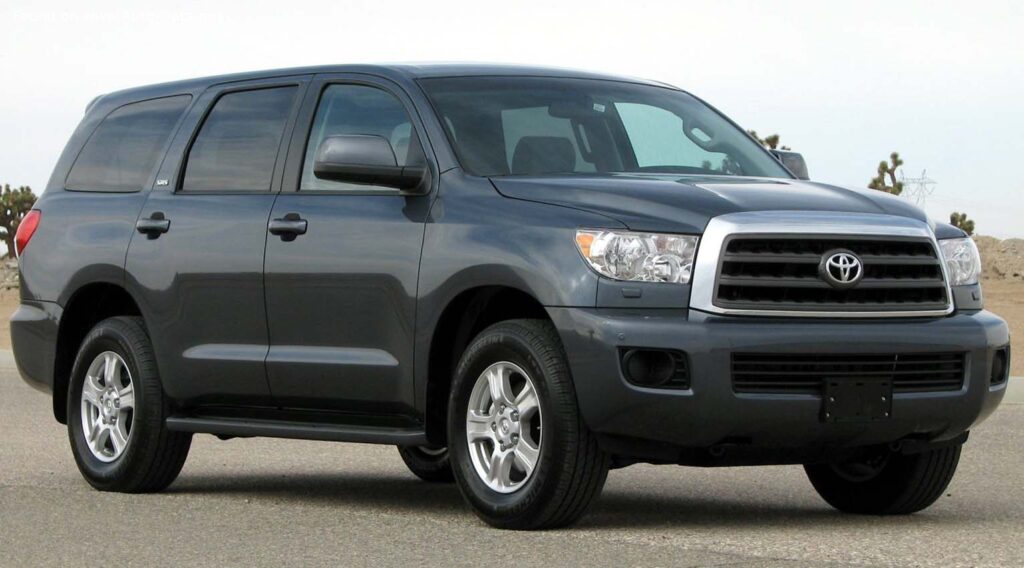
The Toyota Sequoia II, produced between 2009 and 2012, represents the second generation of Toyota’s full-size SUV. Designed primarily for the North American market, the Sequoia II aimed to provide a spacious, comfortable, and capable vehicle for families and those requiring substantial towing capacity. It competed directly with domestic offerings like the Chevrolet Tahoe, Ford Expedition, and GMC Yukon. The Sequoia II continued Toyota’s reputation for reliability while introducing updated styling and technology compared to its predecessor. This generation focused on balancing size with improved fuel efficiency, though remaining a large, body-on-frame SUV.
Toyota Sequoia II: Overview and Market Position
The Sequoia II was a crucial model for Toyota in the full-size SUV segment, a market historically dominated by American manufacturers. It offered seating for seven to eight passengers, depending on configuration, and was available exclusively with a V8 engine. The vehicle’s design emphasized a robust and capable aesthetic, aligning with the expectations of buyers in this class. Unlike some of its competitors, the Sequoia II did not offer a smaller V6 engine option, focusing solely on V8 power for both base and higher trim levels. The model’s success hinged on Toyota’s established brand loyalty and the Sequoia’s reputation for long-term dependability.
Engine & Performance
The 2009-2012 Toyota Sequoia II was powered by a 4.6-liter 1UR-FE V8 engine equipped with Variable Valve Timing with intelligence (VVT-i). This naturally aspirated engine produced 310 horsepower at 5400 rpm and 443 Nm (326.74 lb.-ft.) of torque at 3400 rpm. The engine’s configuration was a longitudinal V8, contributing to a favorable weight distribution. Power was delivered through a six-speed automatic transmission with ECT-i (Electronic Controlled Transmission – intelligent) technology, designed to optimize shift points for both fuel economy and performance. The Sequoia II featured a standard four-wheel-drive system, providing enhanced traction in various conditions. The weight-to-power ratio stood at 8.7 kg/Hp, and the weight-to-torque ratio was 6.1 kg/Nm, indicating a reasonably responsive powertrain for a vehicle of its size. The engine’s displacement of 4608 cm3 (281.2 cu. in.) and a compression ratio of 9.8:1 contributed to its overall performance characteristics.
Design & Features
The Toyota Sequoia II maintained a traditional SUV body style, characterized by its boxy shape and substantial dimensions. It offered five doors and seating for seven or eight passengers, depending on the chosen configuration (second-row captain’s chairs versus a bench seat). The interior focused on providing a comfortable and spacious environment, with ample headroom and legroom for all occupants. Key features included a standard audio system, air conditioning, and power windows and locks. Higher trim levels offered upgrades such as leather upholstery, a premium sound system, navigation, and a rear-seat entertainment system. Safety features were a priority, with standard inclusion of Anti-lock Braking System (ABS). The Sequoia II’s large size translated into significant cargo capacity, ranging from a minimum of 535 liters (18.89 cu. ft.) with all seats in use to a maximum of 3401 liters (120.11 cu. ft.) with the rear seats folded down. The vehicle’s ride height of 254 mm (10 inches) provided adequate ground clearance for moderate off-road conditions.
Technical Specifications
| Brand | Toyota |
| Model | Sequoia |
| Generation | Sequoia II |
| Type (Engine) | 4.6 V8 VVT-i (310 Hp) 4WD ECT-i |
| Start of production | 2009 |
| End of production | 2012 |
| Powertrain Architecture | Internal Combustion engine |
| Body type | SUV |
| Seats | 7-8 |
| Doors | 5 |
| Fuel consumption (urban) | 18.1 l/100 km (13 US mpg, 15.6 UK mpg, 5.5 km/l) |
| Fuel consumption (extra urban) | 13.1 l/100 km (18 US mpg, 21.6 UK mpg, 7.6 km/l) |
| Fuel Type | Petrol (Gasoline) |
| Emission standard | ULEV |
| Weight-to-power ratio | 8.7 kg/Hp |
| Weight-to-torque ratio | 6.1 kg/Nm |
| Power | 310 Hp @ 5400 rpm |
| Power per litre | 67.3 Hp/l |
| Torque | 443 Nm @ 3400 rpm (326.74 lb.-ft. @ 3400 rpm) |
| Engine layout | Front, Longitudinal |
| Engine Model/Code | 1UR-FE |
| Engine displacement | 4608 cm3 (281.2 cu. in.) |
| Number of cylinders | 8 |
| Engine configuration | V-engine |
| Cylinder Bore | 94 mm (3.7 in.) |
| Piston Stroke | 83 mm (3.27 in.) |
| Number of valves per cylinder | 4 |
| Fuel injection system | Multi-port manifold injection |
| Engine aspiration | Naturally aspirated engine |
| Valvetrain | DOHC |
| Engine oil capacity | 7.5 l (7.93 US qt | 6.6 UK qt) |
| Coolant | 14.8 l (15.64 US qt | 13.02 UK qt) |
| Kerb Weight | 2685 kg (5919.41 lbs.) |
| Max. weight | 3311 kg (7299.51 lbs.) |
| Max load | 626 kg (1380.09 lbs.) |
| Trunk (boot) space – minimum | 535 l (18.89 cu. ft.) |
| Trunk (boot) space – maximum | 3401 l (120.11 cu. ft.) |
| Fuel tank capacity | 100 l (26.42 US gal | 22 UK gal) |
| Permitted trailer load with brakes (12%) | 3175 kg (6999.68 lbs.) |
| Length | 5210 mm (205.12 in.) |
| Width | 2030 mm (79.92 in.) |
| Height | 1955 mm (76.97 in.) |
| Wheelbase | 3100 mm (122.05 in.) |
| Front track | 1725 mm (67.91 in.) |
| Rear (Back) track | 1755 mm (69.09 in.) |
| Ride height (ground clearance) | 254 mm (10 in.) |
| Minimum turning circle (turning diameter) | 11.9 m (39.04 ft.) |
| Approach angle | 27° |
| Departure angle | 21° |
| Drivetrain Architecture | All wheel drive (4×4). ICE drives rear wheels, front wheels engaged via clutch. |
| Number of gears and type of gearbox | 6 gears, automatic transmission ECT-i |
| Front suspension | Coil spring, Double wishbone, Transverse stabilizer |
| Rear suspension | Double wishbone, Transverse stabilizer, Coil spring |
| Assisting systems | ABS (Anti-lock braking system) |
| Steering type | Steering rack and pinion |
| Power steering | Hydraulic Steering |
| Tires size | 275/65 R18 |
| Wheel rims size | 8J x 18 |
The Toyota Sequoia II, while not a fuel-efficient vehicle by modern standards, offered a compelling package of space, capability, and reliability for buyers in the full-size SUV market. Its robust construction and powerful V8 engine made it well-suited for towing and hauling, while its spacious interior provided comfortable accommodations for large families. The Sequoia II remains a popular choice in the used vehicle market, appreciated for its longevity and Toyota’s renowned build quality.